Planning commission deadlocks on 1010 V Mission Street SRO project after weeks of community opposition
September 15, 2022 | San Francisco City, San Francisco County, California
This article was created by AI summarizing key points discussed. AI makes mistakes, so for full details and context, please refer to the video of the full meeting. Please report any errors so we can fix them. Report an error »
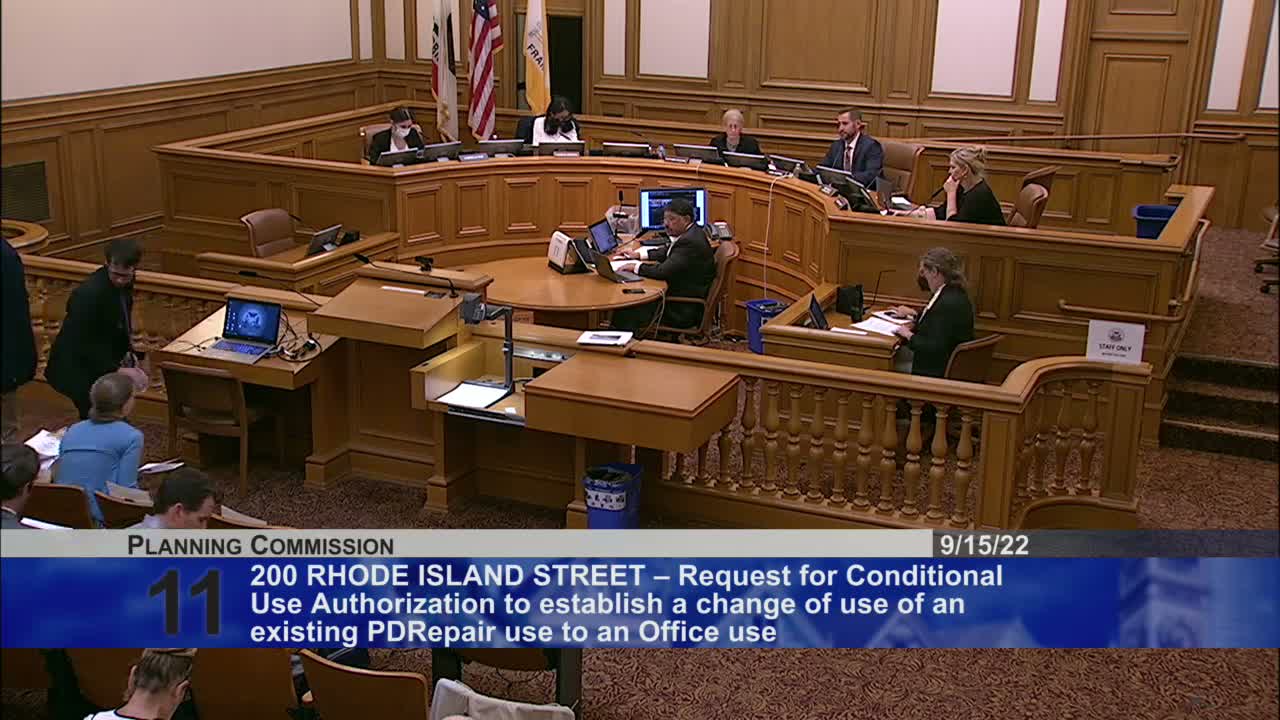
The San Francisco Planning Commission on Sept. 15 heard hours of public testimony and staff briefing on a proposed 9‑story, 57‑unit residential project at 1010 V Mission Street that would provide 13 on‑site below‑market‑rate units but otherwise deliver market‑rate single‑room‑occupancy (SRO) units that neighborhood groups characterized as unsuitable for families.
Planning staff described the project as offering 57 SRO units with 13 below‑market units on site and code exceptions for rear‑yard exposure and floor‑area ratio. Rebecca Salgado, the planner, told the commission the department found the project “on balance consistent with the objectives and policies of the city’s general plan” but noted it seeks a number of exceptions to the planning code.
Opponents, including local Filipino community organizations and neighborhood groups, said the project fails to provide family‑sized or deeply affordable units for the immediate neighborhood, and urged the commission to deny or delay action so the sponsor could work with affected community groups. “We do not need more tiny expensive units,” said Charm Consolacion, who said her program serves children and families near the site.
The sponsor, John Kevlin speaking for the project team, said the building would create 57 units and 13 on‑site affordable units, and offered to increase outreach and provide additional data on wind impacts and unit mix if given a short continuance. He also gave projected sales prices for the inclusionary units: seven low‑income units around $275,000, three at about $400,000 and three at about $500,000.
Commissioners questioned the wind study (staff said two micro‑locations had exceedances at roughly 11–12 mph for a small percentage of the day), the proposed unit mix, and the project’s fit adjacent to a community center. Several motions were put to the body: a proposal to continue for one month failed on a 2–3 vote; a later motion to disapprove based on findings articulated by Commissioners Ruiz, Imperial and Moore produced a split vote and—because no alternate motion to continue was offered—left the item without approval and effectively stalled the project.
Because the applicant had invoked state density bonus provisions and sought multiple code exceptions, commissioners repeatedly weighed the legal constraints of denying or reducing density against residents’ concerns. Commissioner Moore voiced concern about siting market‑rate SROs next to community facilities, while Commissioner Koppel said outreach and further design tweaks could address neighborhood concerns. The commission did not approve the project and left no final adopted motions that would permit construction to proceed.
Next steps: the item remains unresolved. The sponsor indicated willingness to continue outreach; any future formal resubmittal will return to the commission for further action.
Planning staff described the project as offering 57 SRO units with 13 below‑market units on site and code exceptions for rear‑yard exposure and floor‑area ratio. Rebecca Salgado, the planner, told the commission the department found the project “on balance consistent with the objectives and policies of the city’s general plan” but noted it seeks a number of exceptions to the planning code.
Opponents, including local Filipino community organizations and neighborhood groups, said the project fails to provide family‑sized or deeply affordable units for the immediate neighborhood, and urged the commission to deny or delay action so the sponsor could work with affected community groups. “We do not need more tiny expensive units,” said Charm Consolacion, who said her program serves children and families near the site.
The sponsor, John Kevlin speaking for the project team, said the building would create 57 units and 13 on‑site affordable units, and offered to increase outreach and provide additional data on wind impacts and unit mix if given a short continuance. He also gave projected sales prices for the inclusionary units: seven low‑income units around $275,000, three at about $400,000 and three at about $500,000.
Commissioners questioned the wind study (staff said two micro‑locations had exceedances at roughly 11–12 mph for a small percentage of the day), the proposed unit mix, and the project’s fit adjacent to a community center. Several motions were put to the body: a proposal to continue for one month failed on a 2–3 vote; a later motion to disapprove based on findings articulated by Commissioners Ruiz, Imperial and Moore produced a split vote and—because no alternate motion to continue was offered—left the item without approval and effectively stalled the project.
Because the applicant had invoked state density bonus provisions and sought multiple code exceptions, commissioners repeatedly weighed the legal constraints of denying or reducing density against residents’ concerns. Commissioner Moore voiced concern about siting market‑rate SROs next to community facilities, while Commissioner Koppel said outreach and further design tweaks could address neighborhood concerns. The commission did not approve the project and left no final adopted motions that would permit construction to proceed.
Next steps: the item remains unresolved. The sponsor indicated willingness to continue outreach; any future formal resubmittal will return to the commission for further action.
Don't Miss a Word: See the Full Meeting!
Go beyond summaries. Unlock every video, transcript, and key insight with a Founder Membership.
✓
Get instant access to full meeting videos
✓
Search and clip any phrase from complete transcripts
✓
Receive AI-powered summaries & custom alerts
✓
Enjoy lifetime, unrestricted access to government data
30-day money-back guarantee
