Planning Commission backs modified ordinance letting some retailers use less-transparent roll-down gates with artwork, mailed-notice grandfathering
December 08, 2022 | San Francisco City, San Francisco County, California
This article was created by AI summarizing key points discussed. AI makes mistakes, so for full details and context, please refer to the video of the full meeting. Please report any errors so we can fix them. Report an error »
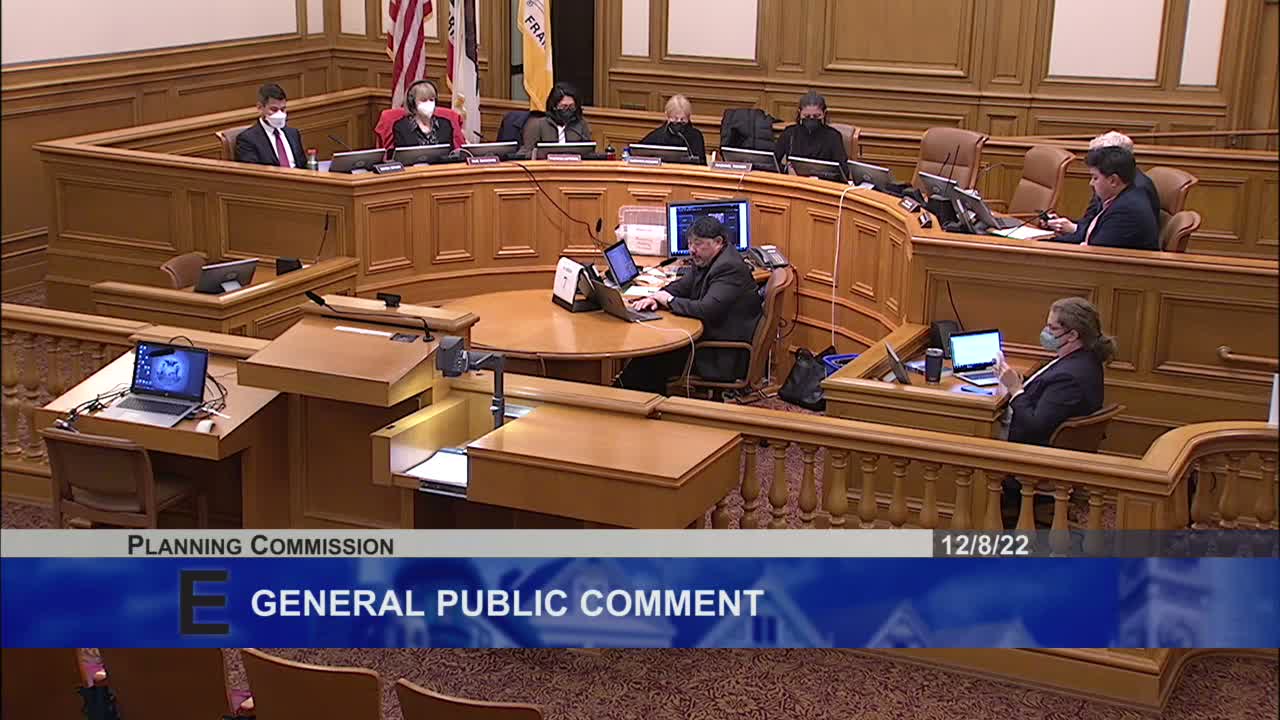
The San Francisco Planning Commission on Dec. 8 approved a modified planning-code amendment that will allow some retailers to install roll-down security gates that do not meet the city's 75% transparency standard, with new conditions to guard neighborhood character and reduce graffiti.
Supervisor Safae, who introduced the legislation, told the commission the measure arose from conversations with small-business owners who said transparent security systems had made them targets for burglary and vandalism. "They told us that having transparent security systems on the front subject them to a higher level of burglary and vandalism," Safae said, arguing the change balances public safety with design goals.
Planning staff recommended several modifications, including not creating a separate code for cannabis retailers, a three-year window for existing nonconforming gates to be legalized via permit, and preserving historic-review procedures for designated buildings. Staff's report also noted the Fire Department's concern about fully opaque gates as potential fire hazards and estimated an average building permit fee of about $950 on a $10,000 gate installation.
Commissioners debated competing priorities: some warned that allowing opaque gates could undermine commercial corridor vibrancy and encourage tagging, while others emphasized the operational and safety problems for cash-heavy businesses such as many cannabis shops. Commissioner Diamond urged including anti-graffiti measures; several commissioners suggested requiring local artwork on roll-down gates. "There had to be'an aesthetic enhancement'so it's not a clean wall," Supervisor Safae said.
The commission's final motion removed staff recommendation 1 (which would have avoided a separate standard for cannabis only), replaced it with an artwork requirement to deter tagging, set the three-year grandfathering window to begin from a city-mailed notice to potentially affected ground-floor retail establishments, retained staff recommendation 3 (clarifying that historic buildings remain subject to other review), and asked staff to develop objective design standards for gate mechanisms (the boxes or housings above roll-down gates).
Commissioner Moore was the lone vote against the measure, expressing concerns about enforcement and design effects on historic facades; the motion passed 5'to'1. The commission also directed staff to work with the Small Business Commission and other departments on outreach and to consider a tiered permitting fee or other measures to reduce costs for long-standing small businesses.
The ordinance as amended creates a time-limited amnesty pathway for qualifying existing gates and scope for future amendments; staff will prepare implementing language and procedures as the item moves to the Board of Supervisors.
Supervisor Safae, who introduced the legislation, told the commission the measure arose from conversations with small-business owners who said transparent security systems had made them targets for burglary and vandalism. "They told us that having transparent security systems on the front subject them to a higher level of burglary and vandalism," Safae said, arguing the change balances public safety with design goals.
Planning staff recommended several modifications, including not creating a separate code for cannabis retailers, a three-year window for existing nonconforming gates to be legalized via permit, and preserving historic-review procedures for designated buildings. Staff's report also noted the Fire Department's concern about fully opaque gates as potential fire hazards and estimated an average building permit fee of about $950 on a $10,000 gate installation.
Commissioners debated competing priorities: some warned that allowing opaque gates could undermine commercial corridor vibrancy and encourage tagging, while others emphasized the operational and safety problems for cash-heavy businesses such as many cannabis shops. Commissioner Diamond urged including anti-graffiti measures; several commissioners suggested requiring local artwork on roll-down gates. "There had to be'an aesthetic enhancement'so it's not a clean wall," Supervisor Safae said.
The commission's final motion removed staff recommendation 1 (which would have avoided a separate standard for cannabis only), replaced it with an artwork requirement to deter tagging, set the three-year grandfathering window to begin from a city-mailed notice to potentially affected ground-floor retail establishments, retained staff recommendation 3 (clarifying that historic buildings remain subject to other review), and asked staff to develop objective design standards for gate mechanisms (the boxes or housings above roll-down gates).
Commissioner Moore was the lone vote against the measure, expressing concerns about enforcement and design effects on historic facades; the motion passed 5'to'1. The commission also directed staff to work with the Small Business Commission and other departments on outreach and to consider a tiered permitting fee or other measures to reduce costs for long-standing small businesses.
The ordinance as amended creates a time-limited amnesty pathway for qualifying existing gates and scope for future amendments; staff will prepare implementing language and procedures as the item moves to the Board of Supervisors.
Don't Miss a Word: See the Full Meeting!
Go beyond summaries. Unlock every video, transcript, and key insight with a Founder Membership.
✓
Get instant access to full meeting videos
✓
Search and clip any phrase from complete transcripts
✓
Receive AI-powered summaries & custom alerts
✓
Enjoy lifetime, unrestricted access to government data
30-day money-back guarantee
