Commission hears public comment on Stonestown draft EIR for large mixed‑use redevelopment
February 09, 2023 | San Francisco City, San Francisco County, California
This article was created by AI summarizing key points discussed. AI makes mistakes, so for full details and context, please refer to the video of the full meeting. Please report any errors so we can fix them. Report an error »
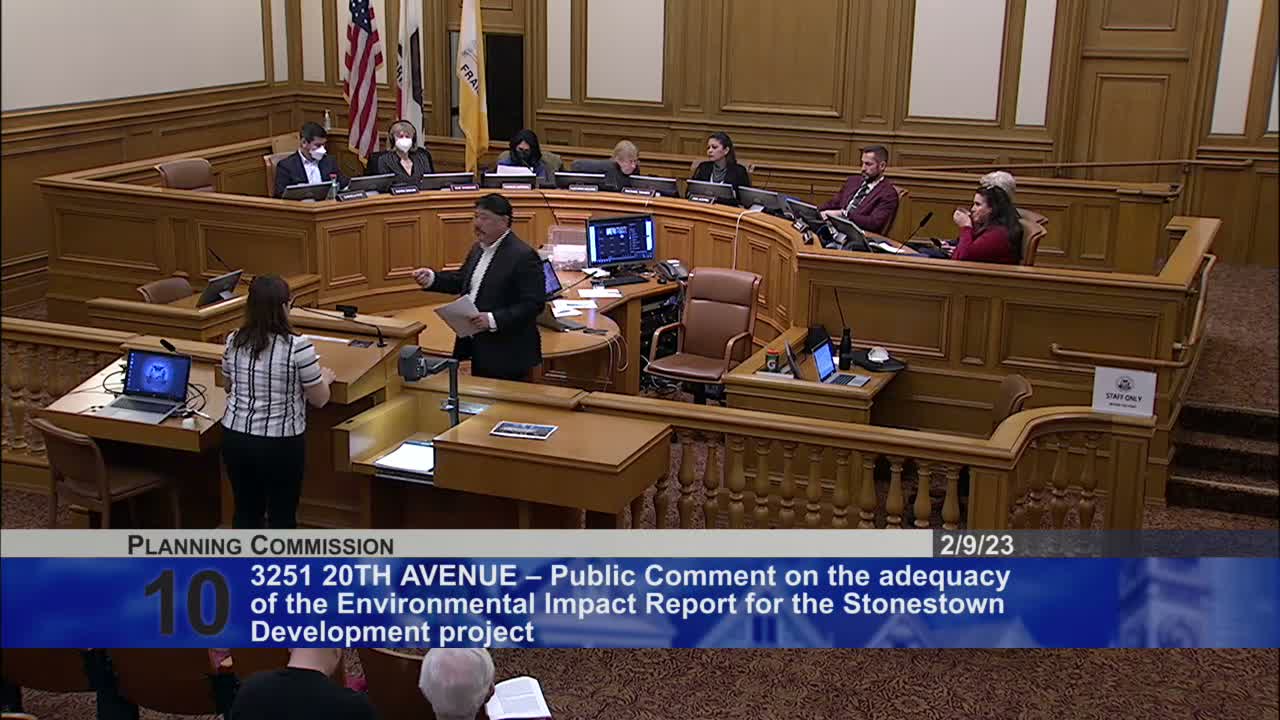
The Planning Commission on Thursday held a lengthy public hearing on the draft environmental impact report (EIR) for the Stonestown (Stone Town) redevelopment at 3251 Twentieth Avenue. Staff described a master‑planned, multi‑phased project that would convert roughly 27 acres of surface parking around the Stonestown Galleria into a mixed‑use community with housing, retail, hotel and institutional uses.
Under the project's principal proposal staff said it would include about 2,930 housing units, retention and modification of the existing mall building, about 6 acres of new open space and a rezoning to a special use district. Staff also presented a project variant that would add approximately 150 residential units, roughly 10,000 square feet of institutional uses and extra parking.
The draft EIR identifies several significant and unavoidable impacts even after proposed mitigation: loss of a historic resource due to demolition of the UA Theater, overlapping construction noise during multi‑phase work, wind hazards for buildings above 85 feet, potential transit delay under cumulative conditions on Twentieth Avenue, and air‑quality exceedances during overlapping construction and early operations. Staff outlined mitigation measures including historic documentation, vehicle‑miles‑traveled reduction strategies, signal coordination, construction‑noise control plans, Tier 4 engine usage during construction, electric vehicle infrastructure and wind safety analysis; staff noted that some impacts would remain significant and unavoidable.
Members of the public were sharply divided. Jim Herlihy of the Lakeside Property Owners Association urged rejection of the draft EIR, saying it fails to evaluate a feasible range of lower‑density alternatives and raises concerns about traffic, transit, emergency services and water/sewer capacity. Supporters including the Housing Action Coalition, neighborhood pro‑housing groups and many nearby residents urged the commission to find the draft EIR adequate and move forward to facilitate housing production.
Commissioners praised the breadth of the environmental analysis and asked detailed questions about the EIR's scope and flexibility. Several commissioners asked whether the document would allow the developer flexibility (for instance, substituting hotel rooms for housing or altering unit counts) without a supplemental EIR, and whether graphics and historic resource discussion should more clearly show the theater's role in alternatives. Staff said comments submitted during the public comment period will be answered in writing in the response‑to‑comments document that becomes part of the final EIR.
Public comment on the draft EIR will remain open through 5 p.m. on Feb. 13, 2023, according to staff. The commission anticipates the project will return later this year for potential certification following response to comments and final EIR preparation.
Under the project's principal proposal staff said it would include about 2,930 housing units, retention and modification of the existing mall building, about 6 acres of new open space and a rezoning to a special use district. Staff also presented a project variant that would add approximately 150 residential units, roughly 10,000 square feet of institutional uses and extra parking.
The draft EIR identifies several significant and unavoidable impacts even after proposed mitigation: loss of a historic resource due to demolition of the UA Theater, overlapping construction noise during multi‑phase work, wind hazards for buildings above 85 feet, potential transit delay under cumulative conditions on Twentieth Avenue, and air‑quality exceedances during overlapping construction and early operations. Staff outlined mitigation measures including historic documentation, vehicle‑miles‑traveled reduction strategies, signal coordination, construction‑noise control plans, Tier 4 engine usage during construction, electric vehicle infrastructure and wind safety analysis; staff noted that some impacts would remain significant and unavoidable.
Members of the public were sharply divided. Jim Herlihy of the Lakeside Property Owners Association urged rejection of the draft EIR, saying it fails to evaluate a feasible range of lower‑density alternatives and raises concerns about traffic, transit, emergency services and water/sewer capacity. Supporters including the Housing Action Coalition, neighborhood pro‑housing groups and many nearby residents urged the commission to find the draft EIR adequate and move forward to facilitate housing production.
Commissioners praised the breadth of the environmental analysis and asked detailed questions about the EIR's scope and flexibility. Several commissioners asked whether the document would allow the developer flexibility (for instance, substituting hotel rooms for housing or altering unit counts) without a supplemental EIR, and whether graphics and historic resource discussion should more clearly show the theater's role in alternatives. Staff said comments submitted during the public comment period will be answered in writing in the response‑to‑comments document that becomes part of the final EIR.
Public comment on the draft EIR will remain open through 5 p.m. on Feb. 13, 2023, according to staff. The commission anticipates the project will return later this year for potential certification following response to comments and final EIR preparation.
View the Full Meeting & All Its Details
This article offers just a summary. Unlock complete video, transcripts, and insights as a Founder Member.
✓
Watch full, unedited meeting videos
✓
Search every word spoken in unlimited transcripts
✓
AI summaries & real-time alerts (all government levels)
✓
Permanent access to expanding government content
30-day money-back guarantee
