Planning Department outlines ILO program and commission places nine conditional‑use applications on consent
March 30, 2023 | San Francisco City, San Francisco County, California
This article was created by AI summarizing key points discussed. AI makes mistakes, so for full details and context, please refer to the video of the full meeting. Please report any errors so we can fix them. Report an error »
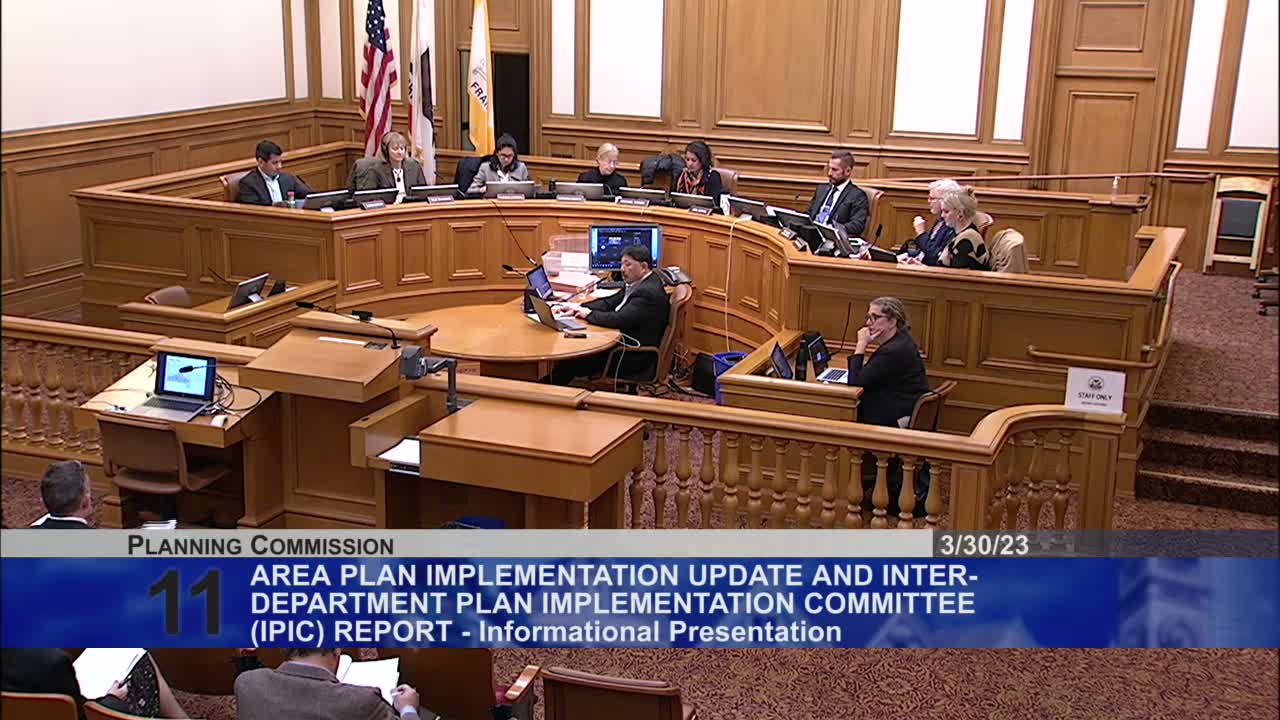
The San Francisco Planning Department briefed the Planning Commission on the intermediate‑length occupancy (ILO) program and recommended approval with conditions for nine conditional‑use applications on March 30.
Joseph Sacchi of planning staff told the commission the ILO definition limits units to stays longer than 30 days but shorter than one year and noted an existing citywide cap of 1,000 ILO units. "Any unit that is subject to the price controls of the rent ordinance cannot be classified as an ILO unit," Sacchi said, and staff described processing rules that allow some smaller buildings to register by building permit while projects in buildings with 10 or more units require conditional‑use authorization.
Staff said a surge of applications followed a June 2022 platform message and that the department had reviewed applications and approved over 20 building‑permit‑level classifications so far. Rogelio Baiza, also with planning staff, summarized eligibility checks and recommended approval with conditions of the nine conditional‑use authorization applications before the commission. "Due to the similarities between the 9 applications before you and the routine nature of the conditional‑use request, future ILO applications will generally be placed on the consent calendar," Baiza said.
Project sponsor attorney Brett Gladstone and one applicant, Jennifer Solomon (owner, 1450 Greenwich St., Unit 403), spoke in support of individual cases and described their use of units for visiting artists and temporary housing. Residents calling in — including Theresa Flandrick — asked the commission to scrutinize certain units and questioned whether corporate rental operators would remove housing stock for long periods.
Commissioners probed enforcement and tracking. Commissioner Braun and others asked for routine reporting and maps so commissioners can see how each consent case affects the cumulative cap and geographic distribution. Planning staff said they are tracking downtown/C3 zoning and the UC‑Berkeley Urban Displacement Project map specified in the ordinance, and they will show commissioners how individual approvals add to the totals.
The commission placed the nine conditional‑use items on consent and moved to approve them, with commissioners expressing interest in more regular tracking and clearer reporting when similar items appear on consent in the future. No formal vote counts on individual applications were recorded separately at the hearing; commissioners voted to approve items 13(a)–(i) on the consent calendar.
Joseph Sacchi of planning staff told the commission the ILO definition limits units to stays longer than 30 days but shorter than one year and noted an existing citywide cap of 1,000 ILO units. "Any unit that is subject to the price controls of the rent ordinance cannot be classified as an ILO unit," Sacchi said, and staff described processing rules that allow some smaller buildings to register by building permit while projects in buildings with 10 or more units require conditional‑use authorization.
Staff said a surge of applications followed a June 2022 platform message and that the department had reviewed applications and approved over 20 building‑permit‑level classifications so far. Rogelio Baiza, also with planning staff, summarized eligibility checks and recommended approval with conditions of the nine conditional‑use authorization applications before the commission. "Due to the similarities between the 9 applications before you and the routine nature of the conditional‑use request, future ILO applications will generally be placed on the consent calendar," Baiza said.
Project sponsor attorney Brett Gladstone and one applicant, Jennifer Solomon (owner, 1450 Greenwich St., Unit 403), spoke in support of individual cases and described their use of units for visiting artists and temporary housing. Residents calling in — including Theresa Flandrick — asked the commission to scrutinize certain units and questioned whether corporate rental operators would remove housing stock for long periods.
Commissioners probed enforcement and tracking. Commissioner Braun and others asked for routine reporting and maps so commissioners can see how each consent case affects the cumulative cap and geographic distribution. Planning staff said they are tracking downtown/C3 zoning and the UC‑Berkeley Urban Displacement Project map specified in the ordinance, and they will show commissioners how individual approvals add to the totals.
The commission placed the nine conditional‑use items on consent and moved to approve them, with commissioners expressing interest in more regular tracking and clearer reporting when similar items appear on consent in the future. No formal vote counts on individual applications were recorded separately at the hearing; commissioners voted to approve items 13(a)–(i) on the consent calendar.
Don't Miss a Word: See the Full Meeting!
Go beyond summaries. Unlock every video, transcript, and key insight with a Founder Membership.
✓
Get instant access to full meeting videos
✓
Search and clip any phrase from complete transcripts
✓
Receive AI-powered summaries & custom alerts
✓
Enjoy lifetime, unrestricted access to government data
30-day money-back guarantee
