Planning Department outlines rapid Housing Element implementation, sparking public concerns about displacement
April 27, 2023 | San Francisco City, San Francisco County, California
This article was created by AI summarizing key points discussed. AI makes mistakes, so for full details and context, please refer to the video of the full meeting. Please report any errors so we can fix them. Report an error »
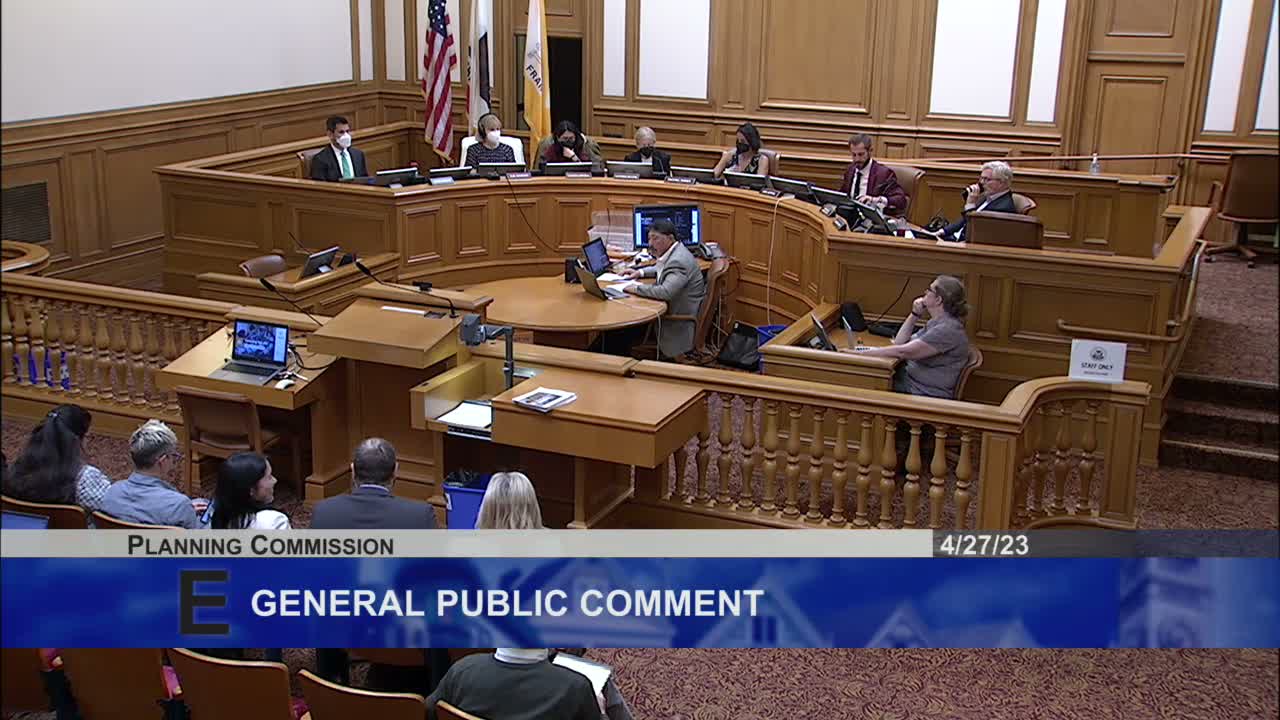
San Francisco ' At an informational hearing April 27, Planning Department staff laid out a one-year push to implement the city's adopted Housing Element, detailing rezoning proposals, permit-process reforms and a new Affordable Housing Leadership Council aimed at raising money and accelerating delivery.
Emery Rogers, the department's director of citywide policy, joined a multi-person team that described four work streams: activating community priorities, "Expanding Housing Choice" through zoning, speeding up housing production and improving permitting, and expanding affordable-housing funding and financing strategies. Lisa Chen, principal planner, said the rezoning program is designed to add capacity for a minimum of 36,200 units tied to the city's RHNA allocation, with room to add up to 29,000 more units if production falls short. "Our rezoning program will focus on adding capacity for mid-rise housing in these neighborhoods, primarily 55 to 85 feet tall," Chen said.
The department also announced process milestones: internal permit-streamlining and data tools planned for a July 1 roll-out, a joint hearing with the Building Inspection Commission on site-permit reform scheduled for May 11, and an appearance before the Planning Commission on mayoral legislation tied to "Housing for All" on June 8. James Pappas, who summarized funding work, said the Affordable Housing Leadership Council will include a seven-person executive team and roughly 20 working-group members and is expected to deliver a report by January 2024.
Public testimony ran long and sharply critical. Representatives of tenant and equity coalitions praised the outreach but said the proposed program relies too heavily on market-based production and upzoning, which they warned would drive displacement. "The mayor's branding of this program as 'Housing for All' hides the fact that the priorities for implementation are entirely dependent on market-based strategies," said Anastasia Yovanopoulos of the San Francisco Tenants Union. Several speakers urged the commission to preserve conditional-use review for demolitions and to strengthen eviction protections before rezoning proceeds.
Commissioners pressed staff for details on outreach and process changes. Commissioner Diamond and others asked the department to notify "well resourced" neighborhoods and supervisors' offices before process changes remove public hearing opportunities. Staff said many details were already described in the Housing Element and pledged to use the housing-element outreach list to reach affected communities and supervisors' offices and to explain process changes before they come to the commission.
The presentation and exchange ended with the department reiterating the ambition of the program and the political and technical hurdles that remain: aligning local density-bonus incentives with state rules, coordinating interagency actions to protect tenants, and identifying funding. The next procedural steps are the May 11 joint site-permit hearing and the June 8 review of the mayor's legislative package; the Leadership Council's work will continue into winter 2024, staff said.
The Commission did not take a formal vote on implementation policy at the hearing; commissioners asked staff to return with outreach and milestone updates in subsequent hearings.
Emery Rogers, the department's director of citywide policy, joined a multi-person team that described four work streams: activating community priorities, "Expanding Housing Choice" through zoning, speeding up housing production and improving permitting, and expanding affordable-housing funding and financing strategies. Lisa Chen, principal planner, said the rezoning program is designed to add capacity for a minimum of 36,200 units tied to the city's RHNA allocation, with room to add up to 29,000 more units if production falls short. "Our rezoning program will focus on adding capacity for mid-rise housing in these neighborhoods, primarily 55 to 85 feet tall," Chen said.
The department also announced process milestones: internal permit-streamlining and data tools planned for a July 1 roll-out, a joint hearing with the Building Inspection Commission on site-permit reform scheduled for May 11, and an appearance before the Planning Commission on mayoral legislation tied to "Housing for All" on June 8. James Pappas, who summarized funding work, said the Affordable Housing Leadership Council will include a seven-person executive team and roughly 20 working-group members and is expected to deliver a report by January 2024.
Public testimony ran long and sharply critical. Representatives of tenant and equity coalitions praised the outreach but said the proposed program relies too heavily on market-based production and upzoning, which they warned would drive displacement. "The mayor's branding of this program as 'Housing for All' hides the fact that the priorities for implementation are entirely dependent on market-based strategies," said Anastasia Yovanopoulos of the San Francisco Tenants Union. Several speakers urged the commission to preserve conditional-use review for demolitions and to strengthen eviction protections before rezoning proceeds.
Commissioners pressed staff for details on outreach and process changes. Commissioner Diamond and others asked the department to notify "well resourced" neighborhoods and supervisors' offices before process changes remove public hearing opportunities. Staff said many details were already described in the Housing Element and pledged to use the housing-element outreach list to reach affected communities and supervisors' offices and to explain process changes before they come to the commission.
The presentation and exchange ended with the department reiterating the ambition of the program and the political and technical hurdles that remain: aligning local density-bonus incentives with state rules, coordinating interagency actions to protect tenants, and identifying funding. The next procedural steps are the May 11 joint site-permit hearing and the June 8 review of the mayor's legislative package; the Leadership Council's work will continue into winter 2024, staff said.
The Commission did not take a formal vote on implementation policy at the hearing; commissioners asked staff to return with outreach and milestone updates in subsequent hearings.
Don't Miss a Word: See the Full Meeting!
Go beyond summaries. Unlock every video, transcript, and key insight with a Founder Membership.
✓
Get instant access to full meeting videos
✓
Search and clip any phrase from complete transcripts
✓
Receive AI-powered summaries & custom alerts
✓
Enjoy lifetime, unrestricted access to government data
30-day money-back guarantee
