Planning commission backs ordinance to require minimum density and limit discretionary reviews in select districts
July 20, 2023 | San Francisco City, San Francisco County, California
This article was created by AI summarizing key points discussed. AI makes mistakes, so for full details and context, please refer to the video of the full meeting. Please report any errors so we can fix them. Report an error »
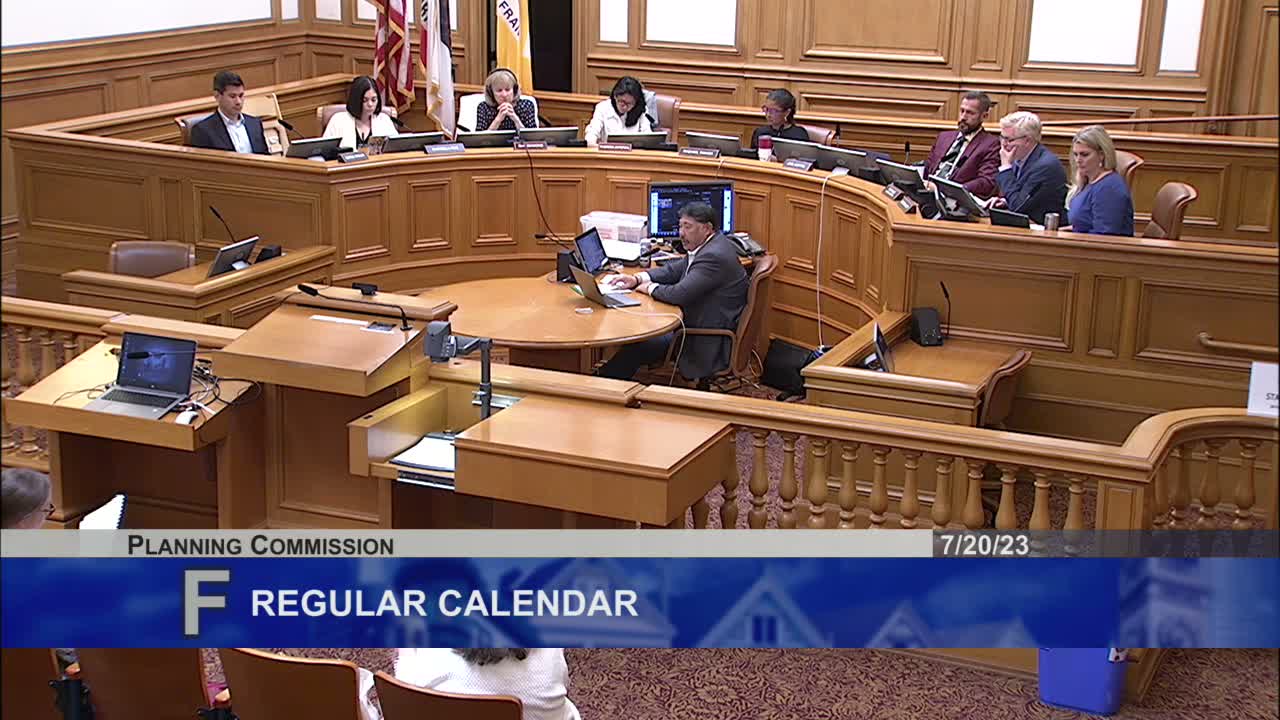
The San Francisco Planning Commission on July 20 approved amendments to the Planning Code that seek to encourage multi‑family housing by setting objective minimum‑density standards and restricting discretionary review for certain new construction.
Audrey Maloney, planning department staff, told commissioners the ordinance would "amend the planning code to require conditional use authorization in residential mixed residential commercial residential transit‑oriented" districts for projects that do not maximize allowable density, while proposing objective minimum‑density standards for new construction. The staff report recommended replacing subjective conditional‑use review with clear thresholds: a 75 percent minimum of the maximum allowable density, unit proportionality and minimum unit sizes, and a single simplified exception for limited expansions of single‑family homes.
The department said the changes are intended to make review more objective and reduce the administrative burden of small‑scale CUAs, while keeping the focus on projects that maximize housing potential. Maloney said the amendment responds to experience with interim controls active from January 2021 and noted staff found those controls most effective on new construction.
Public commenters offered both support and opposition. Jake Price of the Housing Action Coalition urged the commission not to add new conditional‑use requirements, calling them "an additional constraint imposed upon housing construction." Architect Mark Macy, who worked on the 1151 Washington project, described the proposed ordinance as "anti‑housing masquerading as pro housing" and recommended ministerial approval for projects that truly maximize density.
Commissioners pressed staff on how the proposal would apply in practice to single‑family expansions, projects with unknown historic status, and whether rent‑control or short‑term rental restrictions could be layered onto future incentives. Maloney and city legal staff clarified that eligibility determinations for "known" versus "unknown" historic resources would still trigger historic‑resource evaluation and that some legal questions (such as imposing rent control on new units) required additional attorney analysis.
President Aaron Peskin proposed additional eligibility safeguards for projects seeking CUA exemptions: no tenant buyouts within five years, no tenant occupancy in the last five years, and a restriction on demolishing more than two rent‑controlled units. Commissioners said those additions would strengthen the program’s intent to incentivize appropriate development while protecting tenants.
Commissioner Diamond moved to approve the ordinance as modified by staff recommendations and President Peskin’s additional requirements. The motion passed unanimously, 6–0. The item will be forwarded to the Board of Supervisors with the commission’s positive recommendation.
What happens next: The Board of Supervisors will consider the Planning Commission’s recommendations, and city attorneys will complete outstanding legal analyses referenced during the hearing.
Audrey Maloney, planning department staff, told commissioners the ordinance would "amend the planning code to require conditional use authorization in residential mixed residential commercial residential transit‑oriented" districts for projects that do not maximize allowable density, while proposing objective minimum‑density standards for new construction. The staff report recommended replacing subjective conditional‑use review with clear thresholds: a 75 percent minimum of the maximum allowable density, unit proportionality and minimum unit sizes, and a single simplified exception for limited expansions of single‑family homes.
The department said the changes are intended to make review more objective and reduce the administrative burden of small‑scale CUAs, while keeping the focus on projects that maximize housing potential. Maloney said the amendment responds to experience with interim controls active from January 2021 and noted staff found those controls most effective on new construction.
Public commenters offered both support and opposition. Jake Price of the Housing Action Coalition urged the commission not to add new conditional‑use requirements, calling them "an additional constraint imposed upon housing construction." Architect Mark Macy, who worked on the 1151 Washington project, described the proposed ordinance as "anti‑housing masquerading as pro housing" and recommended ministerial approval for projects that truly maximize density.
Commissioners pressed staff on how the proposal would apply in practice to single‑family expansions, projects with unknown historic status, and whether rent‑control or short‑term rental restrictions could be layered onto future incentives. Maloney and city legal staff clarified that eligibility determinations for "known" versus "unknown" historic resources would still trigger historic‑resource evaluation and that some legal questions (such as imposing rent control on new units) required additional attorney analysis.
President Aaron Peskin proposed additional eligibility safeguards for projects seeking CUA exemptions: no tenant buyouts within five years, no tenant occupancy in the last five years, and a restriction on demolishing more than two rent‑controlled units. Commissioners said those additions would strengthen the program’s intent to incentivize appropriate development while protecting tenants.
Commissioner Diamond moved to approve the ordinance as modified by staff recommendations and President Peskin’s additional requirements. The motion passed unanimously, 6–0. The item will be forwarded to the Board of Supervisors with the commission’s positive recommendation.
What happens next: The Board of Supervisors will consider the Planning Commission’s recommendations, and city attorneys will complete outstanding legal analyses referenced during the hearing.
View the Full Meeting & All Its Details
This article offers just a summary. Unlock complete video, transcripts, and insights as a Founder Member.
✓
Watch full, unedited meeting videos
✓
Search every word spoken in unlimited transcripts
✓
AI summaries & real-time alerts (all government levels)
✓
Permanent access to expanding government content
30-day money-back guarantee
