Planning Department briefs commissioners on Cultural Districts program and CHESS strategy
July 20, 2023 | San Francisco City, San Francisco County, California
This article was created by AI summarizing key points discussed. AI makes mistakes, so for full details and context, please refer to the video of the full meeting. Please report any errors so we can fix them. Report an error »
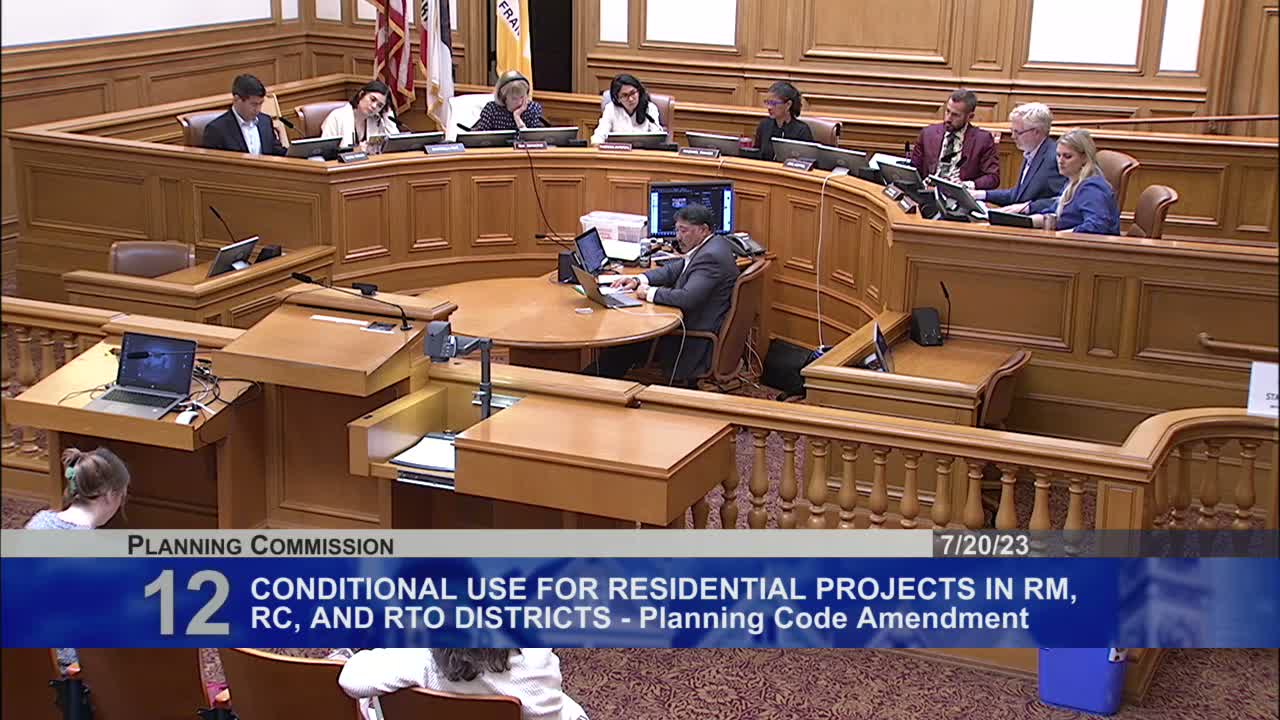
San Francisco planning staff and the mayor’s office presented an informational briefing on July 20 describing the Cultural Districts program, its goals to stabilize cultural communities, and the CHESS (Cultural History, Housing and Economic Sustainability Strategies) planning process.
Grace Lee, Cultural Districts Program Manager at the Mayor’s Office of Community Development, said the program was established by the Board of Supervisors in 2018 and funded by hotel tax revenues from Proposition E. Lee said the districts are designed to preserve, strengthen and promote neighborhoods that "embody a unique cultural heritage," and that each district is required to produce a CHESS report that outlines history, housing strategies, and economic stabilization priorities.
Julia Saburi of the Planning Department described how planning staff act as liaisons, provide data for CHESS reports, and coordinate interdepartmental review. Saburi said the department launched an internal cultural‑district tracker to log projects that intersect district geographies and to improve coordination between planners and district liaisons.
Commissioners focused questions on how cultural districts translate community priorities into land‑use protections and design standards. President Aaron Peskin, Commissioner Diamond and others sought clarity about whether the liaison role and tracker produce formal notice requirements for project sponsors and how design standards or landmarking would be resourced and implemented. Staff responded that some districts have longstanding land‑use plans (for example, Sunset Forward and Japantown) and that planning’s role includes capacity building, helping communities develop feasible strategies, and integrating CHESS priorities with housing‑element implementation.
Several commissioners asked staff to detail next steps on integrating CHESS outputs into rezoning and housing element efforts and whether legacy‑business support and economic tools (for example assistance to help businesses purchase or maintain property) would be sufficient to mitigate displacement pressures. Staff said they will follow up with OEWD and other departments to coordinate commercial‑stability strategies and to ensure CHESS priorities become actionable.
There was no formal action on this informational item; commissioners thanked staff and cultural‑district representatives for the briefing.
Grace Lee, Cultural Districts Program Manager at the Mayor’s Office of Community Development, said the program was established by the Board of Supervisors in 2018 and funded by hotel tax revenues from Proposition E. Lee said the districts are designed to preserve, strengthen and promote neighborhoods that "embody a unique cultural heritage," and that each district is required to produce a CHESS report that outlines history, housing strategies, and economic stabilization priorities.
Julia Saburi of the Planning Department described how planning staff act as liaisons, provide data for CHESS reports, and coordinate interdepartmental review. Saburi said the department launched an internal cultural‑district tracker to log projects that intersect district geographies and to improve coordination between planners and district liaisons.
Commissioners focused questions on how cultural districts translate community priorities into land‑use protections and design standards. President Aaron Peskin, Commissioner Diamond and others sought clarity about whether the liaison role and tracker produce formal notice requirements for project sponsors and how design standards or landmarking would be resourced and implemented. Staff responded that some districts have longstanding land‑use plans (for example, Sunset Forward and Japantown) and that planning’s role includes capacity building, helping communities develop feasible strategies, and integrating CHESS priorities with housing‑element implementation.
Several commissioners asked staff to detail next steps on integrating CHESS outputs into rezoning and housing element efforts and whether legacy‑business support and economic tools (for example assistance to help businesses purchase or maintain property) would be sufficient to mitigate displacement pressures. Staff said they will follow up with OEWD and other departments to coordinate commercial‑stability strategies and to ensure CHESS priorities become actionable.
There was no formal action on this informational item; commissioners thanked staff and cultural‑district representatives for the briefing.
View the Full Meeting & All Its Details
This article offers just a summary. Unlock complete video, transcripts, and insights as a Founder Member.
✓
Watch full, unedited meeting videos
✓
Search every word spoken in unlimited transcripts
✓
AI summaries & real-time alerts (all government levels)
✓
Permanent access to expanding government content
30-day money-back guarantee
