Planning Commission approves temporary reduction in inclusionary requirements and fee changes after TAC feasibility study
July 13, 2023 | San Francisco City, San Francisco County, California
This article was created by AI summarizing key points discussed. AI makes mistakes, so for full details and context, please refer to the video of the full meeting. Please report any errors so we can fix them. Report an error »
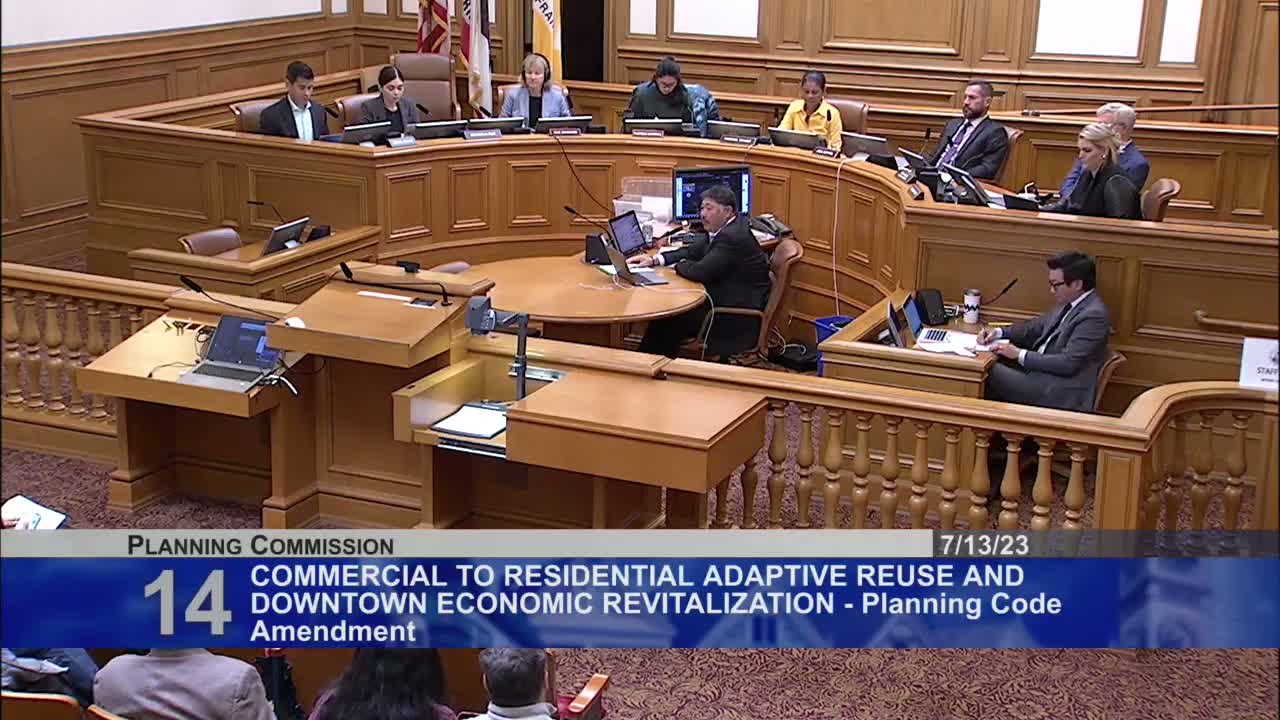
The San Francisco Planning Commission on July 13 advanced a package of changes that temporarily reduces the city's inclusionary housing requirements and adjusts related fees for certain projects, citing a controller-led economic feasibility study that found many proposed housing prototypes cannot pencil under current obligations.
The commission voted 5–1 to approve the ordinance and staff's recommended modifications, with Commissioner Imperial opposed. The motion, made by Commissioner Koppel and seconded by Commissioner Diamond, includes two time-limited windows of relief for projects already in the pipeline and for projects approved through Nov. 1, 2026, along with administrative procedures to implement the reductions without obligating each project to return to the commission.
Why it matters: the controller's Technical Advisory Committee (TAC) and its consultant Century Urban modeled 20 development scenarios and concluded that, for the apartment prototypes they studied, "no project is feasible even if land was free," a finding the controller's representative, Ted Egan, presented to commissioners. That analysis drove recommendations to lower on-site percentages and adjust in-lieu fee calculations so that some projects could move forward and contribute housing supply in the near term.
The ordinance divides eligible projects into three buckets. "Pipeline" projects that had final approval before Nov. 1, 2023, would receive a citywide on-site rate set to 12% (with prescribed AMI tiering) and a reduced off-site/fee rate; "interim" projects approved between Nov. 1, 2023, and Nov. 1, 2026, would receive a lesser reduction (citywide on-site 15%, off-site ~20.4%). Projects securing first construction documents by specified deadlines can vest at the reduced rates; projects that miss the deadlines must revert to the rates in effect when the first construction document is secured.
Controller's analysis and TAC guidance influenced the details. As Egan told commissioners during the presentation: "none of the apartment projects are feasible with or without current inclusionary housing requirements," highlighting the limited ability of rate changes alone to restore feasibility for many prototypes. The TAC recommended that any temporary adjustments be time-limited and that a triennial economic feasibility analysis be reconvened.
Supporters and critics pressed the commission. Housing advocacy groups and developers such as the Housing Action Coalition and Emerald Fund told the commission that lower rates and fee relief are necessary to unlock stalled projects and increase housing production. Jane Natoli (SFUNB) and other supporters called conversions and reduced exactions an important tool; Jake Price of the Housing Action Coalition said the measures are "an important first step" but cautioned they will not alone make all projects feasible.
Opponents — including affordable housing advocates and some community members — warned the city should identify other funding sources to replace lost revenue for permanently affordable housing and questioned whether temporary reductions could become permanent. Lorraine Petty, an affordable housing advocate, urged the commission not to "cut the inclusionary and the number of impact fee reductions package indefinitely," arguing that the program is a critical source of below-market units.
What the ordinance does not do: it does not eliminate the inclusionary program or remove the city's ongoing obligation to fund affordable housing through other means; it sets explicit time limits and administrative conditions. The ordinance also changes the process so that certain modifications (rate reductions, extension of performance periods, and state density bonus findings) can be made administratively by the department for eligible pipeline projects, with limits triggered if a project substantially changes unit counts or gross floor area.
Next steps: The ordinance, as recommended by the Planning Commission, proceeds to the Board of Supervisors for further consideration. The TAC will be reconvened as required by code to reassess rates within three years, and the controller's office will complete follow-up work to monitor market conditions and the ordinance's effects.
Votes at the commission: Motion to approve ordinance with staff modifications passed 5–1 (Commissioner Imperial opposed).
The commission voted 5–1 to approve the ordinance and staff's recommended modifications, with Commissioner Imperial opposed. The motion, made by Commissioner Koppel and seconded by Commissioner Diamond, includes two time-limited windows of relief for projects already in the pipeline and for projects approved through Nov. 1, 2026, along with administrative procedures to implement the reductions without obligating each project to return to the commission.
Why it matters: the controller's Technical Advisory Committee (TAC) and its consultant Century Urban modeled 20 development scenarios and concluded that, for the apartment prototypes they studied, "no project is feasible even if land was free," a finding the controller's representative, Ted Egan, presented to commissioners. That analysis drove recommendations to lower on-site percentages and adjust in-lieu fee calculations so that some projects could move forward and contribute housing supply in the near term.
The ordinance divides eligible projects into three buckets. "Pipeline" projects that had final approval before Nov. 1, 2023, would receive a citywide on-site rate set to 12% (with prescribed AMI tiering) and a reduced off-site/fee rate; "interim" projects approved between Nov. 1, 2023, and Nov. 1, 2026, would receive a lesser reduction (citywide on-site 15%, off-site ~20.4%). Projects securing first construction documents by specified deadlines can vest at the reduced rates; projects that miss the deadlines must revert to the rates in effect when the first construction document is secured.
Controller's analysis and TAC guidance influenced the details. As Egan told commissioners during the presentation: "none of the apartment projects are feasible with or without current inclusionary housing requirements," highlighting the limited ability of rate changes alone to restore feasibility for many prototypes. The TAC recommended that any temporary adjustments be time-limited and that a triennial economic feasibility analysis be reconvened.
Supporters and critics pressed the commission. Housing advocacy groups and developers such as the Housing Action Coalition and Emerald Fund told the commission that lower rates and fee relief are necessary to unlock stalled projects and increase housing production. Jane Natoli (SFUNB) and other supporters called conversions and reduced exactions an important tool; Jake Price of the Housing Action Coalition said the measures are "an important first step" but cautioned they will not alone make all projects feasible.
Opponents — including affordable housing advocates and some community members — warned the city should identify other funding sources to replace lost revenue for permanently affordable housing and questioned whether temporary reductions could become permanent. Lorraine Petty, an affordable housing advocate, urged the commission not to "cut the inclusionary and the number of impact fee reductions package indefinitely," arguing that the program is a critical source of below-market units.
What the ordinance does not do: it does not eliminate the inclusionary program or remove the city's ongoing obligation to fund affordable housing through other means; it sets explicit time limits and administrative conditions. The ordinance also changes the process so that certain modifications (rate reductions, extension of performance periods, and state density bonus findings) can be made administratively by the department for eligible pipeline projects, with limits triggered if a project substantially changes unit counts or gross floor area.
Next steps: The ordinance, as recommended by the Planning Commission, proceeds to the Board of Supervisors for further consideration. The TAC will be reconvened as required by code to reassess rates within three years, and the controller's office will complete follow-up work to monitor market conditions and the ordinance's effects.
Votes at the commission: Motion to approve ordinance with staff modifications passed 5–1 (Commissioner Imperial opposed).
View the Full Meeting & All Its Details
This article offers just a summary. Unlock complete video, transcripts, and insights as a Founder Member.
✓
Watch full, unedited meeting videos
✓
Search every word spoken in unlimited transcripts
✓
AI summaries & real-time alerts (all government levels)
✓
Permanent access to expanding government content
30-day money-back guarantee
