Commission backs temporary impact-fee relief, fixed indexing and fee-deferral program
July 13, 2023 | San Francisco City, San Francisco County, California
This article was created by AI summarizing key points discussed. AI makes mistakes, so for full details and context, please refer to the video of the full meeting. Please report any errors so we can fix them. Report an error »
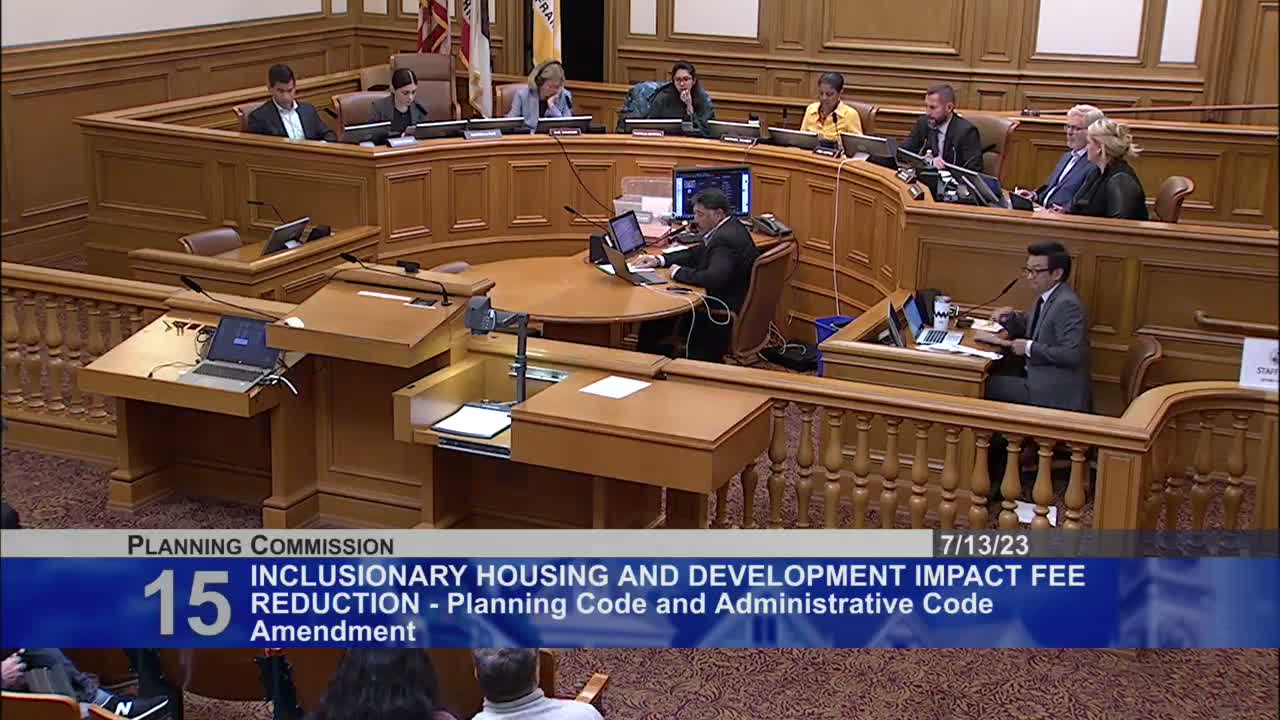
The Planning Commission on July 13 recommended approval of an ordinance intended to stabilize and reduce development impact fees to improve project feasibility and support economic recovery. The commission approved the measure, with Commissioner Imperial voting against, as part of a broader package that included the inclusionary housing adjustments.
Key elements approved include replacing the current annual indexing method (AICCIE) with a flat 2% annual indexing figure, locking in an approved project's impact fee amounts at the moment of commission approval (so later index increases do not affect that project's fees), and reinstating an impact-fee deferral program that allows developers to defer payment until just prior to occupancy (but the deferral would not apply to housing-related impact fees).
Staff framed the changes as predictable and stabilizing for both project sponsors and city budgeting. "This ordinance would replace that somewhat unpredictable and variable number with a flat 2% figure," staff said during the presentation. The ordinance also proposes limited, three‑year fee exemptions for certain industrial/retail projects in PDR districts and for many hospitality projects in C2/C3 zoning to help downtown and neighborhood economic recovery.
The Office of Small Business proposed and the commission supported additional amendments to eliminate "change-of-use" impact fees across a number of fee areas (Eastern Neighborhoods, Central SoMa, Market and Octavia, Rincon Hill, Visitation Valley, and others) to reduce burdens on small businesses converting existing spaces. Staff noted this would mainly affect fees charged when an existing space changes uses and would not materially affect fees collected from net new development.
Supporters, including the Housing Action Coalition, argued predictability and deferral increase the chances that approved projects proceed and receive financing. Small-business advocates and the office of small business emphasized that change-of-use fee elimination helps local merchants convert and expand without substantial up-front charges.
Opponents and cautious commissioners raised concerns about shifting infrastructure costs to other city revenue and the equity of waiving fees that fund neighborhood improvements. Commissioners asked staff to ensure the ordinance includes clear sunsets and monitoring provisions; staff confirmed a three-year sunset for the hospitality and PDR fee waiver provisions.
The commission voted 5–1 to recommend the ordinance to the Board of Supervisors (Commissioner Imperial opposed). The package will proceed to the Board for final action; parallel tracking with the inclusionary changes was noted to keep the policy suite aligned.
Key elements approved include replacing the current annual indexing method (AICCIE) with a flat 2% annual indexing figure, locking in an approved project's impact fee amounts at the moment of commission approval (so later index increases do not affect that project's fees), and reinstating an impact-fee deferral program that allows developers to defer payment until just prior to occupancy (but the deferral would not apply to housing-related impact fees).
Staff framed the changes as predictable and stabilizing for both project sponsors and city budgeting. "This ordinance would replace that somewhat unpredictable and variable number with a flat 2% figure," staff said during the presentation. The ordinance also proposes limited, three‑year fee exemptions for certain industrial/retail projects in PDR districts and for many hospitality projects in C2/C3 zoning to help downtown and neighborhood economic recovery.
The Office of Small Business proposed and the commission supported additional amendments to eliminate "change-of-use" impact fees across a number of fee areas (Eastern Neighborhoods, Central SoMa, Market and Octavia, Rincon Hill, Visitation Valley, and others) to reduce burdens on small businesses converting existing spaces. Staff noted this would mainly affect fees charged when an existing space changes uses and would not materially affect fees collected from net new development.
Supporters, including the Housing Action Coalition, argued predictability and deferral increase the chances that approved projects proceed and receive financing. Small-business advocates and the office of small business emphasized that change-of-use fee elimination helps local merchants convert and expand without substantial up-front charges.
Opponents and cautious commissioners raised concerns about shifting infrastructure costs to other city revenue and the equity of waiving fees that fund neighborhood improvements. Commissioners asked staff to ensure the ordinance includes clear sunsets and monitoring provisions; staff confirmed a three-year sunset for the hospitality and PDR fee waiver provisions.
The commission voted 5–1 to recommend the ordinance to the Board of Supervisors (Commissioner Imperial opposed). The package will proceed to the Board for final action; parallel tracking with the inclusionary changes was noted to keep the policy suite aligned.
Don't Miss a Word: See the Full Meeting!
Go beyond summaries. Unlock every video, transcript, and key insight with a Founder Membership.
✓
Get instant access to full meeting videos
✓
Search and clip any phrase from complete transcripts
✓
Receive AI-powered summaries & custom alerts
✓
Enjoy lifetime, unrestricted access to government data
30-day money-back guarantee
