Stonestown redevelopment update draws broad support and sharp calls to maximize affordability
September 14, 2023 | San Francisco City, San Francisco County, California
This article was created by AI summarizing key points discussed. AI makes mistakes, so for full details and context, please refer to the video of the full meeting. Please report any errors so we can fix them. Report an error »
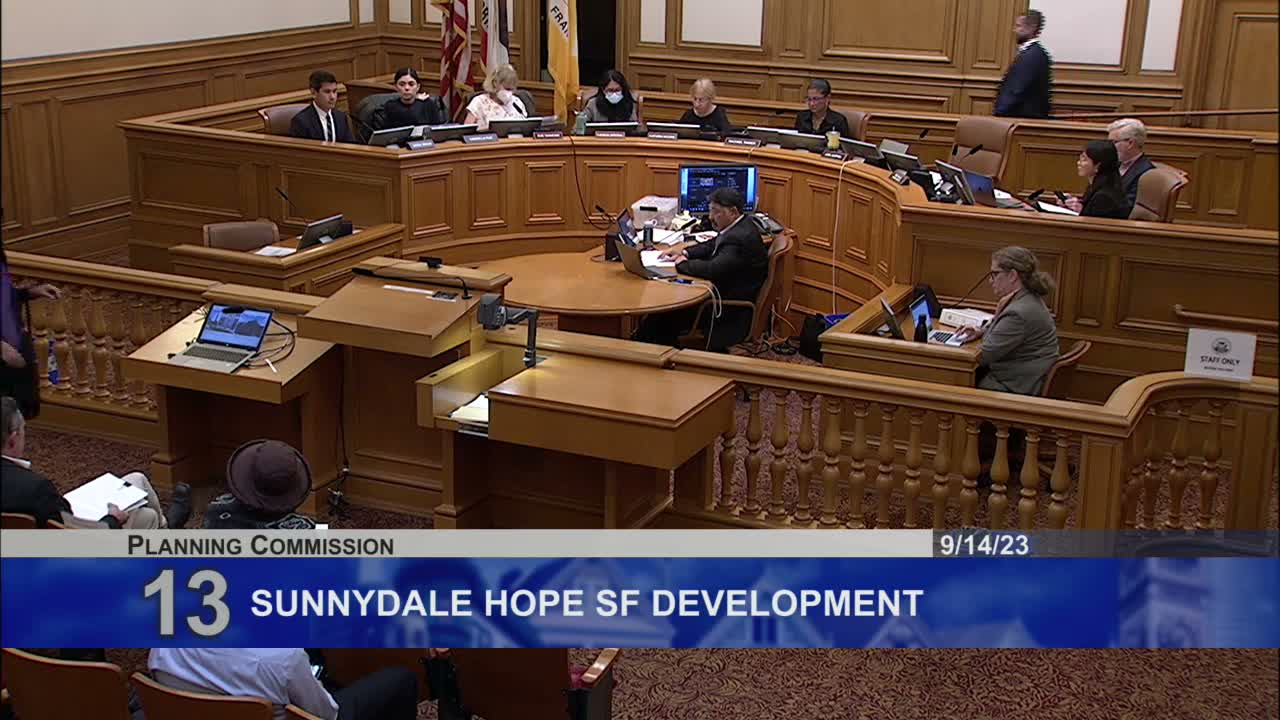
SAN FRANCISCO — City planners and Brookfield Properties on Sept. 14 gave the Planning Commission a programmatic update on the proposed Stonestown redevelopment, a multidecade build-out of the 41-acre mall site that staff and the sponsor say could yield roughly 2,900 to 3,500 housing units, six acres of parks and a new retail main street.
Christie Donnelly of Brookfield described a vision that would replace much of the site’s surface parking with mixed-use, transit-oriented housing and public space. "Our vision is to create 2,900 new residential units from 3 to 18 stories," Donnelly said, adding the sponsor has studied options to increase residential capacity by nearly 600 units by converting some office and hotel uses and adding an additional tower. Brookfield said the added density scenarios are included within the CEQA analysis and would be reflected in the final EIR.
Ted Conrad of the Office of Economic and Workforce Development (OEWD) told commissioners the city’s objective is to require the development agreement to exceed the new citywide baseline affordable-housing requirements. "The new, citywide affordable housing requirements for new projects coming in would be 15% for on-site rental... So we will certainly be requiring that the project exceed those requirements," Conrad said during question-and-answer.
Public comment stretched for more than an hour. Supporters, local neighborhood participants and the Sierra Club praised the plan’s conversion of parking lots into housing and parks; affordable-housing advocates, labor representatives and multiple residents urged the city and Brookfield to push for more deeply affordable and family-sized units and to avoid tax breaks or public-financing deals that would reduce net benefits to the city. Several speakers also referenced Brookfield’s litigation history in other projects and urged heightened accountability if public incentives are considered.
Commissioners asked technical questions about CEQA, how the programmatic EIR relates to development-agreement commitments, and how the city will structure incentives, milestones or financing tools such as an Enhanced Infrastructure Financing District (EIFD) to encourage earlier in‑ground construction. Staff explained that CEQA sets an environmental 'ceiling' for what may be analyzed and that the DA will translate the EIR program into enforceable commitments; staff and OEWD said negotiations are ongoing and that the DA will try to balance feasibility with strong community benefits.
Several commissioners asked for a clear phasing plan, design standards, and specific affordable-housing milestones and enforcement measures to be presented before final approvals. No formal action was taken at the informational item; staff said final approvals, certification of the final EIR and DA recommendations will be returned to the commission later in the year for formal action.
What’s next: Staff will continue DA negotiations and community outreach, refine design standards and phasing, and return with the final EIR and DA language for the commission’s review and recommendation to the Board of Supervisors.
Christie Donnelly of Brookfield described a vision that would replace much of the site’s surface parking with mixed-use, transit-oriented housing and public space. "Our vision is to create 2,900 new residential units from 3 to 18 stories," Donnelly said, adding the sponsor has studied options to increase residential capacity by nearly 600 units by converting some office and hotel uses and adding an additional tower. Brookfield said the added density scenarios are included within the CEQA analysis and would be reflected in the final EIR.
Ted Conrad of the Office of Economic and Workforce Development (OEWD) told commissioners the city’s objective is to require the development agreement to exceed the new citywide baseline affordable-housing requirements. "The new, citywide affordable housing requirements for new projects coming in would be 15% for on-site rental... So we will certainly be requiring that the project exceed those requirements," Conrad said during question-and-answer.
Public comment stretched for more than an hour. Supporters, local neighborhood participants and the Sierra Club praised the plan’s conversion of parking lots into housing and parks; affordable-housing advocates, labor representatives and multiple residents urged the city and Brookfield to push for more deeply affordable and family-sized units and to avoid tax breaks or public-financing deals that would reduce net benefits to the city. Several speakers also referenced Brookfield’s litigation history in other projects and urged heightened accountability if public incentives are considered.
Commissioners asked technical questions about CEQA, how the programmatic EIR relates to development-agreement commitments, and how the city will structure incentives, milestones or financing tools such as an Enhanced Infrastructure Financing District (EIFD) to encourage earlier in‑ground construction. Staff explained that CEQA sets an environmental 'ceiling' for what may be analyzed and that the DA will translate the EIR program into enforceable commitments; staff and OEWD said negotiations are ongoing and that the DA will try to balance feasibility with strong community benefits.
Several commissioners asked for a clear phasing plan, design standards, and specific affordable-housing milestones and enforcement measures to be presented before final approvals. No formal action was taken at the informational item; staff said final approvals, certification of the final EIR and DA recommendations will be returned to the commission later in the year for formal action.
What’s next: Staff will continue DA negotiations and community outreach, refine design standards and phasing, and return with the final EIR and DA language for the commission’s review and recommendation to the Board of Supervisors.
View the Full Meeting & All Its Details
This article offers just a summary. Unlock complete video, transcripts, and insights as a Founder Member.
✓
Watch full, unedited meeting videos
✓
Search every word spoken in unlimited transcripts
✓
AI summaries & real-time alerts (all government levels)
✓
Permanent access to expanding government content
30-day money-back guarantee
