Planning Commission approves coastal permit for Great Highway pilot after intense public debate
November 09, 2023 | San Francisco City, San Francisco County, California
This article was created by AI summarizing key points discussed. AI makes mistakes, so for full details and context, please refer to the video of the full meeting. Please report any errors so we can fix them. Report an error »
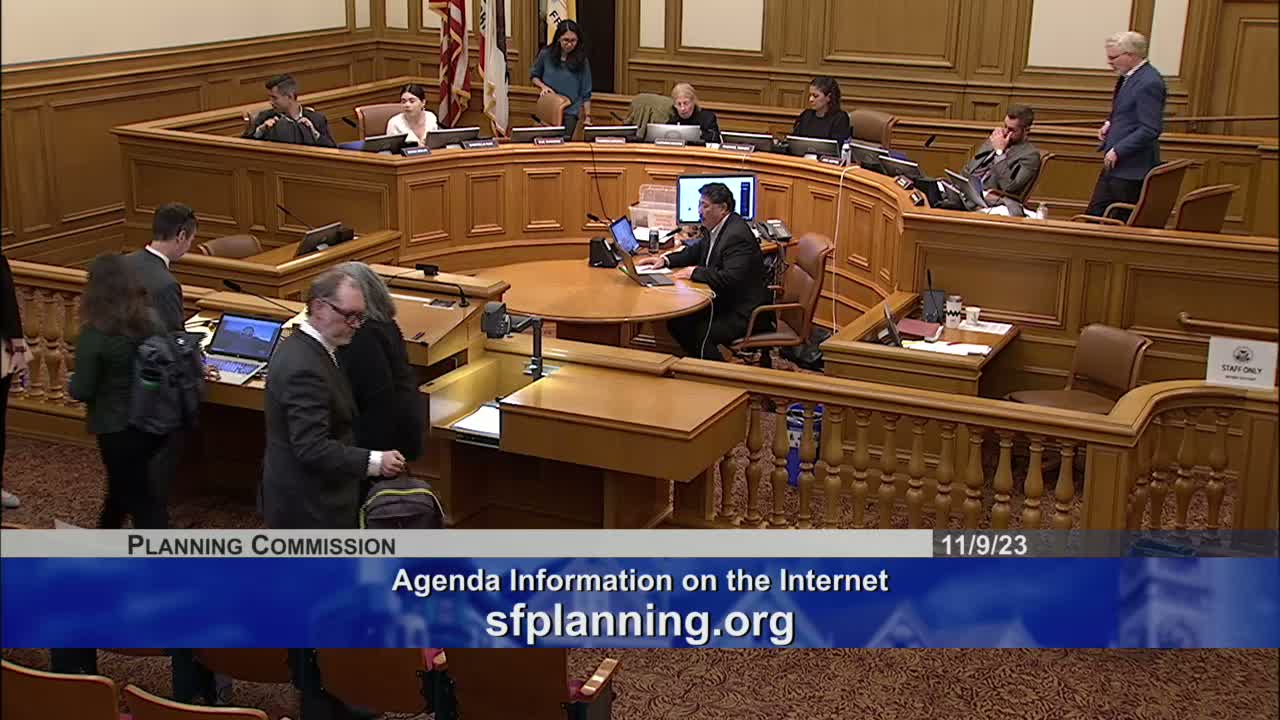
The Planning Commission on Nov. 9 approved a coastal zone permit for the Great Highway pilot — the weekend and holiday closure of the Upper Great Highway (Lincoln Way to Sloat Boulevard) to private vehicles to create a car‑free promenade — after a lengthy public hearing that drew both strong neighborhood support and substantial opposition.
Planning staff (Alex Westhoff) and the Recreation & Parks Department (Brian Stoeckel) framed the hearing as an after‑the‑fact coastal zone permit review that recognizes the pilot’s temporary status and reviews traffic‑calming measures installed by SFMTA. Staff said the pilot began in 2020 for COVID‑era recreation and that the Board of Supervisors approved restrictions in December 2022 through 2025. Staff cited usage data: since 2020 the Upper Great Highway recorded more than 2.8 million visits on foot, bike, and mobility devices; weekend averages since December 2022 were roughly 3,800 daily visits. The proposed permit would include the pilot configuration and several adjacent traffic‑calming installations.
Public input was extensive and sharply divided. Supporters — including volunteers and nonprofit groups that organize programming on the promenade — said the pilot vastly improved coastal access, hosted thousands of participants at city events, made the shoreline safer for walkers and people with mobility devices, and enabled community programming. Zach Lipton told the commission that the pilot aligns with the West Shoreline Area Plan, the Ocean Beach master plan, and the Coastal Act by improving recreational access and providing public events that drew tens of thousands of participants.
Opponents urged the commission to withhold approval pending a full independent environmental review. Eileen Bogan (SPEAK) and other callers argued that the certified Western Shoreline Area Plan (1984, amended 1988) contains policies calling for a four‑lane highway in the area and that the local coastal program remains the legal standard; they said an after‑the‑fact permit cannot cure an LCP inconsistency and recommended a full CEQA EIR to study dune erosion, snowy clover habitat damage, emergency access/evacuation implications and diverted traffic impacts on residential streets.
Commissioners heard both sides and asked procedural and substantive questions. Staff said the coastal permit is consistent with the local coastal program balance given the pilot’s temporary nature and that traffic‑calming measures were installed in response to community input. After public comment, a motion to approve the coastal zone permit carried unanimously, 7–0.
Next steps: Approval allows the pilot configuration and associated traffic‑calming elements to remain while the city continues monitoring, outreach and an Ocean Beach‑area climate adaptation study. Opponents may pursue appeals through coastal or judicial channels; staff noted that the city will continue collecting usage and environmental data to inform any long‑term decisions.
Provenance: topicintro SEG 3192; topfinish SEG 4084.
Planning staff (Alex Westhoff) and the Recreation & Parks Department (Brian Stoeckel) framed the hearing as an after‑the‑fact coastal zone permit review that recognizes the pilot’s temporary status and reviews traffic‑calming measures installed by SFMTA. Staff said the pilot began in 2020 for COVID‑era recreation and that the Board of Supervisors approved restrictions in December 2022 through 2025. Staff cited usage data: since 2020 the Upper Great Highway recorded more than 2.8 million visits on foot, bike, and mobility devices; weekend averages since December 2022 were roughly 3,800 daily visits. The proposed permit would include the pilot configuration and several adjacent traffic‑calming installations.
Public input was extensive and sharply divided. Supporters — including volunteers and nonprofit groups that organize programming on the promenade — said the pilot vastly improved coastal access, hosted thousands of participants at city events, made the shoreline safer for walkers and people with mobility devices, and enabled community programming. Zach Lipton told the commission that the pilot aligns with the West Shoreline Area Plan, the Ocean Beach master plan, and the Coastal Act by improving recreational access and providing public events that drew tens of thousands of participants.
Opponents urged the commission to withhold approval pending a full independent environmental review. Eileen Bogan (SPEAK) and other callers argued that the certified Western Shoreline Area Plan (1984, amended 1988) contains policies calling for a four‑lane highway in the area and that the local coastal program remains the legal standard; they said an after‑the‑fact permit cannot cure an LCP inconsistency and recommended a full CEQA EIR to study dune erosion, snowy clover habitat damage, emergency access/evacuation implications and diverted traffic impacts on residential streets.
Commissioners heard both sides and asked procedural and substantive questions. Staff said the coastal permit is consistent with the local coastal program balance given the pilot’s temporary nature and that traffic‑calming measures were installed in response to community input. After public comment, a motion to approve the coastal zone permit carried unanimously, 7–0.
Next steps: Approval allows the pilot configuration and associated traffic‑calming elements to remain while the city continues monitoring, outreach and an Ocean Beach‑area climate adaptation study. Opponents may pursue appeals through coastal or judicial channels; staff noted that the city will continue collecting usage and environmental data to inform any long‑term decisions.
Provenance: topicintro SEG 3192; topfinish SEG 4084.
Don't Miss a Word: See the Full Meeting!
Go beyond summaries. Unlock every video, transcript, and key insight with a Founder Membership.
✓
Get instant access to full meeting videos
✓
Search and clip any phrase from complete transcripts
✓
Receive AI-powered summaries & custom alerts
✓
Enjoy lifetime, unrestricted access to government data
30-day money-back guarantee
