Planning Commission approves waiver of on-site public-art requirement for 100% affordable projects, 5–1
November 16, 2023 | San Francisco City, San Francisco County, California
This article was created by AI summarizing key points discussed. AI makes mistakes, so for full details and context, please refer to the video of the full meeting. Please report any errors so we can fix them. Report an error »
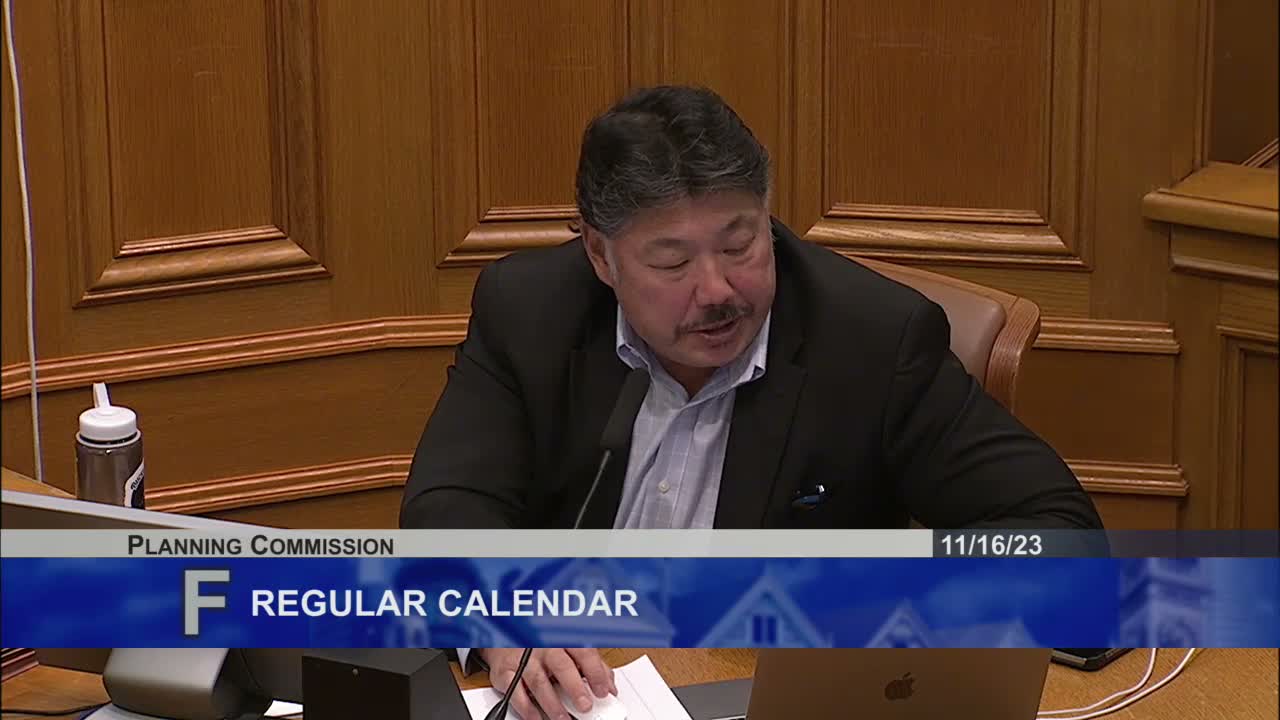
The San Francisco Planning Commission on Nov. 16 approved, by a 5–1 vote, a planning-code amendment that would waive the city’s on-site public-art requirement for 100% affordable housing projects and provide limited relocation/removal flexibility for existing artworks under certain conditions.
Planning staff and a representative from Supervisor Matt Dorsey’s office framed the proposal as a way to reduce development costs for deeply affordable housing and to respond to maintenance burdens on affordable-owner associations. Presenting a case study, staff described a mural at 1400 Mission that has been repeatedly vandalized; under current rules the building would be obligated to replace art of equal or greater value, a financial burden for that below-market-rate HOA. The supervisor’s office said waiving the requirement supports housing-element goals and state funding competitiveness.
Community speakers pushed back. Charlie Shamus of the Council of Community Housing Organizations warned that removing the requirement without identifying a new funding source would “erode racial and social equity” and deprive low-income residents of culturally relevant public art. David Wu (Soma Filipinos) and Raquel Redadis (SoMa Pilipinas) asked for more time to work with the sponsor and city staff to identify alternative funding, noting specific projects (967 Mission, the SoMa Pilipinas Gateway) that could be affected.
Commission debate centered on tradeoffs: the cost burden on 100% affordable projects versus the cultural and placemaking value of public art. Commissioners supported staff modifications that (a) clarify administrative-code amendments to exempt certain affordable projects from the percent-for-art requirement, (b) provide streamlined processes for minor relocations/alterations, and (c) call for interdepartmental coordination on funding options. Commissioner Imperial voted against the motion, citing concerns about removing a tool that fosters collaboration between developers and communities.
Action taken: the commission approved the PCA with modifications (1, 3, 4 and 5 as described in the staff report) and added a finding encouraging further dialogue between departments and stakeholders. Commissioner Ruiz recused from this item before the hearing because of an employer conflict; the recusal was accepted by the commission.
What’s next: the ordinance and recommended amendments will move to the Board of Supervisors (land-use committee) for consideration and to the city attorney’s office for drafting of implementing language; staff and the sponsor said they will continue outreach to cultural districts and nonprofit developers to explore dedicated funding avenues for public art.
Planning staff and a representative from Supervisor Matt Dorsey’s office framed the proposal as a way to reduce development costs for deeply affordable housing and to respond to maintenance burdens on affordable-owner associations. Presenting a case study, staff described a mural at 1400 Mission that has been repeatedly vandalized; under current rules the building would be obligated to replace art of equal or greater value, a financial burden for that below-market-rate HOA. The supervisor’s office said waiving the requirement supports housing-element goals and state funding competitiveness.
Community speakers pushed back. Charlie Shamus of the Council of Community Housing Organizations warned that removing the requirement without identifying a new funding source would “erode racial and social equity” and deprive low-income residents of culturally relevant public art. David Wu (Soma Filipinos) and Raquel Redadis (SoMa Pilipinas) asked for more time to work with the sponsor and city staff to identify alternative funding, noting specific projects (967 Mission, the SoMa Pilipinas Gateway) that could be affected.
Commission debate centered on tradeoffs: the cost burden on 100% affordable projects versus the cultural and placemaking value of public art. Commissioners supported staff modifications that (a) clarify administrative-code amendments to exempt certain affordable projects from the percent-for-art requirement, (b) provide streamlined processes for minor relocations/alterations, and (c) call for interdepartmental coordination on funding options. Commissioner Imperial voted against the motion, citing concerns about removing a tool that fosters collaboration between developers and communities.
Action taken: the commission approved the PCA with modifications (1, 3, 4 and 5 as described in the staff report) and added a finding encouraging further dialogue between departments and stakeholders. Commissioner Ruiz recused from this item before the hearing because of an employer conflict; the recusal was accepted by the commission.
What’s next: the ordinance and recommended amendments will move to the Board of Supervisors (land-use committee) for consideration and to the city attorney’s office for drafting of implementing language; staff and the sponsor said they will continue outreach to cultural districts and nonprofit developers to explore dedicated funding avenues for public art.
Don't Miss a Word: See the Full Meeting!
Go beyond summaries. Unlock every video, transcript, and key insight with a Founder Membership.
✓
Get instant access to full meeting videos
✓
Search and clip any phrase from complete transcripts
✓
Receive AI-powered summaries & custom alerts
✓
Enjoy lifetime, unrestricted access to government data
30-day money-back guarantee
