Planning Commission backs tailored density limits for downtown and waterfront C2 districts
January 18, 2024 | San Francisco City, San Francisco County, California
This article was created by AI summarizing key points discussed. AI makes mistakes, so for full details and context, please refer to the video of the full meeting. Please report any errors so we can fix them. Report an error »
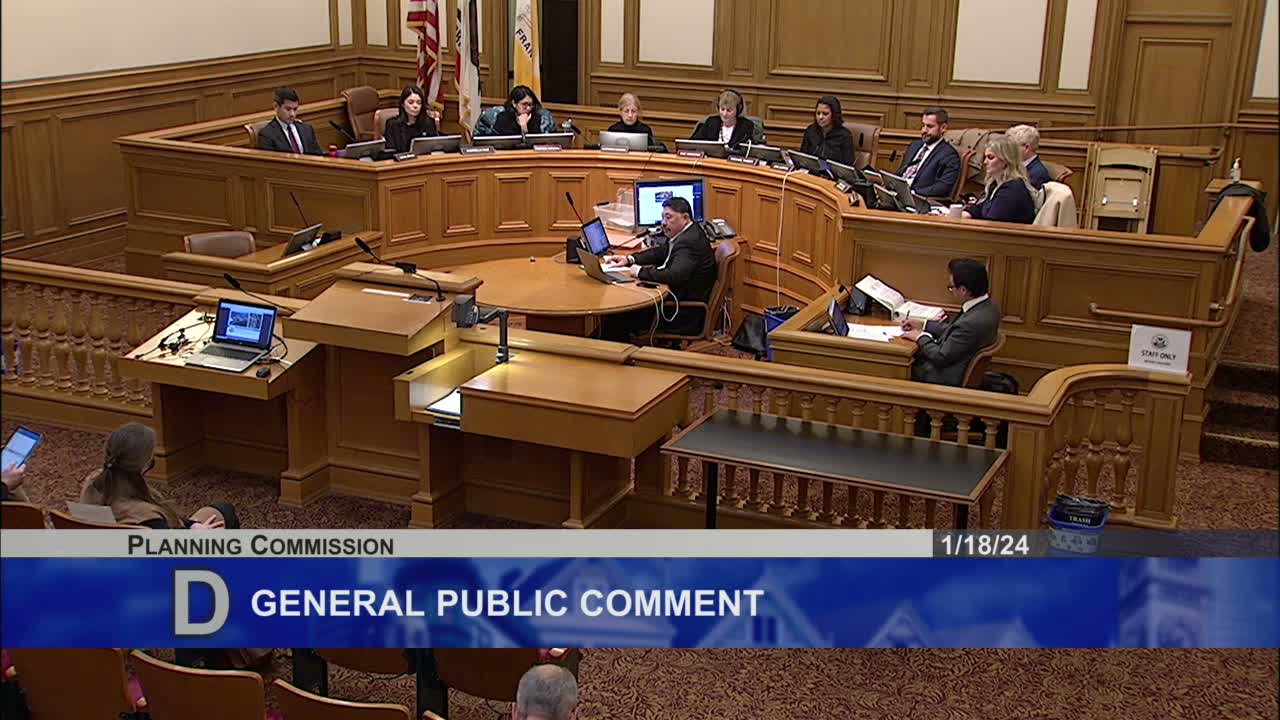
The San Francisco Planning Commission on Jan. 18 recommended that the Board of Supervisors approve a planning‑code amendment to restore numeric density limits in specified downtown and waterfront C2 (community business) zones while retaining form‑based density in other areas to encourage adaptive reuse and protect historic buildings.
Staff planner Audrey Marloni told commissioners the proposed ordinance would revert C2 districts in downtown and the waterfront to their prior numerical density limits, while allowing projects using the commercial‑to‑residential adaptive‑reuse program to continue to use form‑based density. Nate Harel, legislative aide to Board President Aaron Peskin, said the change aims to refocus the adaptive‑reuse ordinance on vacant properties and reduce incentives to demolish occupied historic commercial buildings such as the example he cited at 1088 Sansom.
The move, Marloni said, is narrowly targeted: staff recommended limiting numeric controls to demolition‑new‑construction projects within the Northeast Waterfront and Jackson Square historic districts and allowing reuse projects to keep form‑based density. Deputy City Attorney Austin Yang explained the city’s obligations under state law, including how SB 330’s baseline for measuring intensity is anchored to Jan. 1, 2018, and when 'no net loss' findings would be required.
Public testimony came from housing advocates and development groups. Corey Smith of Housing Action Coalition and Jay Natoli of San Francisco YIMBY supported the modifications as a way to protect significant historic resources while preserving opportunities for new housing downtown. Speakers urged careful mapping of affected parcels and continued analysis of the state density bonus program’s interaction with form‑based code.
Commissioners discussed whether to broaden numeric limits beyond the identified historic districts and requested more parcel‑level analysis of potential demolition incentives. Commissioner Koppel moved to approve the ordinance with staff modifications and asked that the commission’s comments be forwarded to the supervisor; the motion passed unanimously, 7–0.
The commission’s recommendation goes next to the Board of Supervisors, which will consider the ordinance and any amendments before final adoption.
Staff planner Audrey Marloni told commissioners the proposed ordinance would revert C2 districts in downtown and the waterfront to their prior numerical density limits, while allowing projects using the commercial‑to‑residential adaptive‑reuse program to continue to use form‑based density. Nate Harel, legislative aide to Board President Aaron Peskin, said the change aims to refocus the adaptive‑reuse ordinance on vacant properties and reduce incentives to demolish occupied historic commercial buildings such as the example he cited at 1088 Sansom.
The move, Marloni said, is narrowly targeted: staff recommended limiting numeric controls to demolition‑new‑construction projects within the Northeast Waterfront and Jackson Square historic districts and allowing reuse projects to keep form‑based density. Deputy City Attorney Austin Yang explained the city’s obligations under state law, including how SB 330’s baseline for measuring intensity is anchored to Jan. 1, 2018, and when 'no net loss' findings would be required.
Public testimony came from housing advocates and development groups. Corey Smith of Housing Action Coalition and Jay Natoli of San Francisco YIMBY supported the modifications as a way to protect significant historic resources while preserving opportunities for new housing downtown. Speakers urged careful mapping of affected parcels and continued analysis of the state density bonus program’s interaction with form‑based code.
Commissioners discussed whether to broaden numeric limits beyond the identified historic districts and requested more parcel‑level analysis of potential demolition incentives. Commissioner Koppel moved to approve the ordinance with staff modifications and asked that the commission’s comments be forwarded to the supervisor; the motion passed unanimously, 7–0.
The commission’s recommendation goes next to the Board of Supervisors, which will consider the ordinance and any amendments before final adoption.
Don't Miss a Word: See the Full Meeting!
Go beyond summaries. Unlock every video, transcript, and key insight with a Founder Membership.
✓
Get instant access to full meeting videos
✓
Search and clip any phrase from complete transcripts
✓
Receive AI-powered summaries & custom alerts
✓
Enjoy lifetime, unrestricted access to government data
30-day money-back guarantee
