Commission backs streamlined exemptions for removing long‑vacant unauthorized units, with safeguards
January 18, 2024 | San Francisco City, San Francisco County, California
This article was created by AI summarizing key points discussed. AI makes mistakes, so for full details and context, please refer to the video of the full meeting. Please report any errors so we can fix them. Report an error »
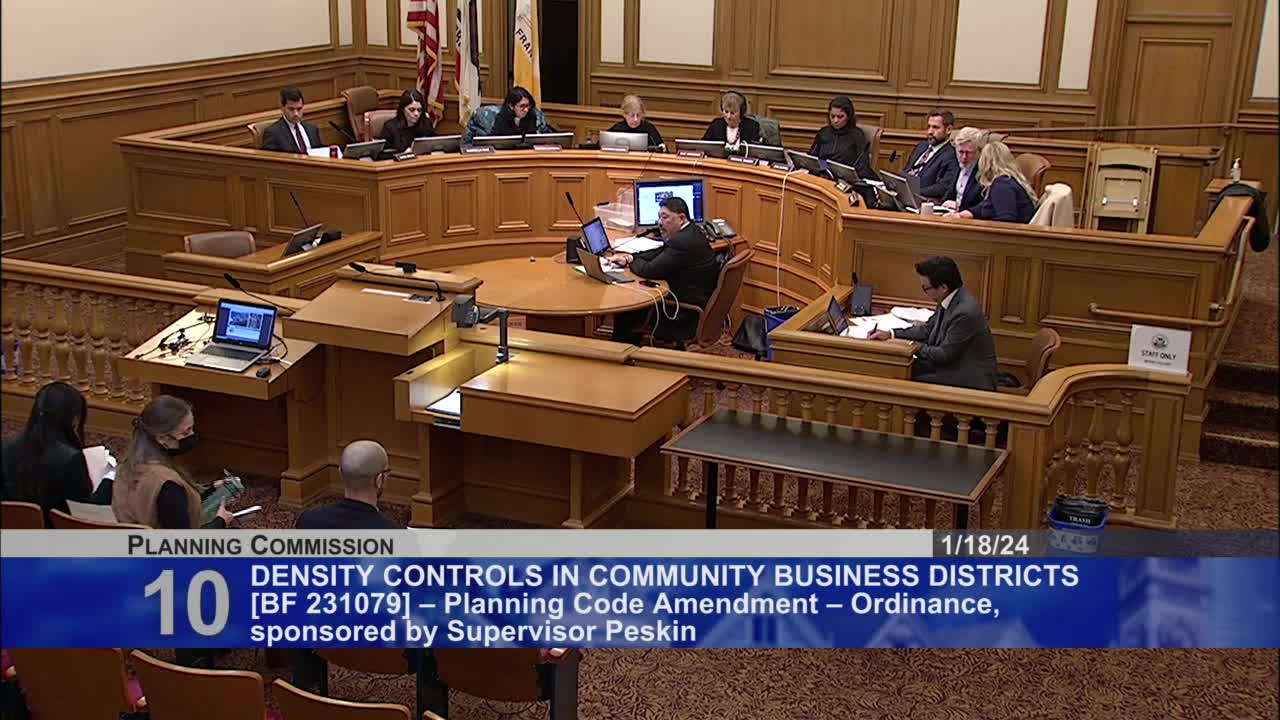
The Planning Commission on Jan. 18 voted 7–0 to recommend a conditional use authorization exemption for certain removals of unauthorized dwelling units (UDUs).
Mike Farah, representing Supervisor Matt Dorsey’s office (presented as Supervisor Melgar’s office in the staff introduction), said the measure responds to constituent concerns and is intended to let single‑family homeowners who occupy their property convert to one home when a UDU has not been rented for at least 10 years. Under the ordinance, an owner would need to reside in the primary unit and commit to living in the resulting single‑family home for at least three years; they would also be required to enter a regulatory agreement subjecting the primary unit to rent‑stabilization limits if it were later rented.
Staff recommended approval with two key modifications: (1) narrow the open‑space/exposure exemption so it applies only when the only path to legalization would be a variance (i.e., preserve units that can be legalized through existing programs), and (2) limit the floor‑to‑ceiling height exemption to units that also fail minimum unit area so that viable units are not forfeited without review. Commissioners pressed staff on implementation details, including whether site visits or affidavits and photographs should be required to verify vacancy claims and how the department would detect false statements. Planning staff and the city attorney advised that site visits are already used in some demolition/new construction reviews but that photos and affidavits could be practical adjuncts when a full site visit provides limited historical evidence.
Commissioners also asked about rent‑control implications and were briefed by Deputy City Attorney Austin Yang on legal exceptions (including references to Costa‑Hawkins) that allow the city to require regulatory agreements in certain circumstances. After discussion the commission voted unanimously 7–0 to approve the ordinance with staff modifications.
The item will be forwarded to the Board of Supervisors for next steps; staff said they will continue to work with the supervisor’s office on implementation details such as triggers for site visits and affidavit requirements.
Mike Farah, representing Supervisor Matt Dorsey’s office (presented as Supervisor Melgar’s office in the staff introduction), said the measure responds to constituent concerns and is intended to let single‑family homeowners who occupy their property convert to one home when a UDU has not been rented for at least 10 years. Under the ordinance, an owner would need to reside in the primary unit and commit to living in the resulting single‑family home for at least three years; they would also be required to enter a regulatory agreement subjecting the primary unit to rent‑stabilization limits if it were later rented.
Staff recommended approval with two key modifications: (1) narrow the open‑space/exposure exemption so it applies only when the only path to legalization would be a variance (i.e., preserve units that can be legalized through existing programs), and (2) limit the floor‑to‑ceiling height exemption to units that also fail minimum unit area so that viable units are not forfeited without review. Commissioners pressed staff on implementation details, including whether site visits or affidavits and photographs should be required to verify vacancy claims and how the department would detect false statements. Planning staff and the city attorney advised that site visits are already used in some demolition/new construction reviews but that photos and affidavits could be practical adjuncts when a full site visit provides limited historical evidence.
Commissioners also asked about rent‑control implications and were briefed by Deputy City Attorney Austin Yang on legal exceptions (including references to Costa‑Hawkins) that allow the city to require regulatory agreements in certain circumstances. After discussion the commission voted unanimously 7–0 to approve the ordinance with staff modifications.
The item will be forwarded to the Board of Supervisors for next steps; staff said they will continue to work with the supervisor’s office on implementation details such as triggers for site visits and affidavit requirements.
View the Full Meeting & All Its Details
This article offers just a summary. Unlock complete video, transcripts, and insights as a Founder Member.
✓
Watch full, unedited meeting videos
✓
Search every word spoken in unlimited transcripts
✓
AI summaries & real-time alerts (all government levels)
✓
Permanent access to expanding government content
30-day money-back guarantee
