Planning Commission approves coastal zone permit for Lake Merced remediation
January 25, 2024 | San Francisco City, San Francisco County, California
This article was created by AI summarizing key points discussed. AI makes mistakes, so for full details and context, please refer to the video of the full meeting. Please report any errors so we can fix them. Report an error »
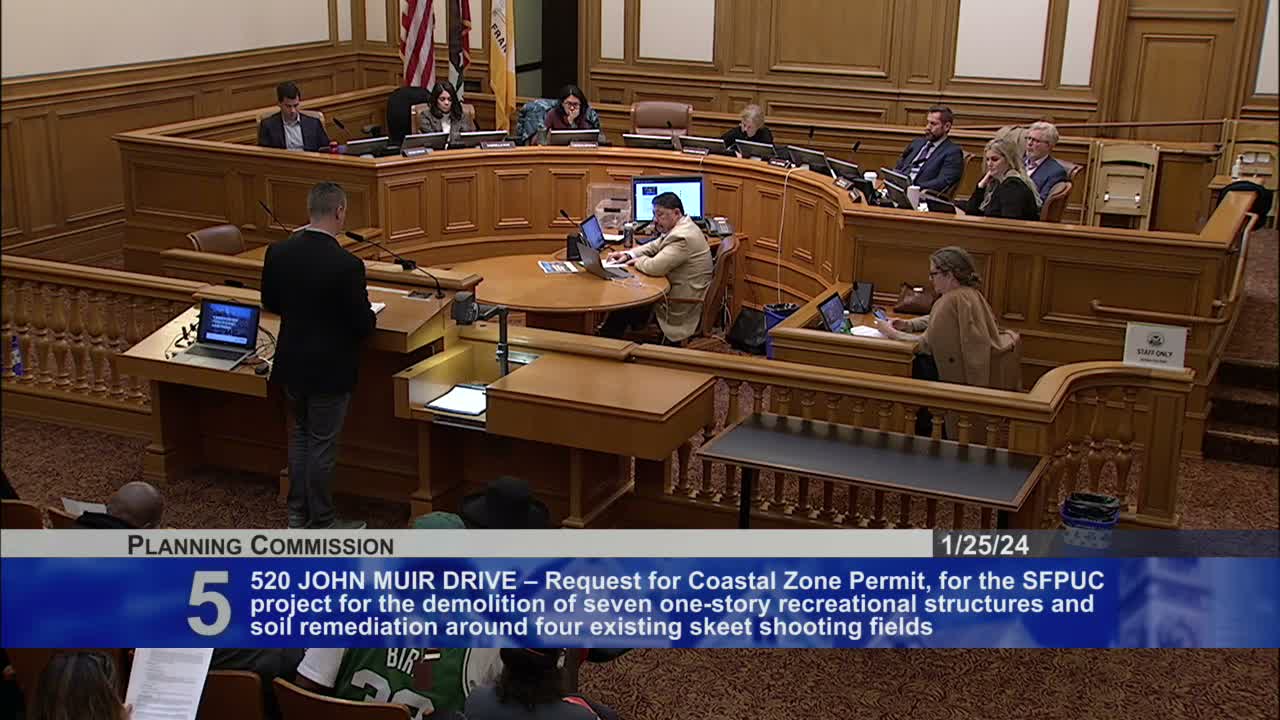
The San Francisco Planning Commission voted unanimously Thursday to approve a coastal zone permit allowing the San Francisco Public Utilities Commission to remove several obsolete recreation structures and remediate contaminated soils at the former Pacific Rod and Gun Club site near Lake Merced.
Planning staff and the project sponsor said the phase‑one work is limited to demolition of seven single‑story structures and cleanup of roughly 4,800 cubic yards of contaminated soil. Karen Lancel of Environmental Science Associates, presenting for the SFPUC, said demolition and remediation would take about three months and that the site would remain closed to the public after phase one is finished. "Phase 1 is required prior to any future redevelopment of the site," she said.
In public comment, Eileen Bogan of the community organization Speak supported cleanup but raised technical concerns about the project description and coastal‑program citations. Bogan cited sections of the California Public Resources Code and argued some language in the staff report misstated the local coastal program components. Planning staff responded that the coastal permit implements work covered under the previously certified project EIR and noted that projects may be phased; staff recommended approval with conditions.
Commissioners debated the accuracy of some staff report language and whether the plan appropriately limited the current action to remediation. Commissioner Perio asked staff to ensure that written materials and notices precisely reflect which phases include future structures; staff said they would tighten the wording. The commission then voted to approve the coastal zone permit with the department’s recommended conditions.
The action clears the way for the SFPUC to remove hazardous soils that project documents say are necessary before any recreational redevelopment can begin. The department said erosion controls required by the regional water quality control board will be implemented at the end of phase one. No new buildings were authorized as part of the approved phase-one permit; any future redevelopment would require additional review and approvals by the city.
Planning staff and the project sponsor said the phase‑one work is limited to demolition of seven single‑story structures and cleanup of roughly 4,800 cubic yards of contaminated soil. Karen Lancel of Environmental Science Associates, presenting for the SFPUC, said demolition and remediation would take about three months and that the site would remain closed to the public after phase one is finished. "Phase 1 is required prior to any future redevelopment of the site," she said.
In public comment, Eileen Bogan of the community organization Speak supported cleanup but raised technical concerns about the project description and coastal‑program citations. Bogan cited sections of the California Public Resources Code and argued some language in the staff report misstated the local coastal program components. Planning staff responded that the coastal permit implements work covered under the previously certified project EIR and noted that projects may be phased; staff recommended approval with conditions.
Commissioners debated the accuracy of some staff report language and whether the plan appropriately limited the current action to remediation. Commissioner Perio asked staff to ensure that written materials and notices precisely reflect which phases include future structures; staff said they would tighten the wording. The commission then voted to approve the coastal zone permit with the department’s recommended conditions.
The action clears the way for the SFPUC to remove hazardous soils that project documents say are necessary before any recreational redevelopment can begin. The department said erosion controls required by the regional water quality control board will be implemented at the end of phase one. No new buildings were authorized as part of the approved phase-one permit; any future redevelopment would require additional review and approvals by the city.
View the Full Meeting & All Its Details
This article offers just a summary. Unlock complete video, transcripts, and insights as a Founder Member.
✓
Watch full, unedited meeting videos
✓
Search every word spoken in unlimited transcripts
✓
AI summaries & real-time alerts (all government levels)
✓
Permanent access to expanding government content
30-day money-back guarantee
