Planning Commission approves ordinance to require conditional use authorization for fleet‑charging in PDR zones
January 11, 2024 | San Francisco City, San Francisco County, California
This article was created by AI summarizing key points discussed. AI makes mistakes, so for full details and context, please refer to the video of the full meeting. Please report any errors so we can fix them. Report an error »
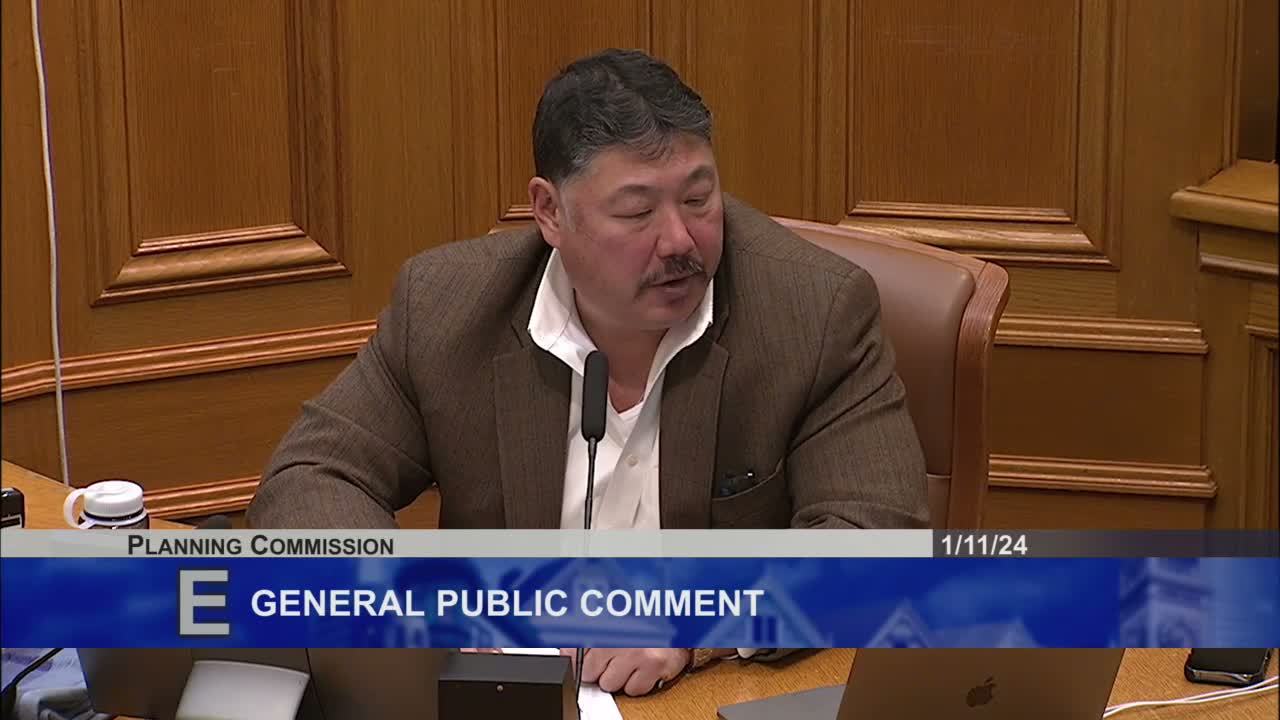
The San Francisco Planning Commission voted unanimously Jan. 11 to require conditional use authorization (CU) for conversions of private parking or vehicle‑storage lots to fleet‑charging facilities in PDR (production, distribution and repair) districts.
Planning staff told commissioners the ordinance, sponsored by Supervisor Aaron Peskin’s office, would remove an exception that allowed applicants to use two sequential over‑the‑counter permits to convert parking lots to 24‑hour fleet‑charging sites without public review. “The department recommends approval of the ordinance as written,” planning staff said, and noted the rule creates a uniform approval process and consistent scrutiny for these intensive land uses.
Sunny Angulo, representing Supervisor Peskin’s office, said the sponsor is considering two technical amendments: a grandfathering date to exempt applications already filed before the effective date, and a clarification to require Section 3.11 public notice for building permits converting a use to fleet charging. Labor groups urged the commission to act: Peter Ziblatt, land‑use counsel for Teamsters Joint Council 7, told the commission that the existing “footnote 24” loophole has been used to avoid CU review and that “conditional use approval should be required universally in PDR zones for fleet charging.” Mark Leesat Harum of Teamsters Joint Council 7 emphasized workplace and community safety concerns.
Commissioners framed the change as a procedural fix to ensure consistent public notice and site‑specific review of operations that can have neighborhood impacts. Commissioner Koppel moved to approve staff recommendations and allow staff and the sponsor to return with any narrow technical edits; the motion passed 7–0.
The ordinance returns to the Board of Supervisors as part of the city’s legislative process. The commission also asked staff to consider the sponsor’s suggested grandfathering language and a footnote clarifying notice requirements for building‑permit pathway conversions.
Planning staff told commissioners the ordinance, sponsored by Supervisor Aaron Peskin’s office, would remove an exception that allowed applicants to use two sequential over‑the‑counter permits to convert parking lots to 24‑hour fleet‑charging sites without public review. “The department recommends approval of the ordinance as written,” planning staff said, and noted the rule creates a uniform approval process and consistent scrutiny for these intensive land uses.
Sunny Angulo, representing Supervisor Peskin’s office, said the sponsor is considering two technical amendments: a grandfathering date to exempt applications already filed before the effective date, and a clarification to require Section 3.11 public notice for building permits converting a use to fleet charging. Labor groups urged the commission to act: Peter Ziblatt, land‑use counsel for Teamsters Joint Council 7, told the commission that the existing “footnote 24” loophole has been used to avoid CU review and that “conditional use approval should be required universally in PDR zones for fleet charging.” Mark Leesat Harum of Teamsters Joint Council 7 emphasized workplace and community safety concerns.
Commissioners framed the change as a procedural fix to ensure consistent public notice and site‑specific review of operations that can have neighborhood impacts. Commissioner Koppel moved to approve staff recommendations and allow staff and the sponsor to return with any narrow technical edits; the motion passed 7–0.
The ordinance returns to the Board of Supervisors as part of the city’s legislative process. The commission also asked staff to consider the sponsor’s suggested grandfathering language and a footnote clarifying notice requirements for building‑permit pathway conversions.
Don't Miss a Word: See the Full Meeting!
Go beyond summaries. Unlock every video, transcript, and key insight with a Founder Membership.
✓
Get instant access to full meeting videos
✓
Search and clip any phrase from complete transcripts
✓
Receive AI-powered summaries & custom alerts
✓
Enjoy lifetime, unrestricted access to government data
30-day money-back guarantee
