Commission backs parcel delivery conditional‑use ordinance with recommended refinements
February 08, 2024 | San Francisco City, San Francisco County, California
This article was created by AI summarizing key points discussed. AI makes mistakes, so for full details and context, please refer to the video of the full meeting. Please report any errors so we can fix them. Report an error »
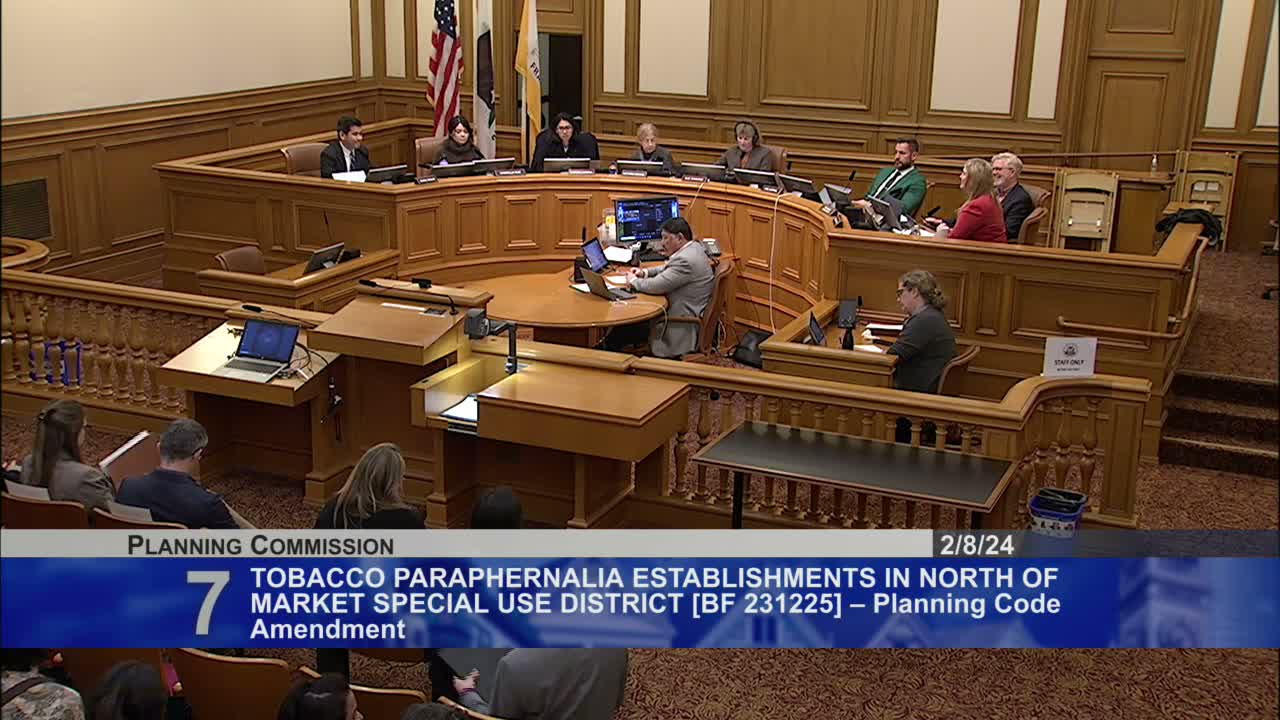
The Planning Commission on Feb. 8 recommended approval of legislation introduced by Supervisor Connie Chan to require conditional‑use authorization (CUA) for parcel delivery service facilities citywide, concluding with a unanimous, negotiated motion that asks the supervisor and planning staff to refine implementation details.
Supervisor Chan described the ordinance as a permanent, citywide successor to interim zoning controls scheduled to expire March 8. Her office asked the commission to retain additional conditional‑use criteria in the code that would allow explicit review of traffic, vehicle‑miles‑traveled, greenhouse‑gas impacts, employment and fiscal effects, and electrification and idling controls for high‑intensity parcel facilities.
Planning staff recommended approval with modifications: they suggested removing the additional criteria as redundant with CEQA and technical review, retaining an existing 5,000‑square‑foot exemption (from the interim controls) to avoid undue burden on small businesses, excluding cannabis delivery from an accessory‑use prohibition, and keeping a temporary 60‑day exemption for holiday surge facilities. Staff also advised caution on prescribing technical electrification or idling limits in the planning code alone when other city and regional bodies (SFE, SFMTA, Bay Area air districts) manage those domains.
Labor unions, environmental groups and resident advocates were the most frequent public speakers. Teamsters locals and joint councils urged the commission to adopt Supervisor Chan’s original language (including the economic and labor analyses) to protect jobs and require more rigorous review of industrial‑scale facilities; Sierra Club and neighborhood groups supported broader scrutiny and electrification requirements to address pollution burdens near warehouses and distribution hubs. Residents near proposed large facilities described potential impacts on air quality, traffic safety and neighborhood character and asked the commission for robust conditions.
Commissioners engaged a sustained discussion about three tradeoffs: (1) whether CEQA plus existing transportation review (DLOPS/SQL) provide sufficient technical analysis to obviate new conditional criteria; (2) how to avoid imposing disproportionate costs on small operators (proposed exemption threshold 5,000 sq ft) while still capturing cumulative impacts of many facilities; and (3) how to craft enforceable electrification or idling measures given utility and enforcement constraints.
After lengthy deliberations commissioners settled on a compromise motion to approve the ordinance as introduced but to forward recommendations to the supervisor and staff: incorporate technical code corrections, exclude cannabis delivery from accessory‑use prohibition, keep the 5,000‑sq‑ft pathway but create an expedited/simplified CUA option for small sites, move electrification expectations into evaluation criteria rather than absolute conditions for small sites (allowing disclosure and project‑level analysis where infrastructure constraints exist), retain the temporary 60‑day holiday exemption, and request a citywide economic and cumulative impact study that project applications could tier off.
The motion passed unanimously, 6–0. Planning staff and the supervisor’s office will continue to work together on implementation details and language before the item advances to the Board of Supervisors.
Supervisor Chan described the ordinance as a permanent, citywide successor to interim zoning controls scheduled to expire March 8. Her office asked the commission to retain additional conditional‑use criteria in the code that would allow explicit review of traffic, vehicle‑miles‑traveled, greenhouse‑gas impacts, employment and fiscal effects, and electrification and idling controls for high‑intensity parcel facilities.
Planning staff recommended approval with modifications: they suggested removing the additional criteria as redundant with CEQA and technical review, retaining an existing 5,000‑square‑foot exemption (from the interim controls) to avoid undue burden on small businesses, excluding cannabis delivery from an accessory‑use prohibition, and keeping a temporary 60‑day exemption for holiday surge facilities. Staff also advised caution on prescribing technical electrification or idling limits in the planning code alone when other city and regional bodies (SFE, SFMTA, Bay Area air districts) manage those domains.
Labor unions, environmental groups and resident advocates were the most frequent public speakers. Teamsters locals and joint councils urged the commission to adopt Supervisor Chan’s original language (including the economic and labor analyses) to protect jobs and require more rigorous review of industrial‑scale facilities; Sierra Club and neighborhood groups supported broader scrutiny and electrification requirements to address pollution burdens near warehouses and distribution hubs. Residents near proposed large facilities described potential impacts on air quality, traffic safety and neighborhood character and asked the commission for robust conditions.
Commissioners engaged a sustained discussion about three tradeoffs: (1) whether CEQA plus existing transportation review (DLOPS/SQL) provide sufficient technical analysis to obviate new conditional criteria; (2) how to avoid imposing disproportionate costs on small operators (proposed exemption threshold 5,000 sq ft) while still capturing cumulative impacts of many facilities; and (3) how to craft enforceable electrification or idling measures given utility and enforcement constraints.
After lengthy deliberations commissioners settled on a compromise motion to approve the ordinance as introduced but to forward recommendations to the supervisor and staff: incorporate technical code corrections, exclude cannabis delivery from accessory‑use prohibition, keep the 5,000‑sq‑ft pathway but create an expedited/simplified CUA option for small sites, move electrification expectations into evaluation criteria rather than absolute conditions for small sites (allowing disclosure and project‑level analysis where infrastructure constraints exist), retain the temporary 60‑day holiday exemption, and request a citywide economic and cumulative impact study that project applications could tier off.
The motion passed unanimously, 6–0. Planning staff and the supervisor’s office will continue to work together on implementation details and language before the item advances to the Board of Supervisors.
Don't Miss a Word: See the Full Meeting!
Go beyond summaries. Unlock every video, transcript, and key insight with a Founder Membership.
✓
Get instant access to full meeting videos
✓
Search and clip any phrase from complete transcripts
✓
Receive AI-powered summaries & custom alerts
✓
Enjoy lifetime, unrestricted access to government data
30-day money-back guarantee
