Planning Commission backs Treasure Island package, including $115 million COP financing
April 04, 2024 | San Francisco City, San Francisco County, California
This article was created by AI summarizing key points discussed. AI makes mistakes, so for full details and context, please refer to the video of the full meeting. Please report any errors so we can fix them. Report an error »
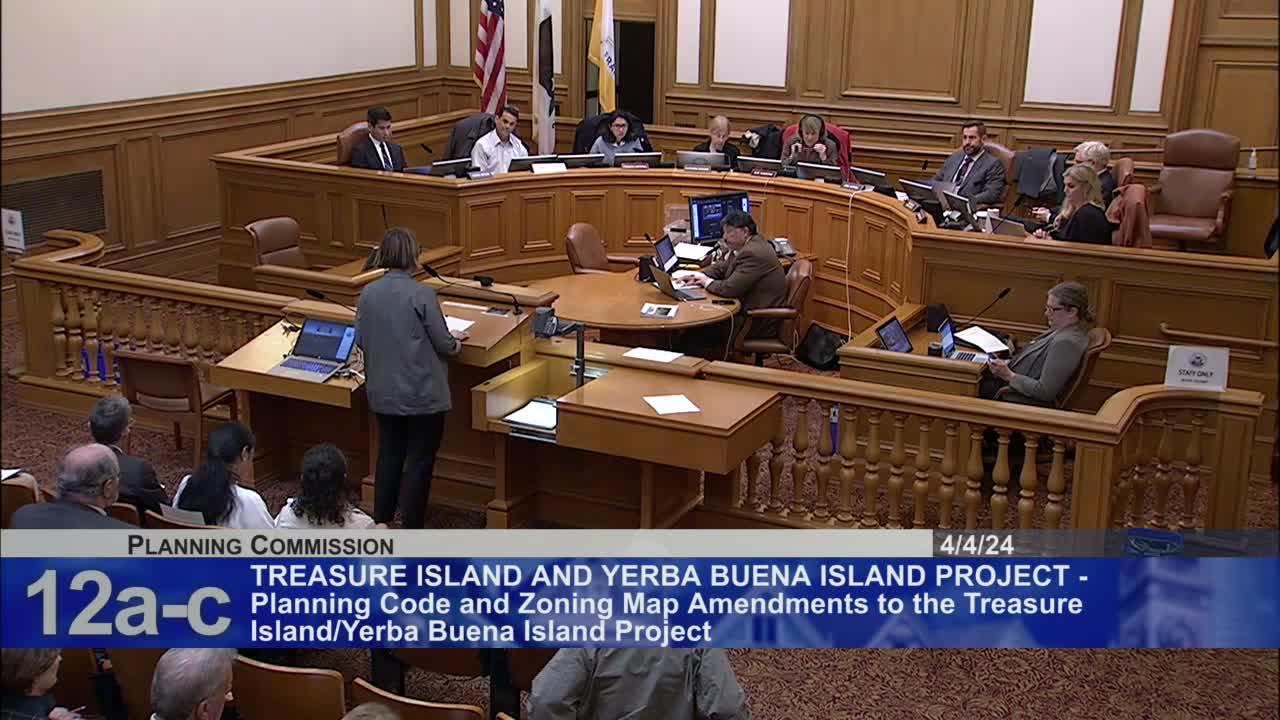
The San Francisco Planning Commission on April 4 recommended that the Board of Supervisors approve a package of amendments to the Treasure Island/Yerba Buena Island development agreement, zoning map and the project’s Design for Development.
Staff framed the package as a set of technical updates and fiscal changes intended to keep the project moving after rising construction and infrastructure costs. "The basic infrastructure costs alone total $1,400,000,000," Lee Lewinsky of the Office of Economic and Workforce Development told commissioners during the presentation. He described a proposal to accelerate $115,000,000 in city general‑fund certificates of participation (COPs) to reimburse eligible Stage 2 infrastructure costs.
Jamie Karubin, finance manager at the Treasure Island Development Authority, told the commission the COPs would likely be issued in three tranches and repaid over about a 20‑year term. "Preliminary numbers run by the controller's office ... assuming a 6.5% interest rate paid over a 20‑year term would result in approximately $233,000,000 of principal plus interest payments over time," Karubin said.
Project sponsors and community partners emphasized the project's job, housing and community benefits. In testimony the carpenters’ union described hundreds of union jobs and apprenticeships created by Phase 1; Mercy Housing and other nonprofit partners said accelerated infrastructure is necessary to unlock two affordable housing sites and a behavioral health facility.
Commissioners asked detailed fiscal and programmatic questions, including whether tax increments could be double‑counted; staff said the COPs are structured so Stage 2 developer costs reimbursed by the COPs would be ineligible for later tax‑increment reimbursement. Commissioners also asked for clarity on the schedule for affordable housing: TIDA said its targets aim to complete a behavioral health building and senior building by 2026 and a family building by 2028.
After discussion commissioners moved to approve the three staff recommendations and to add findings recited by Commission President Diamond; Vice President Moore requested that the findings reference the project’s LEED Platinum neighborhood‑design recognition. The motion passed unanimously, 6–0. The commission’s action is a recommendation to the Board of Supervisors; the COP issuances and any appropriations will require further approvals by the city’s capital and budget processes.
Next steps: the commission’s recommendations will be forwarded to the Board of Supervisors; the city anticipates a multi‑month underwriting process for the proposed COP issuances and subsequent Board consideration of appropriation.
Staff framed the package as a set of technical updates and fiscal changes intended to keep the project moving after rising construction and infrastructure costs. "The basic infrastructure costs alone total $1,400,000,000," Lee Lewinsky of the Office of Economic and Workforce Development told commissioners during the presentation. He described a proposal to accelerate $115,000,000 in city general‑fund certificates of participation (COPs) to reimburse eligible Stage 2 infrastructure costs.
Jamie Karubin, finance manager at the Treasure Island Development Authority, told the commission the COPs would likely be issued in three tranches and repaid over about a 20‑year term. "Preliminary numbers run by the controller's office ... assuming a 6.5% interest rate paid over a 20‑year term would result in approximately $233,000,000 of principal plus interest payments over time," Karubin said.
Project sponsors and community partners emphasized the project's job, housing and community benefits. In testimony the carpenters’ union described hundreds of union jobs and apprenticeships created by Phase 1; Mercy Housing and other nonprofit partners said accelerated infrastructure is necessary to unlock two affordable housing sites and a behavioral health facility.
Commissioners asked detailed fiscal and programmatic questions, including whether tax increments could be double‑counted; staff said the COPs are structured so Stage 2 developer costs reimbursed by the COPs would be ineligible for later tax‑increment reimbursement. Commissioners also asked for clarity on the schedule for affordable housing: TIDA said its targets aim to complete a behavioral health building and senior building by 2026 and a family building by 2028.
After discussion commissioners moved to approve the three staff recommendations and to add findings recited by Commission President Diamond; Vice President Moore requested that the findings reference the project’s LEED Platinum neighborhood‑design recognition. The motion passed unanimously, 6–0. The commission’s action is a recommendation to the Board of Supervisors; the COP issuances and any appropriations will require further approvals by the city’s capital and budget processes.
Next steps: the commission’s recommendations will be forwarded to the Board of Supervisors; the city anticipates a multi‑month underwriting process for the proposed COP issuances and subsequent Board consideration of appropriation.
Don't Miss a Word: See the Full Meeting!
Go beyond summaries. Unlock every video, transcript, and key insight with a Founder Membership.
✓
Get instant access to full meeting videos
✓
Search and clip any phrase from complete transcripts
✓
Receive AI-powered summaries & custom alerts
✓
Enjoy lifetime, unrestricted access to government data
30-day money-back guarantee
