Port and Army Corps Release Draft Waterfront Flood Study; Plan Estimates $13.5 Billion, Seeks Federal Share
March 14, 2024 | San Francisco City, San Francisco County, California
This article was created by AI summarizing key points discussed. AI makes mistakes, so for full details and context, please refer to the video of the full meeting. Please report any errors so we can fix them. Report an error »
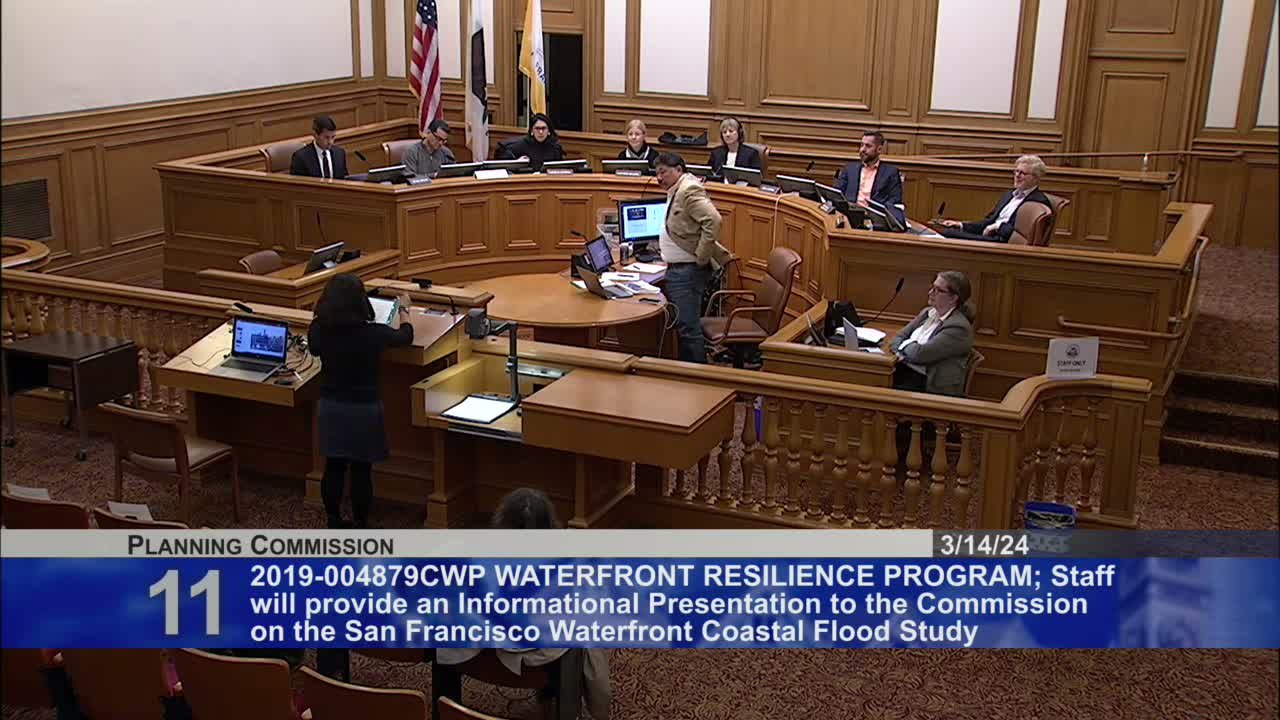
SAN FRANCISCO — Port and Planning Department staff on March 14 briefed the San Francisco Planning Commission on the draft Coastal Waterfront Flood Study, a joint Port–U.S. Army Corps of Engineers feasibility analysis that proposes a phased program of seawalls, elevated wharves, levees and nature-based features to protect 7.5 miles of the city’s eastern shoreline.
Adam Barrett, deputy program manager for the Port’s Waterfront Resilience Program, told commissioners the draft plan identifies "an initial proposal that is estimated to cost $13,500,000,000," and said "the Federal Government would pay up to 65% of this cost" only if Congress authorizes and appropriates funding. Barrett characterized the estimate as a high-level, class‑5 figure that will change as detailed design work proceeds.
Barrett said modeling indicates the city could see as many as 500 structures vulnerable to coastal flooding by midcentury and, under longer-term scenarios, "up to $23,000,000,000 in damages in today's dollars" by the end of the study period (2140). He described the draft as a feasibility plan to guide future pre‑construction engineering and design, not a final design package.
The draft lays out different strategies by reach: limited floodproofing of specific buildings in Fisherman’s Wharf; elevating the Embarcadero shoreline and wharves to defend against as much as 3.5 feet of sea level rise; lower initial defenses and berms in South Beach and Mission Bay, with potential later raises; and berms, levees and nature-based features in the Bayview/Islais Creek area. Barrett said the plan anticipates phased construction across multiple decades.
Danielle Ngo, a senior planner in the Planning Department, said the city and Port are compiling a city comment letter to submit to the Army Corps as part of the NEPA process and noted the formal public comment period for the draft report and environmental review closes March 29. Barrett recommended that formal comments be filed through the Port’s public comment portal at sfport.com/wrp.
Commissioners and public speakers pressed Port staff on several issues that remain unresolved in the draft. Barrett acknowledged contamination risks in southern waterfront neighborhoods and described contamination assessment work the Port has begun. He told the commission the Army Corps will not fund contamination cleanup as part of the Corps’ contribution — "any contamination cleanup remediation is a 100% non‑federal cost to the project," he said — and that remediation funding and liability questions remain an important risk to be addressed.
Commissioners asked about funding and process: whether the federal share is realistic, how cost overruns would be handled and how the city could preserve flexibility without triggering recirculation of NEPA materials. Barrett said congressional authorization through the Water Resources Development Act and phased appropriations would be required, that local (nonfederal) funding could include state, local and private sources, and that the team is trying to balance incorporating local priorities now while avoiding changes that would require full recirculation.
Commissioners emphasized equity, historic preservation and coordination with other infrastructure projects. The draft includes an equity evaluation framework and engagement targeted at southeastern communities, Barrett said. He also pointed to the need to comply with Section 106 of the National Historic Preservation Act for historic districts in the study area and to avoid or mitigate demolition of historic assets where possible.
Next steps: the Port and Army Corps will accept formal NEPA comments through March 29; the city plans to finalize a local sponsor letter and a final report is anticipated in late 2025. If Congress acts, authorization and phased appropriations could follow, and the project would progress into pre‑construction engineering and design and then into multi‑decade construction phases.
— Reporting by Danielle Ngo and Adam Barrett at the March 14 Planning Commission briefing. The commission’s staff report and the Port’s draft materials are part of the public record; formal NEPA comments should be submitted to the Army Corps via the Port portal.
Adam Barrett, deputy program manager for the Port’s Waterfront Resilience Program, told commissioners the draft plan identifies "an initial proposal that is estimated to cost $13,500,000,000," and said "the Federal Government would pay up to 65% of this cost" only if Congress authorizes and appropriates funding. Barrett characterized the estimate as a high-level, class‑5 figure that will change as detailed design work proceeds.
Barrett said modeling indicates the city could see as many as 500 structures vulnerable to coastal flooding by midcentury and, under longer-term scenarios, "up to $23,000,000,000 in damages in today's dollars" by the end of the study period (2140). He described the draft as a feasibility plan to guide future pre‑construction engineering and design, not a final design package.
The draft lays out different strategies by reach: limited floodproofing of specific buildings in Fisherman’s Wharf; elevating the Embarcadero shoreline and wharves to defend against as much as 3.5 feet of sea level rise; lower initial defenses and berms in South Beach and Mission Bay, with potential later raises; and berms, levees and nature-based features in the Bayview/Islais Creek area. Barrett said the plan anticipates phased construction across multiple decades.
Danielle Ngo, a senior planner in the Planning Department, said the city and Port are compiling a city comment letter to submit to the Army Corps as part of the NEPA process and noted the formal public comment period for the draft report and environmental review closes March 29. Barrett recommended that formal comments be filed through the Port’s public comment portal at sfport.com/wrp.
Commissioners and public speakers pressed Port staff on several issues that remain unresolved in the draft. Barrett acknowledged contamination risks in southern waterfront neighborhoods and described contamination assessment work the Port has begun. He told the commission the Army Corps will not fund contamination cleanup as part of the Corps’ contribution — "any contamination cleanup remediation is a 100% non‑federal cost to the project," he said — and that remediation funding and liability questions remain an important risk to be addressed.
Commissioners asked about funding and process: whether the federal share is realistic, how cost overruns would be handled and how the city could preserve flexibility without triggering recirculation of NEPA materials. Barrett said congressional authorization through the Water Resources Development Act and phased appropriations would be required, that local (nonfederal) funding could include state, local and private sources, and that the team is trying to balance incorporating local priorities now while avoiding changes that would require full recirculation.
Commissioners emphasized equity, historic preservation and coordination with other infrastructure projects. The draft includes an equity evaluation framework and engagement targeted at southeastern communities, Barrett said. He also pointed to the need to comply with Section 106 of the National Historic Preservation Act for historic districts in the study area and to avoid or mitigate demolition of historic assets where possible.
Next steps: the Port and Army Corps will accept formal NEPA comments through March 29; the city plans to finalize a local sponsor letter and a final report is anticipated in late 2025. If Congress acts, authorization and phased appropriations could follow, and the project would progress into pre‑construction engineering and design and then into multi‑decade construction phases.
— Reporting by Danielle Ngo and Adam Barrett at the March 14 Planning Commission briefing. The commission’s staff report and the Port’s draft materials are part of the public record; formal NEPA comments should be submitted to the Army Corps via the Port portal.
View the Full Meeting & All Its Details
This article offers just a summary. Unlock complete video, transcripts, and insights as a Founder Member.
✓
Watch full, unedited meeting videos
✓
Search every word spoken in unlimited transcripts
✓
AI summaries & real-time alerts (all government levels)
✓
Permanent access to expanding government content
30-day money-back guarantee
