Planning Commission deadlocks on Peskin form‑based density amendments after hours of testimony
May 23, 2024 | San Francisco City, San Francisco County, California
This article was created by AI summarizing key points discussed. AI makes mistakes, so for full details and context, please refer to the video of the full meeting. Please report any errors so we can fix them. Report an error »
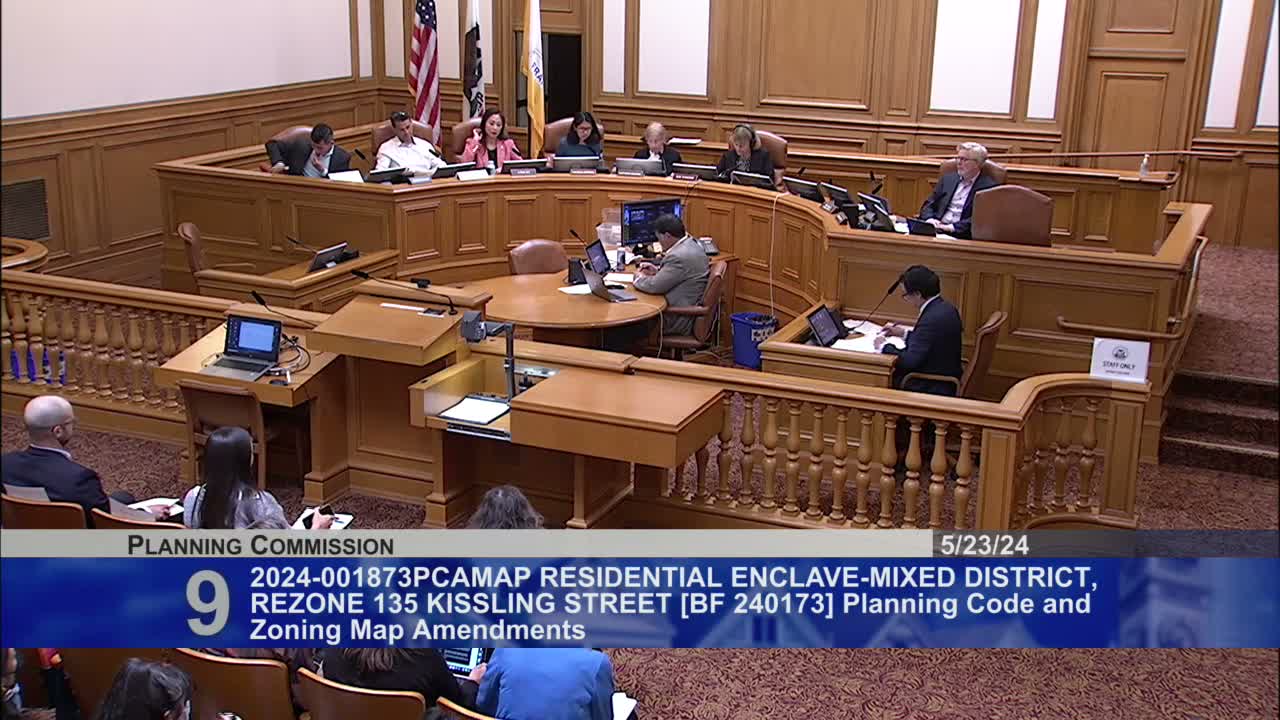
The San Francisco Planning Commission spent much of its May 23 meeting debating whether to adopt Supervisor Aaron Peskin’s amendments to allow form‑based density exceptions on selected neighborhood commercial corridors and to condition use on rent control or inclusionary requirements.
Planning Department staff summarized the ordinance, which would let some parcels opt into form‑based density as an exception to numeric density limits if the developer either dedicates the additional units to rent control or meets local inclusionary requirements. The staff also proposed a modification capping height increases at 50% when combined with state density bonuses and recommended ways to avoid splitting neighborhood commercial districts between numeric and form‑based approaches.
The issue drew an extensive public‑comment record. Representative speakers from neighborhood groups, tenant coalitions and housing advocates urged the commission to either reject piecemeal up‑zoning or insist on stronger tenant and small‑business protections. Supporters of Peskin’s changes said the amendments secure rent control on newly created units as a way to protect tenants while still enabling modest increases in housing capacity.
Commissioners pressed staff and witnesses on technical points: how form‑based density interacts with the state density bonus, how replacement or rent‑control obligations would be tracked, and whether the proposed local bonus would be attractive enough to developers to avoid a state‑density‑bonus path. Planning staff explained examples showing how unit counts and heights would differ under numeric controls, local bonuses and state bonuses and reiterated that implementation details, including a potential registry to track rent‑controlled units, remain in development.
After extended discussion and several motions, a vote on a motion to approve Supervisor Peskin’s amendments resulted in a 3–3 split. Because an affirmative majority is required for approval, the commission did not approve the amendments; staff noted that inaction would be treated as a disapproval and the item will be revisited in the context of the broader housing‑element rezoning work.
The debate underscored competing goals for the city’s rezoning work: increasing housing production to satisfy RHNA targets while protecting rent‑controlled units, neighborhood‑serving retail and the character of commercial corridors. Commissioners repeatedly asked for more district‑level economic and displacement analyses before taking final action.
Next steps: the commission and planning staff said further briefings on the housing element rezoning will follow, and commissioners signaled they expect more analysis and community engagement before approving changes of this scale.
Planning Department staff summarized the ordinance, which would let some parcels opt into form‑based density as an exception to numeric density limits if the developer either dedicates the additional units to rent control or meets local inclusionary requirements. The staff also proposed a modification capping height increases at 50% when combined with state density bonuses and recommended ways to avoid splitting neighborhood commercial districts between numeric and form‑based approaches.
The issue drew an extensive public‑comment record. Representative speakers from neighborhood groups, tenant coalitions and housing advocates urged the commission to either reject piecemeal up‑zoning or insist on stronger tenant and small‑business protections. Supporters of Peskin’s changes said the amendments secure rent control on newly created units as a way to protect tenants while still enabling modest increases in housing capacity.
Commissioners pressed staff and witnesses on technical points: how form‑based density interacts with the state density bonus, how replacement or rent‑control obligations would be tracked, and whether the proposed local bonus would be attractive enough to developers to avoid a state‑density‑bonus path. Planning staff explained examples showing how unit counts and heights would differ under numeric controls, local bonuses and state bonuses and reiterated that implementation details, including a potential registry to track rent‑controlled units, remain in development.
After extended discussion and several motions, a vote on a motion to approve Supervisor Peskin’s amendments resulted in a 3–3 split. Because an affirmative majority is required for approval, the commission did not approve the amendments; staff noted that inaction would be treated as a disapproval and the item will be revisited in the context of the broader housing‑element rezoning work.
The debate underscored competing goals for the city’s rezoning work: increasing housing production to satisfy RHNA targets while protecting rent‑controlled units, neighborhood‑serving retail and the character of commercial corridors. Commissioners repeatedly asked for more district‑level economic and displacement analyses before taking final action.
Next steps: the commission and planning staff said further briefings on the housing element rezoning will follow, and commissioners signaled they expect more analysis and community engagement before approving changes of this scale.
Don't Miss a Word: See the Full Meeting!
Go beyond summaries. Unlock every video, transcript, and key insight with a Founder Membership.
✓
Get instant access to full meeting videos
✓
Search and clip any phrase from complete transcripts
✓
Receive AI-powered summaries & custom alerts
✓
Enjoy lifetime, unrestricted access to government data
30-day money-back guarantee
