Commission approves conversion at 1256 Howard after neighbors’ privacy concerns; developer reduces plan to three units
April 25, 2024 | San Francisco City, San Francisco County, California
This article was created by AI summarizing key points discussed. AI makes mistakes, so for full details and context, please refer to the video of the full meeting. Please report any errors so we can fix them. Report an error »
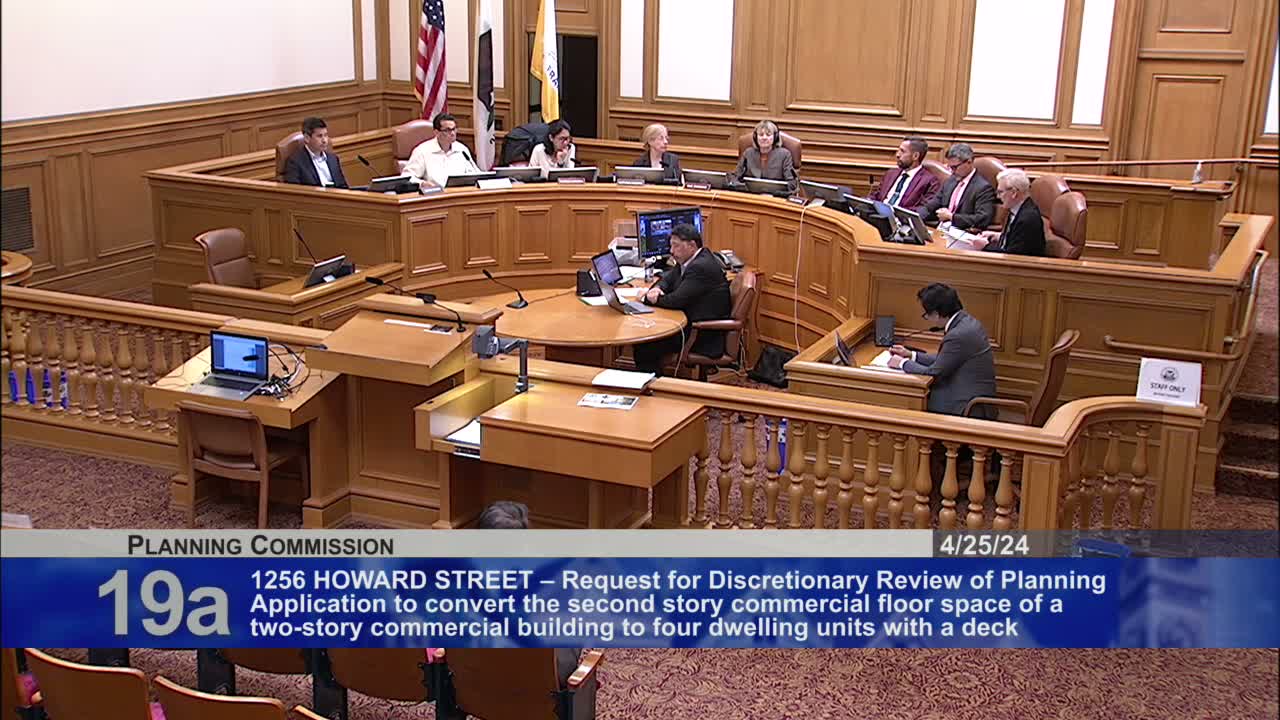
San Francisco — The Planning Commission on April 25 approved a discretionary review and associated variances for a second‑floor office‑to‑residential conversion at 1256 Howard Street, after the applicant reduced the proposal and agreed to additional privacy measures requested by neighbors and commissioners.
Staff and neighbors: Staff architect David Winslow described the project as a public‑initiated conversion that would add residential units in a historic, tightly built Western SoMa block. Neighbors Nicole Radov (Neighbors on Natoma Street) and Ferris Kayali testified that the proposed rear open space and deck would reduce privacy, increase noise risk, and could create security concerns for adjacent properties.
Applicant revision and mitigation: Applicant counsel Justin Zucker said the market context favors modest, financially feasible conversions and proposed to reduce the plan from four units to three private units with three separate rear patios. The applicant agreed to privacy screening, higher internal partitions and guardrails, and to configure the patios so that bedrooms would not directly open onto common terraces.
Zoning and staff clarifications: The zoning administrator explained that roof decks in the Western SoMa special‑use district do not count toward required usable open space and that a six‑foot privacy screen is permitted at the rear; staff discussed options to maintain exposure and separation while respecting the building’s historic envelope. Commissioners and staff discussed whether removing an eight‑foot rear projection could create a code‑compliant four‑unit layout but also noted potential historic‑preservation and demolition costs.
Outcome and conditions: The commission voted to take discretionary review (Doctor) and approve the three‑unit configuration with three separate private rear decks, 5‑ft setbacks, internal privacy partitions (6‑ft where needed to protect bedrooms), and related plan‑note conditions; vote was unanimous, 6–0. The zoning administrator closed the public hearing on the variance and noted he was generally supportive while remaining mindful of light impacts from internal 6‑ft walls.
What happens next: The applicant must finalize design details and comply with building‑code, historic‑preservation and DBI requirements before permits are issued.
Staff and neighbors: Staff architect David Winslow described the project as a public‑initiated conversion that would add residential units in a historic, tightly built Western SoMa block. Neighbors Nicole Radov (Neighbors on Natoma Street) and Ferris Kayali testified that the proposed rear open space and deck would reduce privacy, increase noise risk, and could create security concerns for adjacent properties.
Applicant revision and mitigation: Applicant counsel Justin Zucker said the market context favors modest, financially feasible conversions and proposed to reduce the plan from four units to three private units with three separate rear patios. The applicant agreed to privacy screening, higher internal partitions and guardrails, and to configure the patios so that bedrooms would not directly open onto common terraces.
Zoning and staff clarifications: The zoning administrator explained that roof decks in the Western SoMa special‑use district do not count toward required usable open space and that a six‑foot privacy screen is permitted at the rear; staff discussed options to maintain exposure and separation while respecting the building’s historic envelope. Commissioners and staff discussed whether removing an eight‑foot rear projection could create a code‑compliant four‑unit layout but also noted potential historic‑preservation and demolition costs.
Outcome and conditions: The commission voted to take discretionary review (Doctor) and approve the three‑unit configuration with three separate private rear decks, 5‑ft setbacks, internal privacy partitions (6‑ft where needed to protect bedrooms), and related plan‑note conditions; vote was unanimous, 6–0. The zoning administrator closed the public hearing on the variance and noted he was generally supportive while remaining mindful of light impacts from internal 6‑ft walls.
What happens next: The applicant must finalize design details and comply with building‑code, historic‑preservation and DBI requirements before permits are issued.
Don't Miss a Word: See the Full Meeting!
Go beyond summaries. Unlock every video, transcript, and key insight with a Founder Membership.
✓
Get instant access to full meeting videos
✓
Search and clip any phrase from complete transcripts
✓
Receive AI-powered summaries & custom alerts
✓
Enjoy lifetime, unrestricted access to government data
30-day money-back guarantee
