San Francisco releases first Aging and Disability Affordable Housing Needs Assessment; city officials outline steps to expand subsidies and accessibility
February 17, 2023 | San Francisco City, San Francisco County, California
This article was created by AI summarizing key points discussed. AI makes mistakes, so for full details and context, please refer to the video of the full meeting. Please report any errors so we can fix them. Report an error »
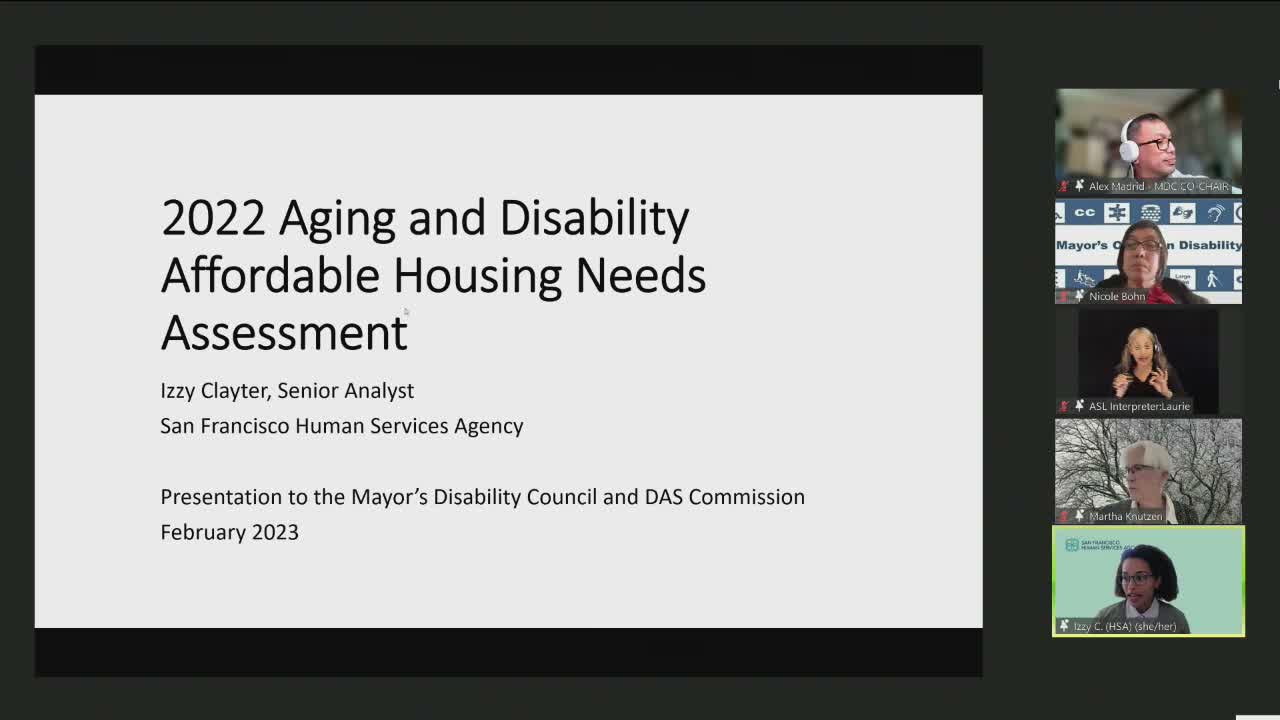
San Francisco staff on the interdepartmental steering committee presented the city’s first Aging and Disability Affordable Housing Needs Assessment, telling the Mayor’s Disability Council and the Disability and Aging Commission that the city lacks sufficient affordable and accessible housing for low‑income older adults and adults with disabilities. “There is not enough affordable and accessible housing for low‑income adults with disabilities and seniors,” said Izzy Quater, senior planning analyst with the Human Services Agency, during the presentation.
The report, mandated by a Board of Supervisors ordinance passed in December 2020, drew on agency data, interviews, community forums and two surveys that reached more than 1,200 participants. Staff summarized 10 findings and more than 40 recommendations but highlighted four main problems for the meeting: a shortage of affordable accessible units, heavy rent burden among lower‑income disabled and senior renters, inadequate on‑site accessibility features in older buildings, and siloed city programs and data that hinder coordinated responses.
Why it matters: The assessment shows a high rent burden and a mismatch between available senior-designated units and what low‑income seniors can afford without subsidies. Presenters said tenant‑based and project‑based operating subsidies are critical to make existing and pipeline housing affordable for deeply low‑income households. The report also recommended formalizing and training staff on a consistent reasonable‑modification process and exploring subsidies or incentives to fund long‑term building accessibility upgrades.
City response and next steps: Departments on the steering committee outlined implementation actions. The Department of Disability & Aging Services (DAS) said it will transition from report convener to implementation planning; DAS and partners plan briefings for supervisors and an anticipated hearing with the Board of Supervisors’ committee on public safety and neighborhood services. City Planning said it will fund a one‑year senior and disability housing planner to develop an implementation plan and an interagency implementation team is being formed to track housing targets. The Mayor’s Office of Housing and Community Development (MOHCD) said it has implemented placement procedures and will launch trainings this spring for waitlist management and reasonable‑accommodation processes.
Public reaction: Several public speakers urged faster, deeper action. Kathy Lipscomb of Senior and Disability Action said she feared the report would “just find a shelf” unless officials secure funding; she called out a figure mentioned in the meeting that only about 27 pipeline units are explicitly designated by funding as disability‑restricted and said that number is unacceptable. HSA’s Izzy Quater clarified that the small “27” figure refers to units that are formally designated by certain funding rules and does not represent the total number of accessible units in the pipeline.
What remains open: Presenters and advocates agreed the city needs clearer data on the current inventory of accessible units and a stable funding source for both tenant‑based rental assistance and project operating subsidies targeted to seniors and people with disabilities. Staff noted the potential to align future needs‑assessment timing with the city’s housing element cycle to coordinate policy and funding work.
The steering committee asked stakeholders to consolidate feedback and promised follow‑up briefings and materials; no formal votes or legislative actions were taken at the meeting. The council set next steps that include an upcoming Board committee hearing and interagency implementation planning.
The report, mandated by a Board of Supervisors ordinance passed in December 2020, drew on agency data, interviews, community forums and two surveys that reached more than 1,200 participants. Staff summarized 10 findings and more than 40 recommendations but highlighted four main problems for the meeting: a shortage of affordable accessible units, heavy rent burden among lower‑income disabled and senior renters, inadequate on‑site accessibility features in older buildings, and siloed city programs and data that hinder coordinated responses.
Why it matters: The assessment shows a high rent burden and a mismatch between available senior-designated units and what low‑income seniors can afford without subsidies. Presenters said tenant‑based and project‑based operating subsidies are critical to make existing and pipeline housing affordable for deeply low‑income households. The report also recommended formalizing and training staff on a consistent reasonable‑modification process and exploring subsidies or incentives to fund long‑term building accessibility upgrades.
City response and next steps: Departments on the steering committee outlined implementation actions. The Department of Disability & Aging Services (DAS) said it will transition from report convener to implementation planning; DAS and partners plan briefings for supervisors and an anticipated hearing with the Board of Supervisors’ committee on public safety and neighborhood services. City Planning said it will fund a one‑year senior and disability housing planner to develop an implementation plan and an interagency implementation team is being formed to track housing targets. The Mayor’s Office of Housing and Community Development (MOHCD) said it has implemented placement procedures and will launch trainings this spring for waitlist management and reasonable‑accommodation processes.
Public reaction: Several public speakers urged faster, deeper action. Kathy Lipscomb of Senior and Disability Action said she feared the report would “just find a shelf” unless officials secure funding; she called out a figure mentioned in the meeting that only about 27 pipeline units are explicitly designated by funding as disability‑restricted and said that number is unacceptable. HSA’s Izzy Quater clarified that the small “27” figure refers to units that are formally designated by certain funding rules and does not represent the total number of accessible units in the pipeline.
What remains open: Presenters and advocates agreed the city needs clearer data on the current inventory of accessible units and a stable funding source for both tenant‑based rental assistance and project operating subsidies targeted to seniors and people with disabilities. Staff noted the potential to align future needs‑assessment timing with the city’s housing element cycle to coordinate policy and funding work.
The steering committee asked stakeholders to consolidate feedback and promised follow‑up briefings and materials; no formal votes or legislative actions were taken at the meeting. The council set next steps that include an upcoming Board committee hearing and interagency implementation planning.
Don't Miss a Word: See the Full Meeting!
Go beyond summaries. Unlock every video, transcript, and key insight with a Founder Membership.
✓
Get instant access to full meeting videos
✓
Search and clip any phrase from complete transcripts
✓
Receive AI-powered summaries & custom alerts
✓
Enjoy lifetime, unrestricted access to government data
30-day money-back guarantee
