Mayor’s housing office lays out recommendations to scale affordable production as funding tightens
February 29, 2024 | San Francisco City, San Francisco County, California
This article was created by AI summarizing key points discussed. AI makes mistakes, so for full details and context, please refer to the video of the full meeting. Please report any errors so we can fix them. Report an error »
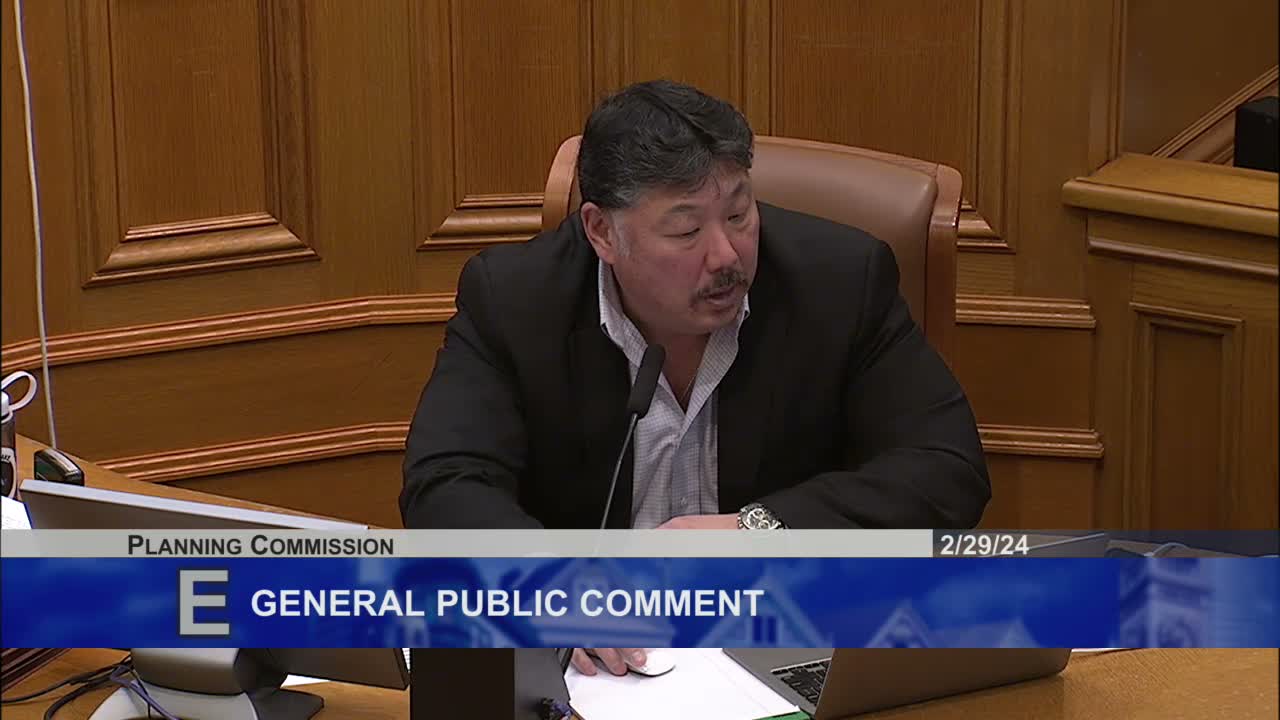
Dan Adams, director of the Mayor’s Office of Housing and Community Development, presented the Affordable Housing Leadership Council’s recommendations to the San Francisco Planning Commission on Feb. 29, describing a suite of strategies the city should pursue to increase production of very low-, low- and moderate‑income housing.
Adams said the council framed its work around a sharp increase in production goals set by the regional housing needs allocation. “This would represent sort of a fivefold increase in housing production,” he said, and added that San Francisco cannot meet the target without state and federal matches and regional cooperation. He warned that some local funding sources are declining and that the city’s pipeline depends on leveraging outside dollars.
The report grouped about 50 recommendations under three themes: (1) advocate for more resources at the state and federal levels and pursue regional bonds; (2) improve internal city processes and seek new, more reliable local revenue; and (3) pilot innovative programmatic ideas, including moderate‑income housing models that require less subsidy.
Planning staff and members of the public urged clearer implementation milestones. A speaker representing housing advocates said the report “lacks a sense of urgency and a clear set of benchmarks” and urged a plan for land acquisition and an annual affordable‑housing allocation in the city budget. Commissioner questions focused on insurance costs for nonprofits, timing of state funding cycles, and whether the proposed fee reductions and incentives would materially increase production.
Adams said the city is pursuing a range of options — from using infrastructure finance districts to exploring revolving loan funds — and flagged regional efforts, including a proposed Bay Area Housing Finance Agency bond that could generate “substantial resources” for the city. He also noted advocacy aims such as ACA 1 to lower thresholds for passing local bonds.
The commission did not take an action to adopt the recommendations that day; commissioners requested additional follow‑up briefings on implementation sequencing, potential budget effects if a March bond does not pass, and coordination between planning, the mayor’s housing office and other agencies.
Next steps: staff said they will return with implementation prioritization and follow‑up briefings in the coming weeks.
Adams said the council framed its work around a sharp increase in production goals set by the regional housing needs allocation. “This would represent sort of a fivefold increase in housing production,” he said, and added that San Francisco cannot meet the target without state and federal matches and regional cooperation. He warned that some local funding sources are declining and that the city’s pipeline depends on leveraging outside dollars.
The report grouped about 50 recommendations under three themes: (1) advocate for more resources at the state and federal levels and pursue regional bonds; (2) improve internal city processes and seek new, more reliable local revenue; and (3) pilot innovative programmatic ideas, including moderate‑income housing models that require less subsidy.
Planning staff and members of the public urged clearer implementation milestones. A speaker representing housing advocates said the report “lacks a sense of urgency and a clear set of benchmarks” and urged a plan for land acquisition and an annual affordable‑housing allocation in the city budget. Commissioner questions focused on insurance costs for nonprofits, timing of state funding cycles, and whether the proposed fee reductions and incentives would materially increase production.
Adams said the city is pursuing a range of options — from using infrastructure finance districts to exploring revolving loan funds — and flagged regional efforts, including a proposed Bay Area Housing Finance Agency bond that could generate “substantial resources” for the city. He also noted advocacy aims such as ACA 1 to lower thresholds for passing local bonds.
The commission did not take an action to adopt the recommendations that day; commissioners requested additional follow‑up briefings on implementation sequencing, potential budget effects if a March bond does not pass, and coordination between planning, the mayor’s housing office and other agencies.
Next steps: staff said they will return with implementation prioritization and follow‑up briefings in the coming weeks.
View the Full Meeting & All Its Details
This article offers just a summary. Unlock complete video, transcripts, and insights as a Founder Member.
✓
Watch full, unedited meeting videos
✓
Search every word spoken in unlimited transcripts
✓
AI summaries & real-time alerts (all government levels)
✓
Permanent access to expanding government content
30-day money-back guarantee
