Board ratifies MOU with teachers' union to bring secondary focal students back; parents and educators warn of transportation and special-education gaps
April 20, 2021 | San Francisco City, San Francisco County, California
This article was created by AI summarizing key points discussed. AI makes mistakes, so for full details and context, please refer to the video of the full meeting. Please report any errors so we can fix them. Report an error »
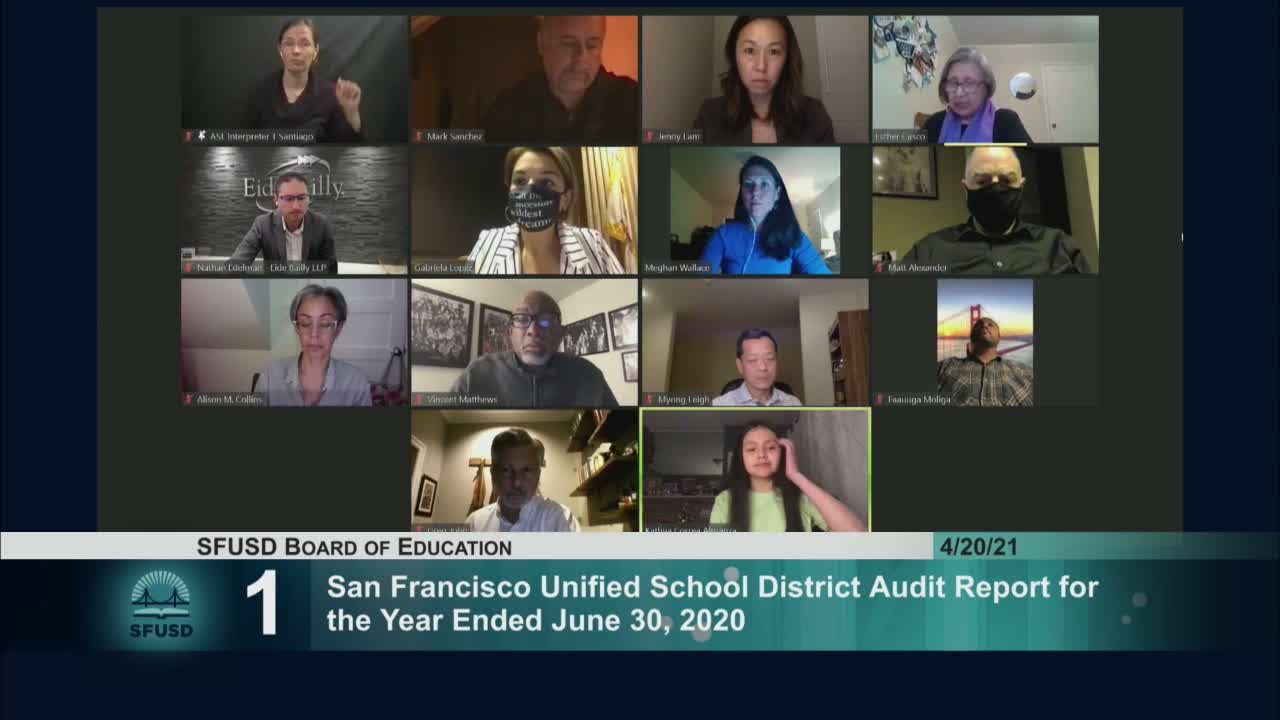
The San Francisco Board of Education ratified a tentative agreement with United Educators of San Francisco (UESF) to bring prioritized secondary students back to campus.
Under the MOU the district will prioritize students in designated focal groups and special-day-class students. Deputy Superintendent Anikia Ford-Martell said the plan schedules secondary focal students to return April 26: roughly 1,900 students across 26 sites, with about 258 classrooms prepared. The district described two instructional models: a "self-contained" model (home-school, five days a week for some SDC students) and a "blended" model in which students attend the host school and receive live instruction from their teachers via technology while an in-person support adult provides assistance in the classroom.
Labor negotiators and the Board emphasized accommodations for staff at higher risk of severe COVID illness and the use of substitutes, central-office deployments and other temporary coverage to staff returning sites. Chief HR Officer Daniel Meneses reported the district had issued thousands of staff testing kits and set up regular staff testing and that about 3,600 employees had self-reported vaccination status; the district is continuing substitute recruitment and said it expects to need roughly 130 substitute teachers and 130 substitute paraeducators to cover combined reopenings.
Public commenters—including teachers, special-education professionals, parents and advocates—praised the MOU but repeatedly warned of operational gaps. They identified recurring problems: transportation schedules that drop students off after classes start, short staffing of substitute and paraeducator positions, and the need to ensure IEP services (including timely translated IEP documents and sufficient meeting time when interpretation is required). Several speakers asked the district to run site-by-site checks to ensure transportation and classroom coverage would preserve students' access to services.
Superintendent Vincent Matthews said staff will review about 300 secondary students who have IEP-written transportation to identify schedule conflicts and fix issues; he also committed to follow-up on implementation details and to provide further updates. The board voted to ratify the agreement by roll call.
Under the MOU the district will prioritize students in designated focal groups and special-day-class students. Deputy Superintendent Anikia Ford-Martell said the plan schedules secondary focal students to return April 26: roughly 1,900 students across 26 sites, with about 258 classrooms prepared. The district described two instructional models: a "self-contained" model (home-school, five days a week for some SDC students) and a "blended" model in which students attend the host school and receive live instruction from their teachers via technology while an in-person support adult provides assistance in the classroom.
Labor negotiators and the Board emphasized accommodations for staff at higher risk of severe COVID illness and the use of substitutes, central-office deployments and other temporary coverage to staff returning sites. Chief HR Officer Daniel Meneses reported the district had issued thousands of staff testing kits and set up regular staff testing and that about 3,600 employees had self-reported vaccination status; the district is continuing substitute recruitment and said it expects to need roughly 130 substitute teachers and 130 substitute paraeducators to cover combined reopenings.
Public commenters—including teachers, special-education professionals, parents and advocates—praised the MOU but repeatedly warned of operational gaps. They identified recurring problems: transportation schedules that drop students off after classes start, short staffing of substitute and paraeducator positions, and the need to ensure IEP services (including timely translated IEP documents and sufficient meeting time when interpretation is required). Several speakers asked the district to run site-by-site checks to ensure transportation and classroom coverage would preserve students' access to services.
Superintendent Vincent Matthews said staff will review about 300 secondary students who have IEP-written transportation to identify schedule conflicts and fix issues; he also committed to follow-up on implementation details and to provide further updates. The board voted to ratify the agreement by roll call.
View the Full Meeting & All Its Details
This article offers just a summary. Unlock complete video, transcripts, and insights as a Founder Member.
✓
Watch full, unedited meeting videos
✓
Search every word spoken in unlimited transcripts
✓
AI summaries & real-time alerts (all government levels)
✓
Permanent access to expanding government content
30-day money-back guarantee
