SFUSD budget plan prompts heated debate as board weighs $35M revenue moves and $90M in cuts
November 09, 2021 | San Francisco City, San Francisco County, California
This article was created by AI summarizing key points discussed. AI makes mistakes, so for full details and context, please refer to the video of the full meeting. Please report any errors so we can fix them. Report an error »
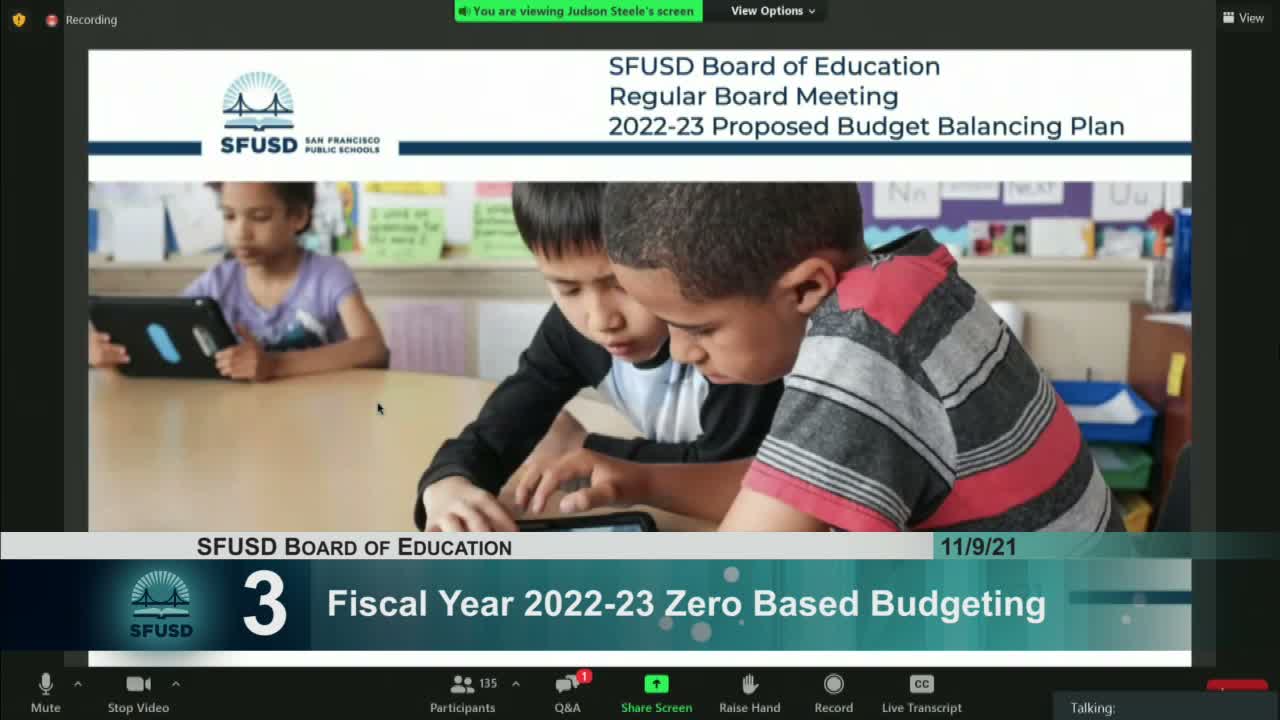
San Francisco Unified School District finance staff presented a detailed 0-based budgeting review and a draft balancing approach on Nov. 9 that would combine one-time revenue moves and new grants with sizable reductions to balance the FY22-23 budget.
Chief Financial Officer Megan Wallace and Executive Director Anne Marie Gordon summarized analysis showing SFUSD operates on thin reserves (near the 2% minimum), spends more on salaries and benefits per average daily attendance than many Bay Area peers, and has a lower student-to-adult ratio than comparable districts. Gordon said staff used a 0-based inventory of services to estimate where reductions could be found and outlined a high-level proposal that includes:
- $35 million in FY22-23 revenue solutions: $20 million of existing fund balance, $5 million drawn from the child-development fund, a near-term reclassification of ~ $3 million in expenses onto the Expanded Learning Opportunities (ELO) grant, and a proposed $3 million shift onto a new Educator Effectiveness Block Grant.
- Proposed reductions that, combined with other measures, would address the district'a's structural deficit (discussion cited a target in the range of $90 million in service reductions or reassignments over the budget horizon).
Staff noted the $35 million relies partly on one-time sources and stressed the need to find recurring savings and to secure current-year savings that can be carried forward to 23-24. A budget town hall for community input was scheduled for Nov. 30.
Board reaction: Commissioners vigorously questioned the allocation of cuts between central-office functions and school-site budgets. Several board members requested site-level modeling that shows how baseline allocations and common services would change under different reduction scenarios. Commissioner Alexander and others cited comparative data from other districts (Long Beach) and asked staff to provide more granular org-chart and position-level comparisons.
Deputy Superintendent and staff emphasized that certain central functions have already been reduced and that some areas are at minimal operational capacity. Fiscal expert(s) working with the district (an external advisor) said the state expects a board-endorsed interim balancing framework in mid-December; staff must then work through a more detailed implementation and the statutory layoff-notice timetable in early spring if reductions include affected positions.
Public commenters (teachers, union representatives and UESF leaders) urged protecting direct student services (social workers, nurses, paraprofessionals) and said that deep cuts to school-site staffing would harm students.
Next steps: Staff will return with more granular proposals in committee meetings leading up to a board vote on a stabilization plan (deadline mid-December); commissioners signaled they will prepare alternative allocations for consideration.
Chief Financial Officer Megan Wallace and Executive Director Anne Marie Gordon summarized analysis showing SFUSD operates on thin reserves (near the 2% minimum), spends more on salaries and benefits per average daily attendance than many Bay Area peers, and has a lower student-to-adult ratio than comparable districts. Gordon said staff used a 0-based inventory of services to estimate where reductions could be found and outlined a high-level proposal that includes:
- $35 million in FY22-23 revenue solutions: $20 million of existing fund balance, $5 million drawn from the child-development fund, a near-term reclassification of ~ $3 million in expenses onto the Expanded Learning Opportunities (ELO) grant, and a proposed $3 million shift onto a new Educator Effectiveness Block Grant.
- Proposed reductions that, combined with other measures, would address the district'a's structural deficit (discussion cited a target in the range of $90 million in service reductions or reassignments over the budget horizon).
Staff noted the $35 million relies partly on one-time sources and stressed the need to find recurring savings and to secure current-year savings that can be carried forward to 23-24. A budget town hall for community input was scheduled for Nov. 30.
Board reaction: Commissioners vigorously questioned the allocation of cuts between central-office functions and school-site budgets. Several board members requested site-level modeling that shows how baseline allocations and common services would change under different reduction scenarios. Commissioner Alexander and others cited comparative data from other districts (Long Beach) and asked staff to provide more granular org-chart and position-level comparisons.
Deputy Superintendent and staff emphasized that certain central functions have already been reduced and that some areas are at minimal operational capacity. Fiscal expert(s) working with the district (an external advisor) said the state expects a board-endorsed interim balancing framework in mid-December; staff must then work through a more detailed implementation and the statutory layoff-notice timetable in early spring if reductions include affected positions.
Public commenters (teachers, union representatives and UESF leaders) urged protecting direct student services (social workers, nurses, paraprofessionals) and said that deep cuts to school-site staffing would harm students.
Next steps: Staff will return with more granular proposals in committee meetings leading up to a board vote on a stabilization plan (deadline mid-December); commissioners signaled they will prepare alternative allocations for consideration.
Don't Miss a Word: See the Full Meeting!
Go beyond summaries. Unlock every video, transcript, and key insight with a Founder Membership.
✓
Get instant access to full meeting videos
✓
Search and clip any phrase from complete transcripts
✓
Receive AI-powered summaries & custom alerts
✓
Enjoy lifetime, unrestricted access to government data
30-day money-back guarantee
