Board rejects resolution to continue all‑virtual meetings beyond March 31
March 08, 2022 | San Francisco City, San Francisco County, California
This article was created by AI summarizing key points discussed. AI makes mistakes, so for full details and context, please refer to the video of the full meeting. Please report any errors so we can fix them. Report an error »
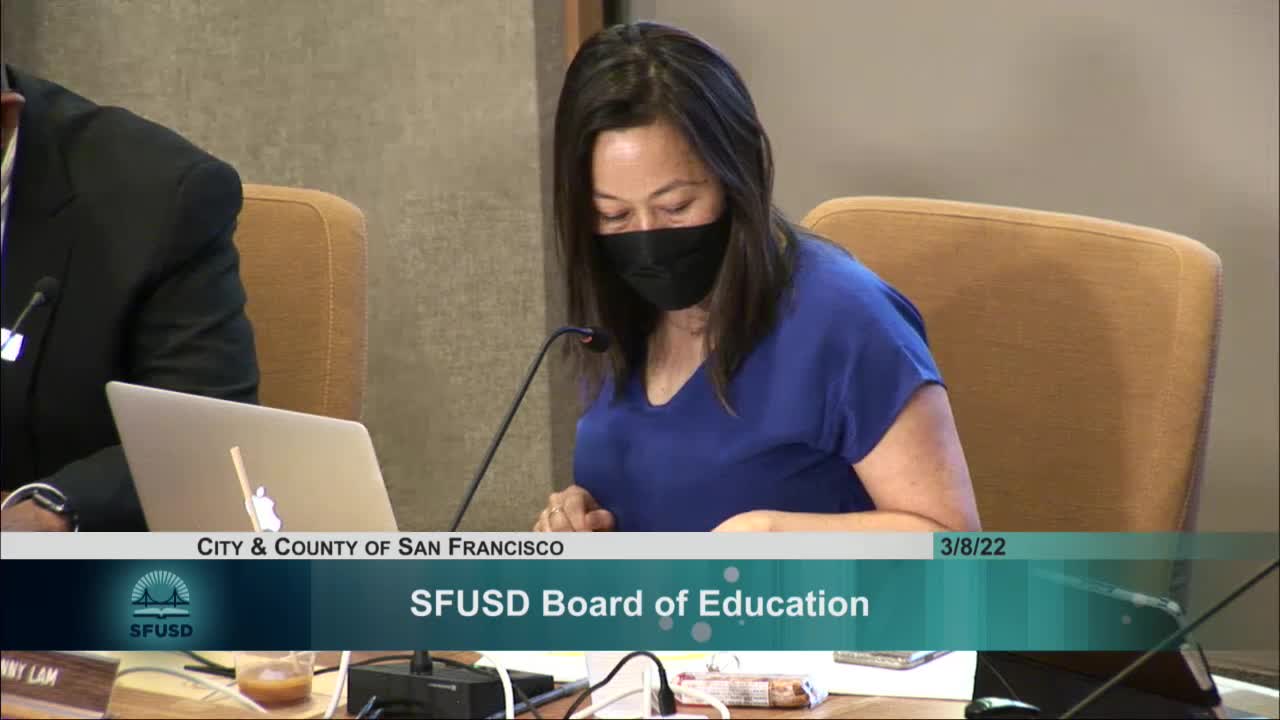
The San Francisco Board of Education on March 8 voted against a resolution that would have continued the board’s authorization to meet fully virtually under the state emergency declaration.
Superintendent Dr. Matthews and legal counsel explained the agenda item was to "consider" whether virtual meetings remained necessary; staff noted the statewide emergency declared by Governor Gavin Newsom on March 4, 2020, expires March 31, and this meeting’s vote would determine only the next meeting’s format. "This item is to determine whether there are virtual meetings or not," the superintendent said, noting any action would be short‑term because the state declaration is scheduled to end on March 31.
Public comment favored keeping at least a hybrid or virtual option to protect people who are immunocompromised and to preserve access for advisory committees and members who cannot attend in person. "This is the only one of the main shining lights to be able to participate," said a caller who identified as disabled and asked the board to keep virtual options.
Board discussion addressed logistics and capacity. Staff said the district can support hybrid models for regular board meetings with its existing technical team, but committee meetings and advisory bodies would require additional staffing and funding to run hybrid public comment reliably. General Counsel noted the Brown Act allows virtual participation by committee members but the board must still design acceptable procedures to allow virtual public comment.
The roll‑call vote on the resolution failed, with the board recording 'No' votes across student delegates and commissioners present. Commissioners asked staff to return with options for hybrid public participation and details about room capacity, spacing and technical support when in‑person meetings resume.
After the vote, staff reiterated that if the resolution was not approved, the board and its advisory committees would return to in‑person meetings as soon as permitted by law and public‑health conditions, and leadership would work on procedures to retain remote observation and potential mechanisms for remote public comment.
Superintendent Dr. Matthews and legal counsel explained the agenda item was to "consider" whether virtual meetings remained necessary; staff noted the statewide emergency declared by Governor Gavin Newsom on March 4, 2020, expires March 31, and this meeting’s vote would determine only the next meeting’s format. "This item is to determine whether there are virtual meetings or not," the superintendent said, noting any action would be short‑term because the state declaration is scheduled to end on March 31.
Public comment favored keeping at least a hybrid or virtual option to protect people who are immunocompromised and to preserve access for advisory committees and members who cannot attend in person. "This is the only one of the main shining lights to be able to participate," said a caller who identified as disabled and asked the board to keep virtual options.
Board discussion addressed logistics and capacity. Staff said the district can support hybrid models for regular board meetings with its existing technical team, but committee meetings and advisory bodies would require additional staffing and funding to run hybrid public comment reliably. General Counsel noted the Brown Act allows virtual participation by committee members but the board must still design acceptable procedures to allow virtual public comment.
The roll‑call vote on the resolution failed, with the board recording 'No' votes across student delegates and commissioners present. Commissioners asked staff to return with options for hybrid public participation and details about room capacity, spacing and technical support when in‑person meetings resume.
After the vote, staff reiterated that if the resolution was not approved, the board and its advisory committees would return to in‑person meetings as soon as permitted by law and public‑health conditions, and leadership would work on procedures to retain remote observation and potential mechanisms for remote public comment.
View the Full Meeting & All Its Details
This article offers just a summary. Unlock complete video, transcripts, and insights as a Founder Member.
✓
Watch full, unedited meeting videos
✓
Search every word spoken in unlimited transcripts
✓
AI summaries & real-time alerts (all government levels)
✓
Permanent access to expanding government content
30-day money-back guarantee
