Board approves UESF tentative agreement and staffing MOU amid fierce public debate over AP funding and layoffs
March 01, 2022 | San Francisco City, San Francisco County, California
This article was created by AI summarizing key points discussed. AI makes mistakes, so for full details and context, please refer to the video of the full meeting. Please report any errors so we can fix them. Report an error »
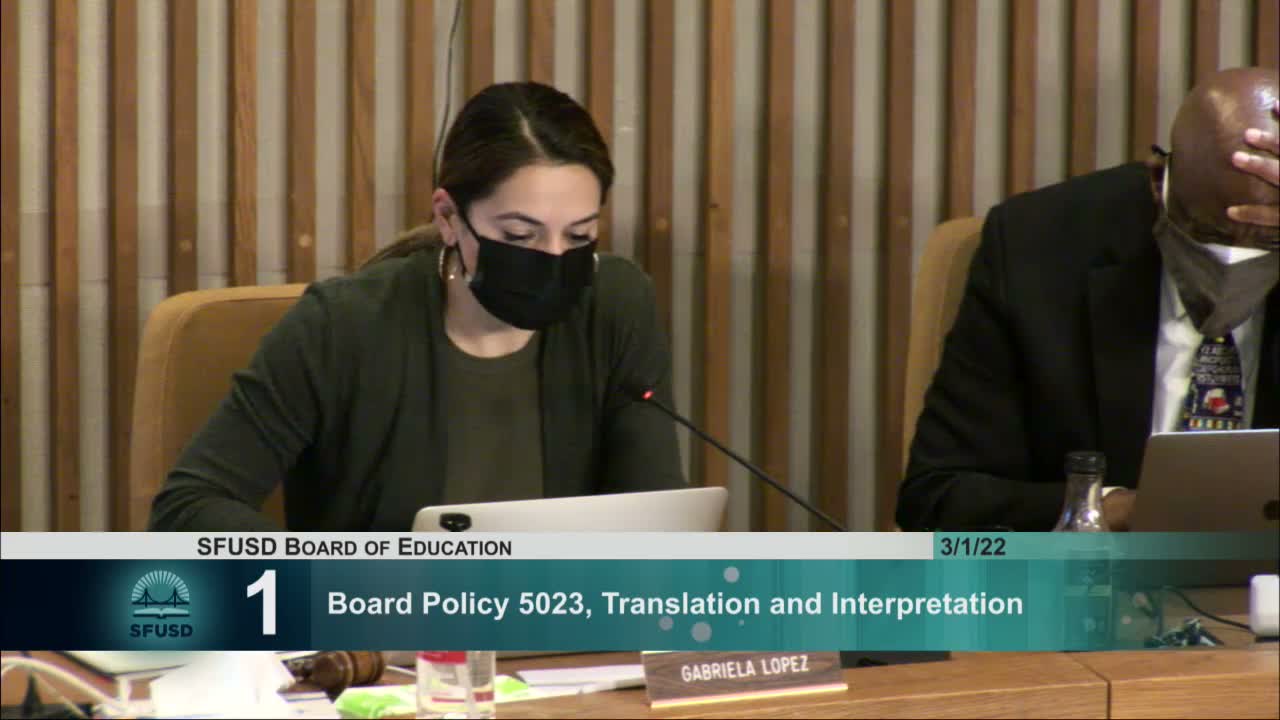
The San Francisco Board of Education voted on March 1 to approve a tentative agreement between the district and United Educators of San Francisco (UESF) and a related staffing stabilization memorandum that change how certain AP prep funds are allocated. Board members cast separate roll‑call votes: the tentative agreement passed and the staffing Memorandum of Understanding passed by recorded majorities.
Superintendent leaders and labor negotiators presented the items as interdependent: the TA shifts funding that previously covered additional preparation periods for AP teachers back into school schedules, a move district officials said would reduce inequitable per‑test funding and free prep periods for classroom instruction. District staff warned, however, that the change would cause consolidations at some high schools. Assistant Superintendent Bill Sanderson and HR staff told the board they were projecting roughly 35–39 position consolidations tied to eliminating the additional AP prep period but said staff were not projecting those consolidations to automatically produce additional layoffs given vacancies, retirements and resignations.
Chief Human Resources Officer Kristen Bijour presented estimates in a later staffing package that showed a worst‑case forecast the district used for particular‑kinds‑of‑service (PKS) layoff notices: up to 150 certificated positions (about 3% of that employee group), up to 47 paraeducator positions (about 4% of that group) and up to 20 administrator positions (about 7% of that group). Bijour said the numbers were precautionary maximums used to meet a March 15 timeline required by state law for preliminary layoff notices; she repeatedly urged the board to approve the resolutions so staff could preserve local control and continue negotiations with labor to reduce impacts.
Public comment occupied many hours. Supporters — including substitute teachers, paraprofessionals and some classroom teachers — said the TA would raise pay for subs and extend bonuses to paraprofessionals and security staff. Opponents, including large numbers of students, teachers and parents from Lowell High School and other campuses, said the TA’s change to AP prep funding would effectively pull $2.6 million from Lowell and other schools and force program and staff cuts; students described losing elective classes, trusted advisors and community programs. “These budget cuts will devastate several relationships between students and teachers,” said a Lowell student testifyin.g
Board members debated alternatives. Several commissioners pushed staff to identify $3.8 million in upper‑management savings that could have spared some paraeducator positions; others said the district had a structural deficit and a legally required timeline and that declines in enrollment made reductions unavoidable. State‑appointed fiscal experts advised the board that failing to act on a credible balancing package risked a state takeover; the experts emphasized the March 15 deadline for the district’s financial reporting and the legal consequences of a growing structural deficit.
On the layoff resolutions that followed, the board approved the certificated reduction resolution and the seniority order and approved administrative reductions. When the board voted on the paraeducator reduction resolution it failed to pass (the roll call recorded a 4–4 tie), meaning that specific paraeducator reductions did not move forward at that time. The board extended the meeting and later recessed to closed session; upon reconvening, it reported a closed‑session action to expel one middle‑school student (the board recorded the vote in open session). The board also approved a language access policy earlier in the meeting.
The combination of approvals and the failed paraeducator motion leaves the district with an approved bargaining package and staffing authorization while an open question remains about the final staffing impact as retirements, resignations and site budgeting are finalized. Staff told the board they would continue to collaborate with UESF and attempt to mitigate impacts, rescind notices where possible and provide updated numbers as the spring staffing process proceeds.
What comes next: staff said they will issue preliminary notices as required by statute, continue bargaining with UESF to avoid final layoffs where possible, engage an external consultant to review central management structure, and return updated staffing and budget information to the board. The board also directed staff to post clearer site‑level data about AP funding discrepancies and to continue outreach to affected school communities.
Superintendent leaders and labor negotiators presented the items as interdependent: the TA shifts funding that previously covered additional preparation periods for AP teachers back into school schedules, a move district officials said would reduce inequitable per‑test funding and free prep periods for classroom instruction. District staff warned, however, that the change would cause consolidations at some high schools. Assistant Superintendent Bill Sanderson and HR staff told the board they were projecting roughly 35–39 position consolidations tied to eliminating the additional AP prep period but said staff were not projecting those consolidations to automatically produce additional layoffs given vacancies, retirements and resignations.
Chief Human Resources Officer Kristen Bijour presented estimates in a later staffing package that showed a worst‑case forecast the district used for particular‑kinds‑of‑service (PKS) layoff notices: up to 150 certificated positions (about 3% of that employee group), up to 47 paraeducator positions (about 4% of that group) and up to 20 administrator positions (about 7% of that group). Bijour said the numbers were precautionary maximums used to meet a March 15 timeline required by state law for preliminary layoff notices; she repeatedly urged the board to approve the resolutions so staff could preserve local control and continue negotiations with labor to reduce impacts.
Public comment occupied many hours. Supporters — including substitute teachers, paraprofessionals and some classroom teachers — said the TA would raise pay for subs and extend bonuses to paraprofessionals and security staff. Opponents, including large numbers of students, teachers and parents from Lowell High School and other campuses, said the TA’s change to AP prep funding would effectively pull $2.6 million from Lowell and other schools and force program and staff cuts; students described losing elective classes, trusted advisors and community programs. “These budget cuts will devastate several relationships between students and teachers,” said a Lowell student testifyin.g
Board members debated alternatives. Several commissioners pushed staff to identify $3.8 million in upper‑management savings that could have spared some paraeducator positions; others said the district had a structural deficit and a legally required timeline and that declines in enrollment made reductions unavoidable. State‑appointed fiscal experts advised the board that failing to act on a credible balancing package risked a state takeover; the experts emphasized the March 15 deadline for the district’s financial reporting and the legal consequences of a growing structural deficit.
On the layoff resolutions that followed, the board approved the certificated reduction resolution and the seniority order and approved administrative reductions. When the board voted on the paraeducator reduction resolution it failed to pass (the roll call recorded a 4–4 tie), meaning that specific paraeducator reductions did not move forward at that time. The board extended the meeting and later recessed to closed session; upon reconvening, it reported a closed‑session action to expel one middle‑school student (the board recorded the vote in open session). The board also approved a language access policy earlier in the meeting.
The combination of approvals and the failed paraeducator motion leaves the district with an approved bargaining package and staffing authorization while an open question remains about the final staffing impact as retirements, resignations and site budgeting are finalized. Staff told the board they would continue to collaborate with UESF and attempt to mitigate impacts, rescind notices where possible and provide updated numbers as the spring staffing process proceeds.
What comes next: staff said they will issue preliminary notices as required by statute, continue bargaining with UESF to avoid final layoffs where possible, engage an external consultant to review central management structure, and return updated staffing and budget information to the board. The board also directed staff to post clearer site‑level data about AP funding discrepancies and to continue outreach to affected school communities.
Don't Miss a Word: See the Full Meeting!
Go beyond summaries. Unlock every video, transcript, and key insight with a Founder Membership.
✓
Get instant access to full meeting videos
✓
Search and clip any phrase from complete transcripts
✓
Receive AI-powered summaries & custom alerts
✓
Enjoy lifetime, unrestricted access to government data
30-day money-back guarantee
