SFUSD outlines $7.5M A–G completion grant plan to boost college‑eligible graduates
March 08, 2022 | San Francisco City, San Francisco County, California
This article was created by AI summarizing key points discussed. AI makes mistakes, so for full details and context, please refer to the video of the full meeting. Please report any errors so we can fix them. Report an error »
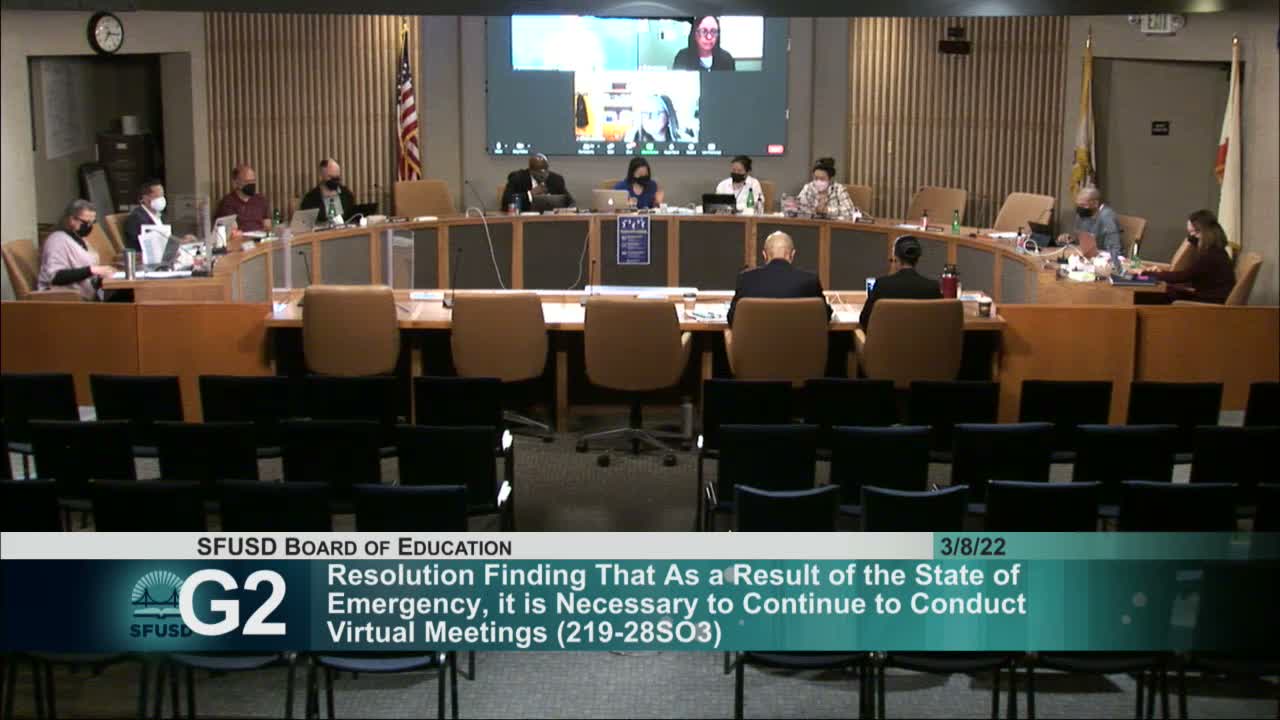
San Francisco Unified staff presented the district’s plan for the state A–G Completion Improvement Grant on March 8, describing proposed uses, timelines and targeted populations to raise the share of graduates meeting University of California/CSU A–G course requirements.
Roderick Castro and Jen (Dr.) Fong said SFUSD will receive success and mitigation grants based on its A–G completion rate (presented at 70.9 percent) while the county office will receive related funds; the combined funding for SFUSD and the county office was described as approximately $7.5 million over a four‑year window ending in June 2026. Proposed uses include professional development for teachers and counselors, credit‑recovery programming (evening, Saturday and summer options), English‑learner credit recovery, pre‑AP classes and AP fee coverage for unduplicated pupils.
"This grant consists of three grants: access, success and learning‑loss mitigation," the presenter said, adding districts must submit a funding plan on or before April 1 and report metrics to the State Superintendent by the end of 2023 and final outcomes by August 2026. The mitigation grant specifically targets students who received D/F grades in A–G courses in 2020–21 and would pay for retake opportunities.
Public commenters supported the effort but warned that credit recovery alone will not close underlying skill gaps. Alita Fisher, representing the Community Advisory Committee for Special Education, urged the district to invest in foundational reading and remedial skill‑building in high schools, calling credit recovery "a band aid on a bullet hole." A student‑teacher suggested a seven‑class schedule to expand course access during the regular day rather than relying solely on after‑hours credit recovery.
Board members asked for a breakdown of central versus site allocations and disaggregated completion rates by subgroup. Commissioner Bogus read DataQuest figures for subgroup A–G completion and asked how the district will target supports for groups with lower completion rates. Staff said the district will supply more detailed breakdowns and highlighted affinity‑based programming and site‑tailored "Sprout" grants intended to reach unduplicated students.
The presentation concluded with staff committing to bring a finalized plan for adoption at a subsequent meeting and to work with the budget office to clarify direct student services versus indirect administrative support.
Roderick Castro and Jen (Dr.) Fong said SFUSD will receive success and mitigation grants based on its A–G completion rate (presented at 70.9 percent) while the county office will receive related funds; the combined funding for SFUSD and the county office was described as approximately $7.5 million over a four‑year window ending in June 2026. Proposed uses include professional development for teachers and counselors, credit‑recovery programming (evening, Saturday and summer options), English‑learner credit recovery, pre‑AP classes and AP fee coverage for unduplicated pupils.
"This grant consists of three grants: access, success and learning‑loss mitigation," the presenter said, adding districts must submit a funding plan on or before April 1 and report metrics to the State Superintendent by the end of 2023 and final outcomes by August 2026. The mitigation grant specifically targets students who received D/F grades in A–G courses in 2020–21 and would pay for retake opportunities.
Public commenters supported the effort but warned that credit recovery alone will not close underlying skill gaps. Alita Fisher, representing the Community Advisory Committee for Special Education, urged the district to invest in foundational reading and remedial skill‑building in high schools, calling credit recovery "a band aid on a bullet hole." A student‑teacher suggested a seven‑class schedule to expand course access during the regular day rather than relying solely on after‑hours credit recovery.
Board members asked for a breakdown of central versus site allocations and disaggregated completion rates by subgroup. Commissioner Bogus read DataQuest figures for subgroup A–G completion and asked how the district will target supports for groups with lower completion rates. Staff said the district will supply more detailed breakdowns and highlighted affinity‑based programming and site‑tailored "Sprout" grants intended to reach unduplicated students.
The presentation concluded with staff committing to bring a finalized plan for adoption at a subsequent meeting and to work with the budget office to clarify direct student services versus indirect administrative support.
Don't Miss a Word: See the Full Meeting!
Go beyond summaries. Unlock every video, transcript, and key insight with a Founder Membership.
✓
Get instant access to full meeting videos
✓
Search and clip any phrase from complete transcripts
✓
Receive AI-powered summaries & custom alerts
✓
Enjoy lifetime, unrestricted access to government data
30-day money-back guarantee
