SFUSD holds deep-dive workshop on college and career readiness; staff outline dual-enrollment growth, precovery plans and course-matrix responses
April 25, 2023 | San Francisco City, San Francisco County, California
This article was created by AI summarizing key points discussed. AI makes mistakes, so for full details and context, please refer to the video of the full meeting. Please report any errors so we can fix them. Report an error »
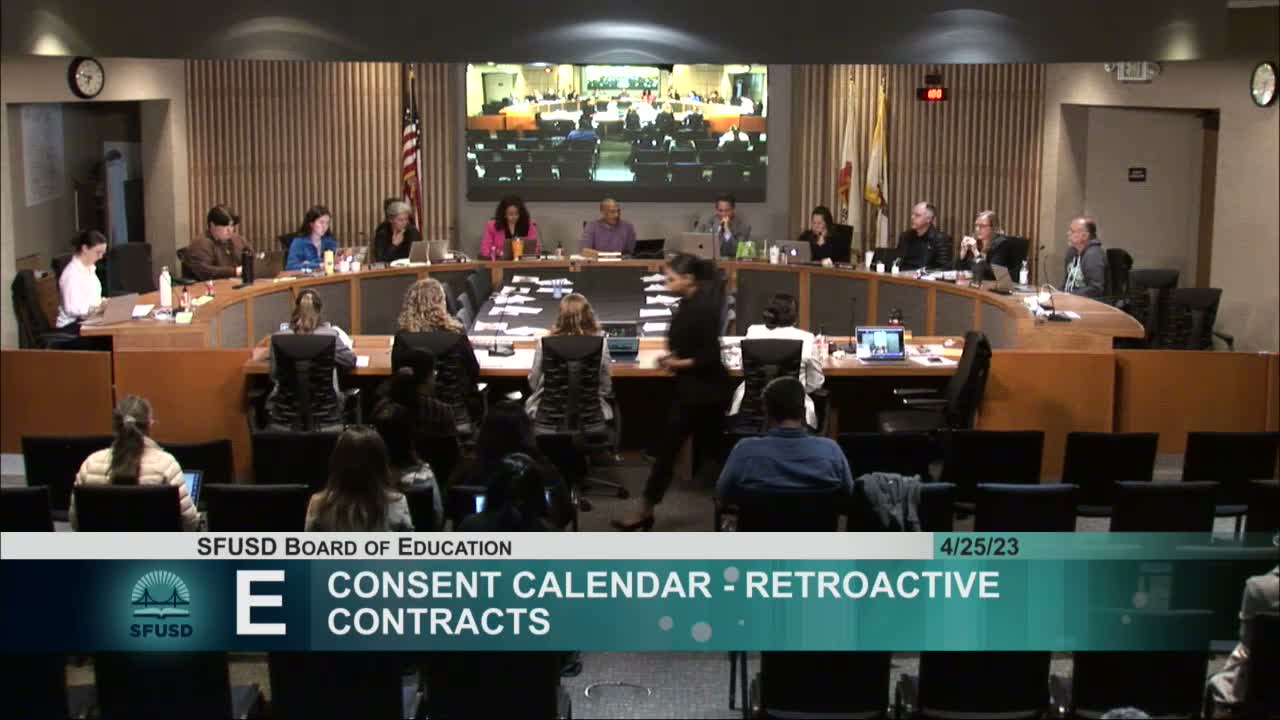
The San Francisco Unified School District held a lengthy workshop on student outcomes, progress monitoring and the board’s college-and-career readiness goal. Superintendent Wayne and district staff framed the session as a forward-looking expansion of the board’s work on literacy and graduation that now shifts attention to measures of college and career access and readiness.
Joanna Feitz, executive director of college and career readiness, told the board the district plans two near-term expansions: a centrally led set of precovery/credit‑recovery courses aimed at ninth graders to intervene early in the school year, and an increase in dual‑enrollment offerings in partnership with City College. Feitz said fall dual‑enrollment participation was “a little less than 600” students and that year‑to‑date participation exceeds 1,000; she also said the district has been allotted 10 additional dual‑enrollment classes for the next year and described class-size minimums (20) and maximums (35).
Julie Yu, the district’s data policy manager, read a demographic breakdown for City‑College dual enrollment in 2021–22: total students stated as 1,421 (as read), with African American/Black students 4%, Chinese students 45%, Filipino students 3%, Latinx students 26%, White students 6%, Southeast Asian students 3% and other groups 12%. Staff said they can provide similar demographic breakdowns for internships at a later date.
Staff described the course matrix — newly published to show course offerings by site — and said it reveals wide disparities in AP, electives and world-language options across high schools. Smaller schools, they said, often have fewer offerings and the district is exploring off‑site partnerships, hub models, transportation strategies and virtual options to broaden access while working through labor, technology and scheduling constraints.
On early intervention, staff explained a 'precovery' approach: pull initial first‑quarter grades for key courses and use a district team to work on‑site with teachers and counselors to prevent students from failing rather than relying solely on after‑the‑fact credit recovery. "So grades are submitted, we pull it, we go... we're doing that precovery, that intervention right then to make sure that we're meeting this a through g," a staff presenter said.
Board members asked detailed follow‑ups. Commissioners pressed for clarity about an apparent discrepancy in reported starting points for readiness (examples given in Q&A as 6% not on track vs. 40% not ready) and asked how the district will ensure family engagement, equity for underrepresented groups, and consistent counselor practices across schools. Staff committed to more targeted work with the high‑school task force, said recommendations should be available in September and to the board by December to inform budget and master‑schedule decisions, and outlined plans for standardized scripts and counselor 'shutdown' weeks to improve consistency.
Commissioners also asked about internships and city partnerships; staff said internships and CTE expansions are largely grant‑funded and that some placements have been blocked by MOU/legal negotiations with city partners (for example, an SFO placement cited by a commissioner). Staff said the district has begun conversations with the city’s Office of Economic and Workforce Development and other agencies to expand placements but that legal agreements remain a gating factor.
Public commenters thanked staff for the course matrix, urged stronger nonprofit school partnerships to expand college access, pushed for more internships and individualized learning plans, and urged earlier root‑cause analysis to identify when students go off track (including as early as kindergarten).
What happens next: staff will finalize interim guardrails, produce demographic breakdowns for internships, continue high‑school task‑force work with a target to return recommendations in September, and bring resource‑allocation proposals back to the board by December to support scheduling and budget choices for the following school year.
Direct quotes above are taken from the public transcript of the meeting and are attributed to speakers who spoke on the record.
Joanna Feitz, executive director of college and career readiness, told the board the district plans two near-term expansions: a centrally led set of precovery/credit‑recovery courses aimed at ninth graders to intervene early in the school year, and an increase in dual‑enrollment offerings in partnership with City College. Feitz said fall dual‑enrollment participation was “a little less than 600” students and that year‑to‑date participation exceeds 1,000; she also said the district has been allotted 10 additional dual‑enrollment classes for the next year and described class-size minimums (20) and maximums (35).
Julie Yu, the district’s data policy manager, read a demographic breakdown for City‑College dual enrollment in 2021–22: total students stated as 1,421 (as read), with African American/Black students 4%, Chinese students 45%, Filipino students 3%, Latinx students 26%, White students 6%, Southeast Asian students 3% and other groups 12%. Staff said they can provide similar demographic breakdowns for internships at a later date.
Staff described the course matrix — newly published to show course offerings by site — and said it reveals wide disparities in AP, electives and world-language options across high schools. Smaller schools, they said, often have fewer offerings and the district is exploring off‑site partnerships, hub models, transportation strategies and virtual options to broaden access while working through labor, technology and scheduling constraints.
On early intervention, staff explained a 'precovery' approach: pull initial first‑quarter grades for key courses and use a district team to work on‑site with teachers and counselors to prevent students from failing rather than relying solely on after‑the‑fact credit recovery. "So grades are submitted, we pull it, we go... we're doing that precovery, that intervention right then to make sure that we're meeting this a through g," a staff presenter said.
Board members asked detailed follow‑ups. Commissioners pressed for clarity about an apparent discrepancy in reported starting points for readiness (examples given in Q&A as 6% not on track vs. 40% not ready) and asked how the district will ensure family engagement, equity for underrepresented groups, and consistent counselor practices across schools. Staff committed to more targeted work with the high‑school task force, said recommendations should be available in September and to the board by December to inform budget and master‑schedule decisions, and outlined plans for standardized scripts and counselor 'shutdown' weeks to improve consistency.
Commissioners also asked about internships and city partnerships; staff said internships and CTE expansions are largely grant‑funded and that some placements have been blocked by MOU/legal negotiations with city partners (for example, an SFO placement cited by a commissioner). Staff said the district has begun conversations with the city’s Office of Economic and Workforce Development and other agencies to expand placements but that legal agreements remain a gating factor.
Public commenters thanked staff for the course matrix, urged stronger nonprofit school partnerships to expand college access, pushed for more internships and individualized learning plans, and urged earlier root‑cause analysis to identify when students go off track (including as early as kindergarten).
What happens next: staff will finalize interim guardrails, produce demographic breakdowns for internships, continue high‑school task‑force work with a target to return recommendations in September, and bring resource‑allocation proposals back to the board by December to support scheduling and budget choices for the following school year.
Direct quotes above are taken from the public transcript of the meeting and are attributed to speakers who spoke on the record.
View the Full Meeting & All Its Details
This article offers just a summary. Unlock complete video, transcripts, and insights as a Founder Member.
✓
Watch full, unedited meeting videos
✓
Search every word spoken in unlimited transcripts
✓
AI summaries & real-time alerts (all government levels)
✓
Permanent access to expanding government content
30-day money-back guarantee
