SFUSD board rates itself 'not student-outcomes focused' in self-evaluation, directs guardrail and monitoring updates
August 22, 2023 | San Francisco City, San Francisco County, California
This article was created by AI summarizing key points discussed. AI makes mistakes, so for full details and context, please refer to the video of the full meeting. Please report any errors so we can fix them. Report an error »
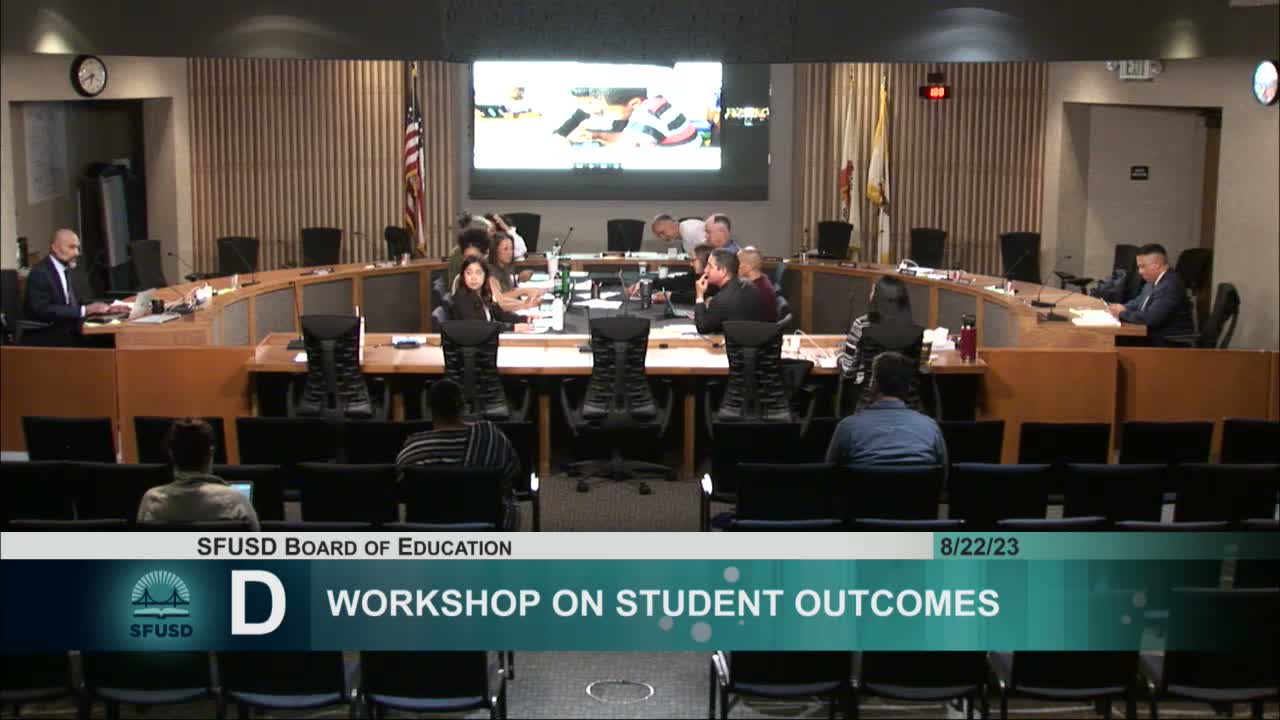
At a special board workshop that resumed open session at 6:37 p.m., the San Francisco Unified School District Board of Education spent several hours reviewing a self-evaluation instrument and a time‑use analysis designed by the Council of the Great City Schools and facilitated by AJ Crabill.
The exercise focused on whether the board’s work is centered on student outcomes. After discussion and debate over rubric interpretation — including whether a board must meet every listed criterion in a scoring column before advancing — the board recorded a score of “0” (not student‑outcomes‑focused) on the vision and goals page and identified steps to improve monitoring and clarity of interim goals and guardrails. "This is not about good or bad or right or wrong. Your intentions are not, being judged this evening. Your impact is your actions," AJ Crabill said as he urged the board to ground scores in evidence.
Members pushed staff for more detail on the time‑use pie charts and on the contents of the “other” category used in the analysis. Commissioners and student delegates asked for clearer documentation tying contracts, expenditures and agenda items to the board’s stated goals so the board can track whether district investments align with intended student outcomes. A student delegate said, "As a student, I think... it’s helpful when students evaluate themselves as well as the educators evaluating themselves," arguing that classroom‑level reflection supports systemwide accountability.
Commissioners debated technical distinctions in the rubric (inputs, outputs, outcomes) and whether some interim measures properly qualify as student outcomes or weaker outputs. On several pages (vision & goals; values & guardrails; monitoring & accountability), board members concluded that some interim goals and guardrails were not written to the SMART criteria (specific, measurable, achievable, relevant, time‑bound) or were not scheduled to update frequently enough to support intra‑year progress monitoring.
The board agreed on a set of follow‑up actions: direct the superintendent to revise interim guardrails and interim goals to be measurable and to return those revisions for board review; add a review of interim goals and a monitoring calendar to a future agenda; prepare a concise "one‑pager" summarizing interim goals and guardrails for public use; provide training for commissioners and student delegates on distinguishing inputs/outputs/outcomes and on the time‑use evaluation spreadsheet; and consider forming an ad hoc group or leadership team to draft ethics/conflict‑of‑interest language for board policy consideration.
AJ Crabill recommended quarterly board self‑evaluations going forward and offered scenario‑based training for the board to improve consistency in scoring. Several commissioners said they expected to use the process to tighten monitoring reports and to prepare for more frequent progress‑monitoring sessions this school year. "Practice makes progress," one commissioner said, urging the board to use the instrument as an ongoing coaching tool.
The board closed the workshop by thanking student delegates and public commenters and by scheduling the noted follow‑ups. The board adjourned the special meeting at 9:31 p.m.
The exercise focused on whether the board’s work is centered on student outcomes. After discussion and debate over rubric interpretation — including whether a board must meet every listed criterion in a scoring column before advancing — the board recorded a score of “0” (not student‑outcomes‑focused) on the vision and goals page and identified steps to improve monitoring and clarity of interim goals and guardrails. "This is not about good or bad or right or wrong. Your intentions are not, being judged this evening. Your impact is your actions," AJ Crabill said as he urged the board to ground scores in evidence.
Members pushed staff for more detail on the time‑use pie charts and on the contents of the “other” category used in the analysis. Commissioners and student delegates asked for clearer documentation tying contracts, expenditures and agenda items to the board’s stated goals so the board can track whether district investments align with intended student outcomes. A student delegate said, "As a student, I think... it’s helpful when students evaluate themselves as well as the educators evaluating themselves," arguing that classroom‑level reflection supports systemwide accountability.
Commissioners debated technical distinctions in the rubric (inputs, outputs, outcomes) and whether some interim measures properly qualify as student outcomes or weaker outputs. On several pages (vision & goals; values & guardrails; monitoring & accountability), board members concluded that some interim goals and guardrails were not written to the SMART criteria (specific, measurable, achievable, relevant, time‑bound) or were not scheduled to update frequently enough to support intra‑year progress monitoring.
The board agreed on a set of follow‑up actions: direct the superintendent to revise interim guardrails and interim goals to be measurable and to return those revisions for board review; add a review of interim goals and a monitoring calendar to a future agenda; prepare a concise "one‑pager" summarizing interim goals and guardrails for public use; provide training for commissioners and student delegates on distinguishing inputs/outputs/outcomes and on the time‑use evaluation spreadsheet; and consider forming an ad hoc group or leadership team to draft ethics/conflict‑of‑interest language for board policy consideration.
AJ Crabill recommended quarterly board self‑evaluations going forward and offered scenario‑based training for the board to improve consistency in scoring. Several commissioners said they expected to use the process to tighten monitoring reports and to prepare for more frequent progress‑monitoring sessions this school year. "Practice makes progress," one commissioner said, urging the board to use the instrument as an ongoing coaching tool.
The board closed the workshop by thanking student delegates and public commenters and by scheduling the noted follow‑ups. The board adjourned the special meeting at 9:31 p.m.
View the Full Meeting & All Its Details
This article offers just a summary. Unlock complete video, transcripts, and insights as a Founder Member.
✓
Watch full, unedited meeting videos
✓
Search every word spoken in unlimited transcripts
✓
AI summaries & real-time alerts (all government levels)
✓
Permanent access to expanding government content
30-day money-back guarantee
