SFUSD budget update: district keeps conservative assumptions while approving educator housing ground leases
June 14, 2022 | San Francisco City, San Francisco County, California
This article was created by AI summarizing key points discussed. AI makes mistakes, so for full details and context, please refer to the video of the full meeting. Please report any errors so we can fix them. Report an error »
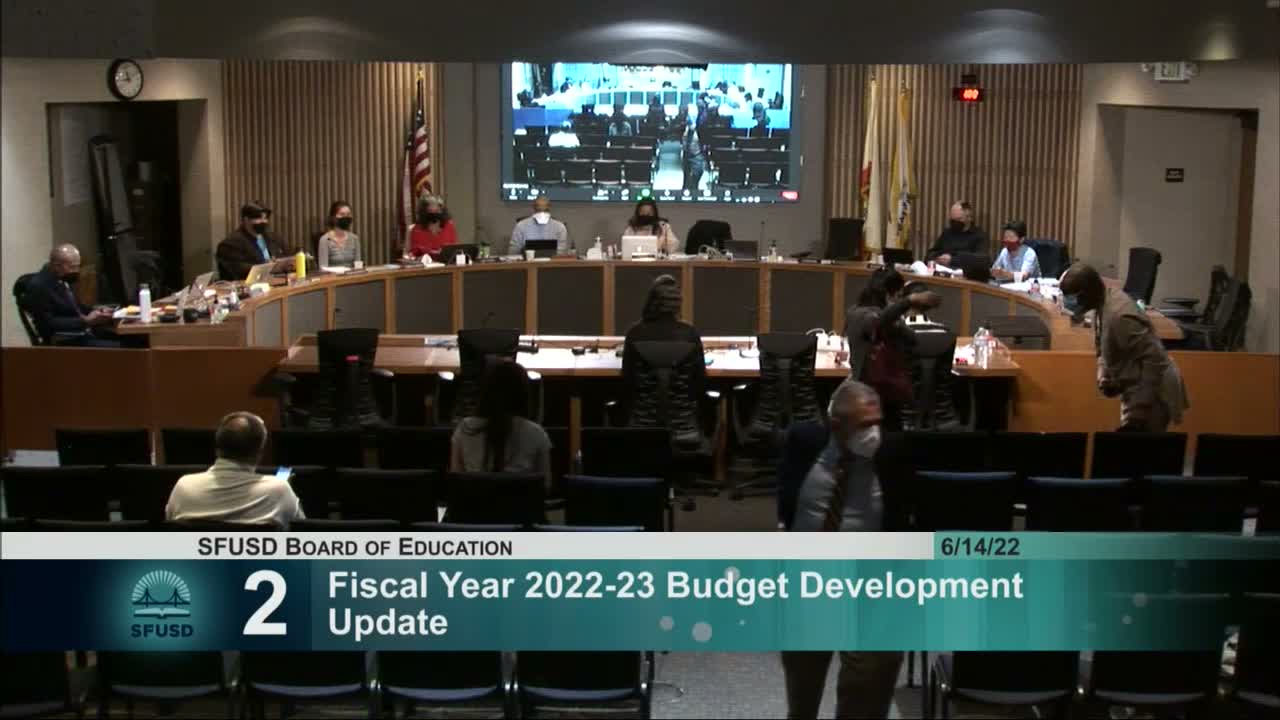
At the June 14 meeting the San Francisco Unified School District provided a fiscal-year 2022–23 budget update and approved agreements to advance a city-district educator housing project.
Budget update: Megan Wallace outlined how the district modeled multiple state budget scenarios — the governor’s May revision and a larger legislative proposal — and said the district chose conservative assumptions for its proposed budget package, including a $20 million one-time discretionary block-grant assumption rather than assuming larger legislative augmentation. Wallace highlighted ongoing fiscal risks: a structural deficit driven by declining enrollment and reduced average daily attendance (ADA), which dampen LCFF growth and make revenue projections sensitive to changes in state policy. Staff recommended using one‑time funds for discrete needs (for example, cybersecurity, deferred negotiated obligations and an LCAP coordinator) and reserving the option of a 45‑day revision after the state finalizes its budget in July.
Educator housing approvals: Separately the board approved two ground leases with MidPen Housing (the low‑income parcel and the moderate‑income parcel) and authorized a memorandum of understanding with the Mayor’s Office of Housing and Community Development to coordinate marketing, lottery administration and outreach for Shirley Chisholm Village — a single building that will contain 135 subsidized units, largely prioritized for SFUSD educators and employees. Staff described the approvals as a milestone and said more outreach and project updates will follow; both lease items passed by roll call (5–0) and the MOU passed (5–0).
Contract item scrutiny: Commissioners also questioned a consent item (contract modification item 45) involving long-running program-management services tied to the 2016 bond program for technology modernization; board members and a Citizens Bond Oversight Committee member asked for clarity about rising modification totals and staffing plans. The board voted the modification down in a separate roll-call vote (failed to get required support), and staff committed to additional follow-up and procurement refinements ahead of the next bond effort.
Why it matters: The district emphasized conservatism in revenue forecasting to avoid overcommitting to ongoing expenses and flagged the August 45‑day revision window as the time to re-evaluate spending when the state finalizes the budget. The housing approvals advance a long‑planned educator housing project intended to support staff retention amid a tight local housing market.
Budget update: Megan Wallace outlined how the district modeled multiple state budget scenarios — the governor’s May revision and a larger legislative proposal — and said the district chose conservative assumptions for its proposed budget package, including a $20 million one-time discretionary block-grant assumption rather than assuming larger legislative augmentation. Wallace highlighted ongoing fiscal risks: a structural deficit driven by declining enrollment and reduced average daily attendance (ADA), which dampen LCFF growth and make revenue projections sensitive to changes in state policy. Staff recommended using one‑time funds for discrete needs (for example, cybersecurity, deferred negotiated obligations and an LCAP coordinator) and reserving the option of a 45‑day revision after the state finalizes its budget in July.
Educator housing approvals: Separately the board approved two ground leases with MidPen Housing (the low‑income parcel and the moderate‑income parcel) and authorized a memorandum of understanding with the Mayor’s Office of Housing and Community Development to coordinate marketing, lottery administration and outreach for Shirley Chisholm Village — a single building that will contain 135 subsidized units, largely prioritized for SFUSD educators and employees. Staff described the approvals as a milestone and said more outreach and project updates will follow; both lease items passed by roll call (5–0) and the MOU passed (5–0).
Contract item scrutiny: Commissioners also questioned a consent item (contract modification item 45) involving long-running program-management services tied to the 2016 bond program for technology modernization; board members and a Citizens Bond Oversight Committee member asked for clarity about rising modification totals and staffing plans. The board voted the modification down in a separate roll-call vote (failed to get required support), and staff committed to additional follow-up and procurement refinements ahead of the next bond effort.
Why it matters: The district emphasized conservatism in revenue forecasting to avoid overcommitting to ongoing expenses and flagged the August 45‑day revision window as the time to re-evaluate spending when the state finalizes the budget. The housing approvals advance a long‑planned educator housing project intended to support staff retention amid a tight local housing market.
View the Full Meeting & All Its Details
This article offers just a summary. Unlock complete video, transcripts, and insights as a Founder Member.
✓
Watch full, unedited meeting videos
✓
Search every word spoken in unlimited transcripts
✓
AI summaries & real-time alerts (all government levels)
✓
Permanent access to expanding government content
30-day money-back guarantee
