SFUSD unveils progress‑monitoring plan and equity‑enhanced targets; board presses for resources and scaling
September 26, 2023 | San Francisco City, San Francisco County, California
This article was created by AI summarizing key points discussed. AI makes mistakes, so for full details and context, please refer to the video of the full meeting. Please report any errors so we can fix them. Report an error »
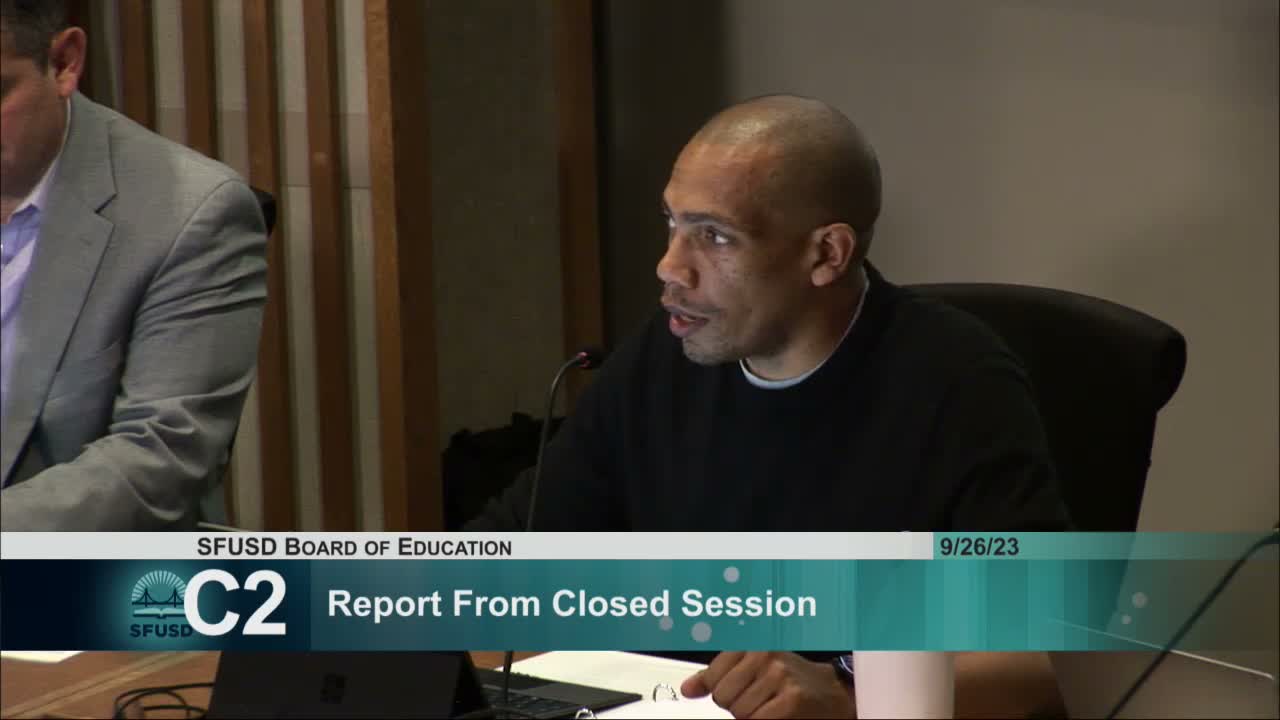
San Francisco Unified School District leaders on Monday presented a new progress‑monitoring approach that pairs district goals with site‑level targets and a set of interim guardrails designed to move the district from analysis to action.
Superintendent Doctor Wayne opened the workshop by saying the governance team’s purpose is to improve student outcomes and that doing so requires changing adult behaviors. He summarized district performance: third‑grade literacy at about 52% (target 55% next year), a decline in math to roughly 40% for all students, 26% of students chronically absent and declines in measures of sense of belonging. ‘‘We are off track,’’ he said, and framed the session as an effort to show evidence and a plan for improvement.
Ritu Khanna, head of Research, Planning and Accountability (RPA), described guardrail 3.2, which focuses on regular use of implementation and impact data for continuous instructional improvement. ‘‘Data use should be prevalent at all levels of the district,’’ Khanna said, and outlined a theory of action that pairs implementation measures (what schools do) with impact measures (student outcomes).
District staff described a three‑step method for setting site targets: determine a baseline capacity (the higher of a three‑year historical average or 2023 performance), compare that baseline to the district average and assign a growth target. Sites with low baselines may receive equity‑enhanced targets (illustrated in the presentation by an example of School C moving from a 20% baseline to a 25% target). Jess Reyes (RPA) said the district will hold deeper data conferences aligned to equity‑enhanced targets (third‑grade literacy and eighth‑grade math), provide training and new data‑review protocols timed with interim assessments, and offer $500 to schools that complete a survey and submit instructional‑leadership team artifacts in November and March.
Two site leaders described practical steps. Emily Licham, principal of Roosevelt Middle School, credited protected common planning time (an Initiate Wonder schedule), cycles of inquiry (PDSA), focus on academic language and targeted supports for special education and English learners for recent gains: "Our students have shown growth in both math and ELA." Dina Edwards, principal at Sheridan Elementary School, highlighted early parent‑teacher conferences, demonstrations of learning, and structured literacy (the science of reading) as drivers of site improvements.
Board members pressed district staff on how promising site practices will be scaled systemwide and how targets will be matched to resources. Commissioners repeatedly warned that assigning higher equity‑enhanced targets without commensurate resources could lead to educator burnout and cynicism. Commissioner Alexander asked for clarity on how site‑level targets tie to resource allocations; RPA said one‑on‑one data conferences with equity‑enhanced target schools will surface needed programs and supports and ask sites what resources are required to meet targets.
Other lines of questioning probed the teacher survey (QTEA) response rate (about 66%), whether cohort or matched data will be used in monitoring, and how the district plans to track social‑emotional measures such as sense of belonging. RPA said matched/cohort analyses have been run and will be incorporated in future reports, and that attendance has the strongest correlation with academic outcomes (students with 90%+ attendance show proficiency rates near 70% while students with 80% or lower show rates as low as 17%).
Public commenters urged the board to move faster on concrete interventions: tutoring, additional instructional hours, and individually tailored plans for students who are falling behind. Commenters also raised staffing shortages (nurse vacancies and classroom vacancies), local concerns about school closures (commenters asked that Academy High School not be closed) and criticism that district fiscal choices (moving funds to reserves) could reduce resources available for schools.
District staff and RPA said the workshop’s purpose was to present revised SMART interim guardrails and to solicit board feedback. They described near‑term next steps: scheduled data conferences with schools, training for site leaders and coaches, and public posting of “street data” artifacts tied to school improvement. The board requested follow‑up reporting on how targets are being resourced and how progress will be communicated between calendared board meetings.
Superintendent Doctor Wayne opened the workshop by saying the governance team’s purpose is to improve student outcomes and that doing so requires changing adult behaviors. He summarized district performance: third‑grade literacy at about 52% (target 55% next year), a decline in math to roughly 40% for all students, 26% of students chronically absent and declines in measures of sense of belonging. ‘‘We are off track,’’ he said, and framed the session as an effort to show evidence and a plan for improvement.
Ritu Khanna, head of Research, Planning and Accountability (RPA), described guardrail 3.2, which focuses on regular use of implementation and impact data for continuous instructional improvement. ‘‘Data use should be prevalent at all levels of the district,’’ Khanna said, and outlined a theory of action that pairs implementation measures (what schools do) with impact measures (student outcomes).
District staff described a three‑step method for setting site targets: determine a baseline capacity (the higher of a three‑year historical average or 2023 performance), compare that baseline to the district average and assign a growth target. Sites with low baselines may receive equity‑enhanced targets (illustrated in the presentation by an example of School C moving from a 20% baseline to a 25% target). Jess Reyes (RPA) said the district will hold deeper data conferences aligned to equity‑enhanced targets (third‑grade literacy and eighth‑grade math), provide training and new data‑review protocols timed with interim assessments, and offer $500 to schools that complete a survey and submit instructional‑leadership team artifacts in November and March.
Two site leaders described practical steps. Emily Licham, principal of Roosevelt Middle School, credited protected common planning time (an Initiate Wonder schedule), cycles of inquiry (PDSA), focus on academic language and targeted supports for special education and English learners for recent gains: "Our students have shown growth in both math and ELA." Dina Edwards, principal at Sheridan Elementary School, highlighted early parent‑teacher conferences, demonstrations of learning, and structured literacy (the science of reading) as drivers of site improvements.
Board members pressed district staff on how promising site practices will be scaled systemwide and how targets will be matched to resources. Commissioners repeatedly warned that assigning higher equity‑enhanced targets without commensurate resources could lead to educator burnout and cynicism. Commissioner Alexander asked for clarity on how site‑level targets tie to resource allocations; RPA said one‑on‑one data conferences with equity‑enhanced target schools will surface needed programs and supports and ask sites what resources are required to meet targets.
Other lines of questioning probed the teacher survey (QTEA) response rate (about 66%), whether cohort or matched data will be used in monitoring, and how the district plans to track social‑emotional measures such as sense of belonging. RPA said matched/cohort analyses have been run and will be incorporated in future reports, and that attendance has the strongest correlation with academic outcomes (students with 90%+ attendance show proficiency rates near 70% while students with 80% or lower show rates as low as 17%).
Public commenters urged the board to move faster on concrete interventions: tutoring, additional instructional hours, and individually tailored plans for students who are falling behind. Commenters also raised staffing shortages (nurse vacancies and classroom vacancies), local concerns about school closures (commenters asked that Academy High School not be closed) and criticism that district fiscal choices (moving funds to reserves) could reduce resources available for schools.
District staff and RPA said the workshop’s purpose was to present revised SMART interim guardrails and to solicit board feedback. They described near‑term next steps: scheduled data conferences with schools, training for site leaders and coaches, and public posting of “street data” artifacts tied to school improvement. The board requested follow‑up reporting on how targets are being resourced and how progress will be communicated between calendared board meetings.
View the Full Meeting & All Its Details
This article offers just a summary. Unlock complete video, transcripts, and insights as a Founder Member.
✓
Watch full, unedited meeting videos
✓
Search every word spoken in unlimited transcripts
✓
AI summaries & real-time alerts (all government levels)
✓
Permanent access to expanding government content
30-day money-back guarantee
