San Francisco school board reviews plan to cut chronic absenteeism; staff outlines targeted supports and daily monitoring
October 24, 2023 | San Francisco City, San Francisco County, California
This article was created by AI summarizing key points discussed. AI makes mistakes, so for full details and context, please refer to the video of the full meeting. Please report any errors so we can fix them. Report an error »
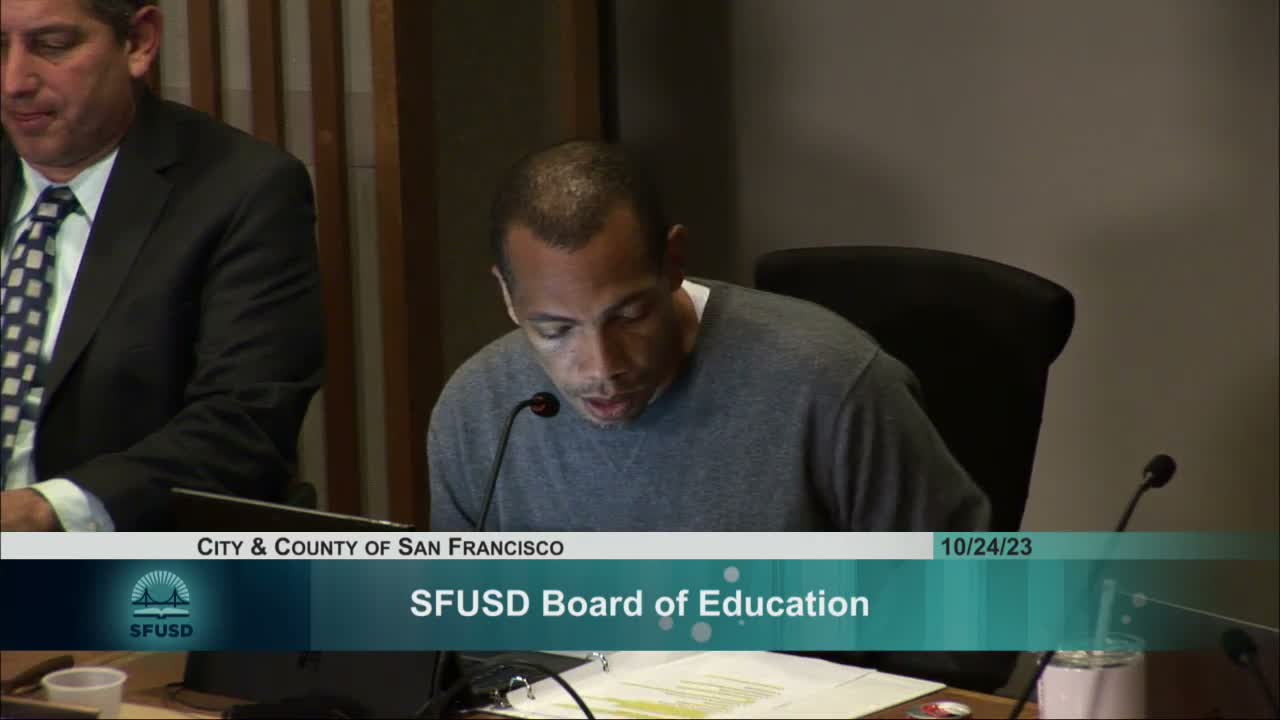
District staff told the San Francisco Board of Education on the evening they were launching a systemwide effort to reduce chronic absenteeism, presenting a root‑cause analysis and a set of strategies the district says have produced early, small improvements.
Associate Superintendent Demetrius Rice Mitchell outlined a fishbone analysis that identified six themes driving absences after the pandemic: inconsistent attendance‑data quality, reduced resources and infrastructure to address patterns, decreased student sense of belonging, discontinuity in daily attendance taking, unclear guidance at some sites, and higher family needs. The district’s interim guardrail 2.1 aims to reduce chronic absenteeism toward a 24 percent target.
Staff described four focal investments tied to a logic model: district and site capacity building, research‑based family messaging and an attendance‑awareness month, automated mandatory truancy notices plus softer "nudge" letters and texts (launched Oct. 4), and targeted supports for African American and Native Hawaiian/Pacific Islander students. Assistant Superintendent Eric Gutters said every site has created a CCT (coordinated care team) attendance plan and staff built a district tracker and rubric to give feedback to schools.
Commissioners pressed for more accessible data: Commissioner Fisher asked for raw student counts to accompany the percentages; staff said a linked attendance report with three‑year counts and percentages is available and agreed to add bar charts and ZIP‑code breakdowns directly into presentation materials for public use. Commissioners and the student delegate raised transportation and staffing as contributing causes; staff acknowledged public transit reliability is largely outside district control but committed to operational supports and coaching for sites.
Staff also pointed to operational fixes: the data team remade reporting so attendance is a leading indicator with daily student‑by‑student and cumulative reports (24‑hour lag) and reported a reduction in attendance ‘missing sections’ from roughly 3,000 last year to about 1,000 this year. Early results cited by staff showed African American chronic‑absence in the first six weeks decline from 44% to 41%, and districtwide figures around the low‑20s percent.
Board members asked for more detail on the root‑cause interviews (how many families and students were reached) and for the district to identify bright spots where site practices have produced better attendance for high‑need groups. Staff committed to returning exact counts and to sharing exemplars and a more granular ZIP‑code and grade‑level breakdown before upcoming community conversations.
Public commenters reiterated calls for clearer family messaging about truancy notices, easier call‑back options when schools leave attendance messages, attention to bullying and student safety concerns that can affect attendance, and caution about asking small site staff to implement additional duties without commensurate resources.
The board did not take any formal vote at the workshop; the meeting moved from presentation and Q&A into public comment and then adjourned. Future steps the district identified include publishing updated charts with raw counts and ZIP‑code analysis, distributing a referral form for tier‑3 cases, and continuing weekly CCT meetings at most sites while the district monitors outcomes and refines strategies.
Associate Superintendent Demetrius Rice Mitchell outlined a fishbone analysis that identified six themes driving absences after the pandemic: inconsistent attendance‑data quality, reduced resources and infrastructure to address patterns, decreased student sense of belonging, discontinuity in daily attendance taking, unclear guidance at some sites, and higher family needs. The district’s interim guardrail 2.1 aims to reduce chronic absenteeism toward a 24 percent target.
Staff described four focal investments tied to a logic model: district and site capacity building, research‑based family messaging and an attendance‑awareness month, automated mandatory truancy notices plus softer "nudge" letters and texts (launched Oct. 4), and targeted supports for African American and Native Hawaiian/Pacific Islander students. Assistant Superintendent Eric Gutters said every site has created a CCT (coordinated care team) attendance plan and staff built a district tracker and rubric to give feedback to schools.
Commissioners pressed for more accessible data: Commissioner Fisher asked for raw student counts to accompany the percentages; staff said a linked attendance report with three‑year counts and percentages is available and agreed to add bar charts and ZIP‑code breakdowns directly into presentation materials for public use. Commissioners and the student delegate raised transportation and staffing as contributing causes; staff acknowledged public transit reliability is largely outside district control but committed to operational supports and coaching for sites.
Staff also pointed to operational fixes: the data team remade reporting so attendance is a leading indicator with daily student‑by‑student and cumulative reports (24‑hour lag) and reported a reduction in attendance ‘missing sections’ from roughly 3,000 last year to about 1,000 this year. Early results cited by staff showed African American chronic‑absence in the first six weeks decline from 44% to 41%, and districtwide figures around the low‑20s percent.
Board members asked for more detail on the root‑cause interviews (how many families and students were reached) and for the district to identify bright spots where site practices have produced better attendance for high‑need groups. Staff committed to returning exact counts and to sharing exemplars and a more granular ZIP‑code and grade‑level breakdown before upcoming community conversations.
Public commenters reiterated calls for clearer family messaging about truancy notices, easier call‑back options when schools leave attendance messages, attention to bullying and student safety concerns that can affect attendance, and caution about asking small site staff to implement additional duties without commensurate resources.
The board did not take any formal vote at the workshop; the meeting moved from presentation and Q&A into public comment and then adjourned. Future steps the district identified include publishing updated charts with raw counts and ZIP‑code analysis, distributing a referral form for tier‑3 cases, and continuing weekly CCT meetings at most sites while the district monitors outcomes and refines strategies.
Don't Miss a Word: See the Full Meeting!
Go beyond summaries. Unlock every video, transcript, and key insight with a Founder Membership.
✓
Get instant access to full meeting videos
✓
Search and clip any phrase from complete transcripts
✓
Receive AI-powered summaries & custom alerts
✓
Enjoy lifetime, unrestricted access to government data
30-day money-back guarantee
