Board reviews literacy progress monitoring, pilot curriculum and March adoption timeline
December 19, 2023 | San Francisco City, San Francisco County, California
This article was created by AI summarizing key points discussed. AI makes mistakes, so for full details and context, please refer to the video of the full meeting. Please report any errors so we can fix them. Report an error »
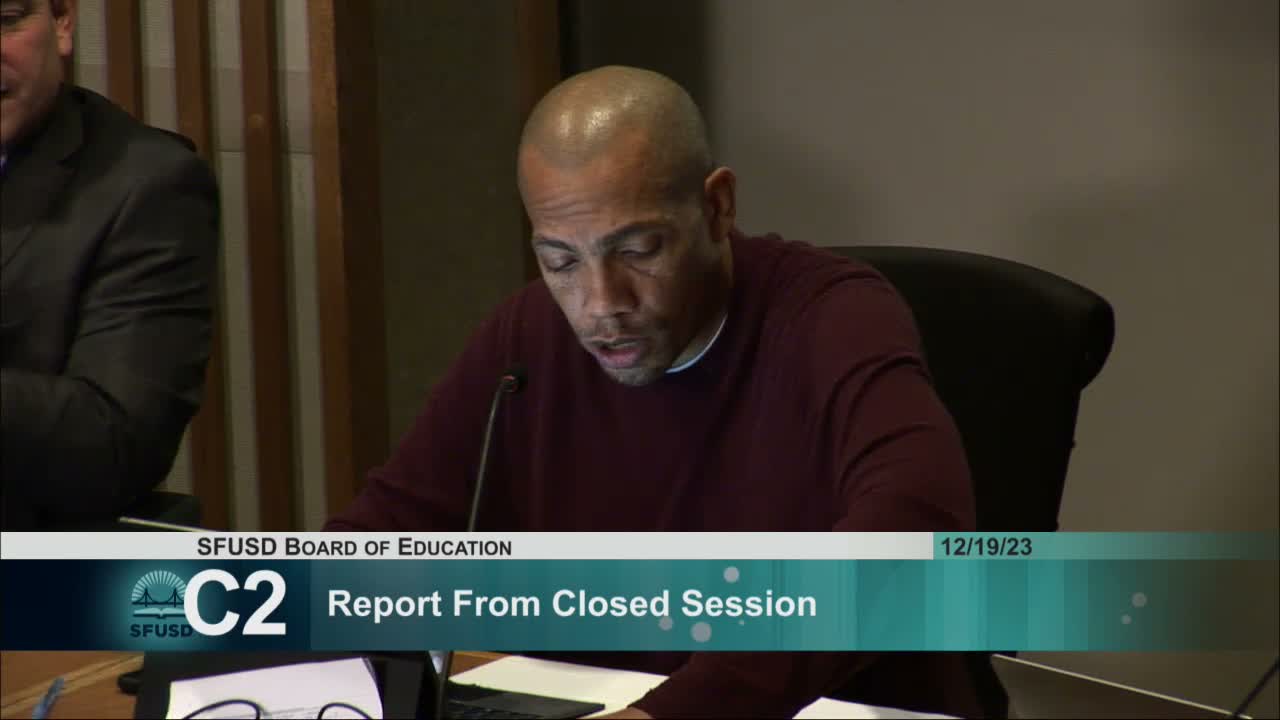
SAN FRANCISCO — District leaders presented the Board of Education with the first formal progress-monitoring update on Goal 1: third-grade literacy, outlined pilot findings, and described next steps toward a March curriculum adoption recommendation.
Superintendent Wayne opened the workshop by setting the targets: the district’s long-term goal is 70% of third graders at standard by 2027, with an interim target of 55% by the end of the current school year. Wayne reported an overall interim result of 51.7% on the new interim assessment and singled out performance gaps for historically underserved groups, including Black and Pacific Islander students (reported at 31.9% at standard on the interim assessment) and English learners (reported near 20%). "70% is a district in 2027," Wayne said, framing the timeline for district-wide progress.
Devin Krugman, executive director of content, described two strategic actions: an elementary language-arts curriculum pilot (English and Spanish materials plus designated English-language development) and a district-aligned professional development program. Krugman said the pilot is collecting multiple implementation measures — surveys, work samples, focus groups and classroom observations — across roughly 160 pilot teachers, and that pilot teachers are observed twice per program to track implementation quality.
Staff reported preliminary classroom-observation gains in measures they call "essential content" and "academic ownership," with particularly notable gains in daily, systematic foundational-skills instruction and student ownership of learning. A district data presenter said the pilot group was compared to a demographically equivalent non-pilot group and that no statistically significant outcome differences had yet emerged at midyear; staff emphasized the implementation timeline (the core curriculum implementation was incomplete at the time of the first assessment) and said they expect to evaluate final pilot data in January–February to inform a March recommendation to the board.
Glen Park Elementary was highlighted as a "bright spot." Principal Liz Zarr and third-grade teacher Sheila Tenney presented site-level context: long staff tenure, targeted bilingual pathways, and improved attendance (the principal reported English-learner chronic absenteeism falling from 59% last year to 30% so far this year). Glen Park teachers credited daily foundational skills, decodable text use and regular small-group instruction; the presenters said Glen Park’s third-grade proficiency reached 58% on the interim assessment, exceeding the school target of 44% and improving substantially from prior SBAC results.
Staff outlined the process and timing for adoption and implementation: final pilot evaluation in January–February, a board recommendation in March, and distribution of adopted materials to teachers before the end of the school year so professional learning can occur in the summer and full implementation TK–5 can begin in 2024–25. Dr. Carlene Aguilera Forte described a planned coaching model, an "instructional cabinet" to coordinate divisional supports, and a district dashboard prototype to track adult practice and student progress.
Board members pressed staff on how the district’s fiscal outlook and recent personnel decisions (commissioners referenced AB 1200 and substantial position reductions) will affect implementation capacity. Staff responded that funding for curriculum adoption has been set aside, that coaching allocations are being planned, and that the budget-planning process will include discussions about trade-offs and differentiated supports for schools depending on readiness and staffing conditions. Staff also emphasized building capacity through instructional leadership teams (ILTs), coordinated care teams (CCTs), and school-based supports rather than purely top-down mandates.
Public commenters — in person and virtually — largely supported the focus on early literacy while urging transparency about budget impacts and special-education staffing. Several speakers asked staff to track or report subgroup outcomes (students with IEPs, homeless or foster youth, low-income families) in interim measures and asked that special-education and intervention staff be included in training on assessment and structured-literacy materials.
What happens next: staff will finalize pilot evaluations in January–February, present a formal recommendation for curriculum adoption in March, and deliver materials to teachers prior to summer professional learning. The board will review adoption materials against its guardrails (standards-based, culturally responsive, differentiated) at that time.
Quotes from the meeting:
"Student outcomes will not change unless adult behaviors change," a slide attributed to an internal statement emphasized during the presentation.
"It's been transformative," said Sheila Tenney, a Glen Park third-grade teacher, describing routines and foundational-skills work adopted in the pilot classrooms.
The workshop concluded with the board opening public comment and later adjourning at 8:42 p.m.
Superintendent Wayne opened the workshop by setting the targets: the district’s long-term goal is 70% of third graders at standard by 2027, with an interim target of 55% by the end of the current school year. Wayne reported an overall interim result of 51.7% on the new interim assessment and singled out performance gaps for historically underserved groups, including Black and Pacific Islander students (reported at 31.9% at standard on the interim assessment) and English learners (reported near 20%). "70% is a district in 2027," Wayne said, framing the timeline for district-wide progress.
Devin Krugman, executive director of content, described two strategic actions: an elementary language-arts curriculum pilot (English and Spanish materials plus designated English-language development) and a district-aligned professional development program. Krugman said the pilot is collecting multiple implementation measures — surveys, work samples, focus groups and classroom observations — across roughly 160 pilot teachers, and that pilot teachers are observed twice per program to track implementation quality.
Staff reported preliminary classroom-observation gains in measures they call "essential content" and "academic ownership," with particularly notable gains in daily, systematic foundational-skills instruction and student ownership of learning. A district data presenter said the pilot group was compared to a demographically equivalent non-pilot group and that no statistically significant outcome differences had yet emerged at midyear; staff emphasized the implementation timeline (the core curriculum implementation was incomplete at the time of the first assessment) and said they expect to evaluate final pilot data in January–February to inform a March recommendation to the board.
Glen Park Elementary was highlighted as a "bright spot." Principal Liz Zarr and third-grade teacher Sheila Tenney presented site-level context: long staff tenure, targeted bilingual pathways, and improved attendance (the principal reported English-learner chronic absenteeism falling from 59% last year to 30% so far this year). Glen Park teachers credited daily foundational skills, decodable text use and regular small-group instruction; the presenters said Glen Park’s third-grade proficiency reached 58% on the interim assessment, exceeding the school target of 44% and improving substantially from prior SBAC results.
Staff outlined the process and timing for adoption and implementation: final pilot evaluation in January–February, a board recommendation in March, and distribution of adopted materials to teachers before the end of the school year so professional learning can occur in the summer and full implementation TK–5 can begin in 2024–25. Dr. Carlene Aguilera Forte described a planned coaching model, an "instructional cabinet" to coordinate divisional supports, and a district dashboard prototype to track adult practice and student progress.
Board members pressed staff on how the district’s fiscal outlook and recent personnel decisions (commissioners referenced AB 1200 and substantial position reductions) will affect implementation capacity. Staff responded that funding for curriculum adoption has been set aside, that coaching allocations are being planned, and that the budget-planning process will include discussions about trade-offs and differentiated supports for schools depending on readiness and staffing conditions. Staff also emphasized building capacity through instructional leadership teams (ILTs), coordinated care teams (CCTs), and school-based supports rather than purely top-down mandates.
Public commenters — in person and virtually — largely supported the focus on early literacy while urging transparency about budget impacts and special-education staffing. Several speakers asked staff to track or report subgroup outcomes (students with IEPs, homeless or foster youth, low-income families) in interim measures and asked that special-education and intervention staff be included in training on assessment and structured-literacy materials.
What happens next: staff will finalize pilot evaluations in January–February, present a formal recommendation for curriculum adoption in March, and deliver materials to teachers prior to summer professional learning. The board will review adoption materials against its guardrails (standards-based, culturally responsive, differentiated) at that time.
Quotes from the meeting:
"Student outcomes will not change unless adult behaviors change," a slide attributed to an internal statement emphasized during the presentation.
"It's been transformative," said Sheila Tenney, a Glen Park third-grade teacher, describing routines and foundational-skills work adopted in the pilot classrooms.
The workshop concluded with the board opening public comment and later adjourning at 8:42 p.m.
Don't Miss a Word: See the Full Meeting!
Go beyond summaries. Unlock every video, transcript, and key insight with a Founder Membership.
✓
Get instant access to full meeting videos
✓
Search and clip any phrase from complete transcripts
✓
Receive AI-powered summaries & custom alerts
✓
Enjoy lifetime, unrestricted access to government data
30-day money-back guarantee
