SFUSD board authorizes piloting Algebra 1 in eighth grade after weeks of debate over equity and resources
February 13, 2024 | San Francisco City, San Francisco County, California
This article was created by AI summarizing key points discussed. AI makes mistakes, so for full details and context, please refer to the video of the full meeting. Please report any errors so we can fix them. Report an error »
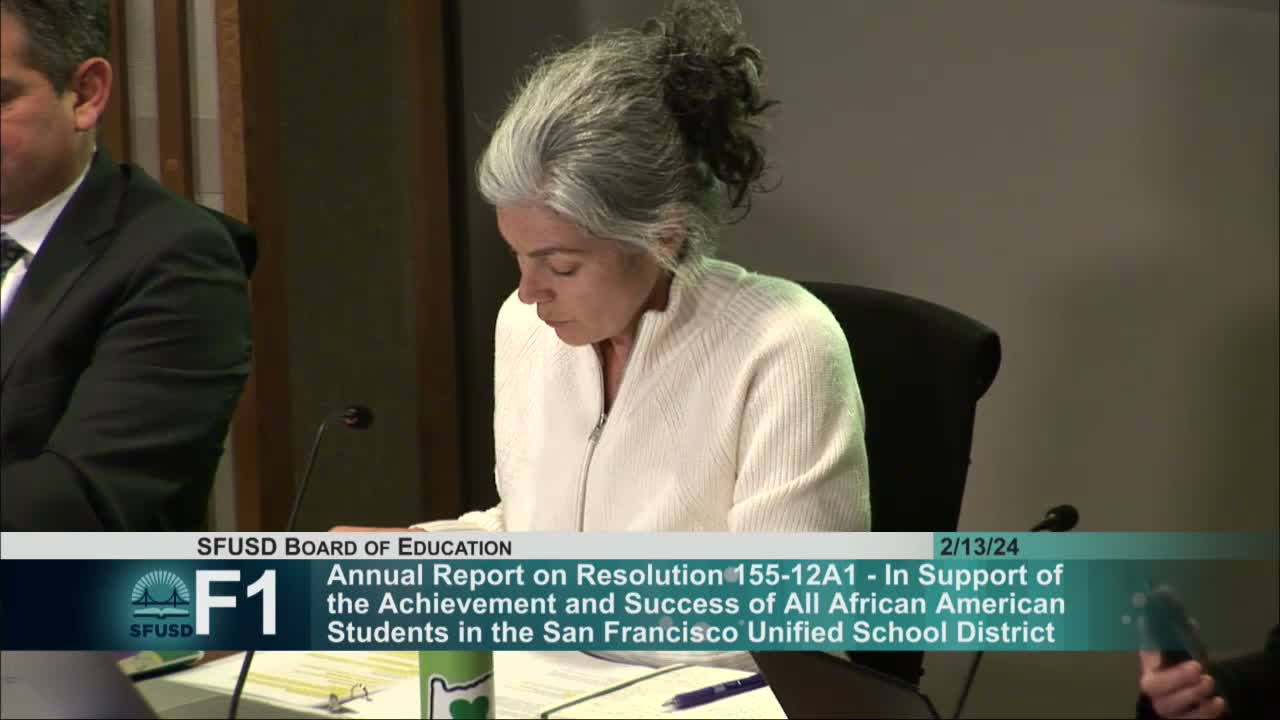
The San Francisco Unified School District board on Feb. 13 voted to authorize offering Algebra 1 in eighth grade and to pilot multiple acceleration models beginning in the 2024–25 school year, after extensive public comment and a lengthy board discussion about equity, staffing and costs.
Superintendent Doctor Wayne and district curriculum staff presented three pilot prototypes: a course‑skipping model that enrolls students directly from Math 7 into Algebra 1, a compressed model that combines Math 8 and Algebra 1 in a single year, and concurrent enrollment in Math 8 plus Algebra 1. Staff also described two supplementary options: a centrally supported online Algebra 1 course and a summer Algebra 1 intensive. The pilots — intended to run in 2024–25 and 2025–26 — will be paired with a K–8 curriculum adoption and expanded supports such as Math 8 labs, high‑impact tutoring and designated instructional time.
“We are asking the board to approve offering Algebra 1 in the eighth grade,” Associate Superintendent Carlene Aguilara Fort told commissioners during the presentation, framing the vote as a policy change needed to update the district’s course sequence.
District staff said the pilots will include eligibility criteria based on multiple measures (assessment data, grades, and family/student interest), and will use opt‑out and opt‑in approaches designed to increase equitable enrollment. Staff also proposed setting a minimum of 205 minutes per week of math instruction for middle‑school students as a baseline and said some schools may need schedule changes to meet that target.
The presentation cited research the district has reviewed and a Stanford causal study staff highlighted: the study found a 14 percent increase in the probability a Black student remains in SFUSD after enrolling in the Mastering Cultural Identity (MCI) program, which the district uses as one example of targeted supports. Staff said those kinds of supports — plus curriculum adoption and teacher professional learning — are essential complements to any acceleration model.
Board members supported the goal of increasing access to higher‑level math but pressed staff for more equity analysis, clearer staffing plans, and confirmed funding commitments before scaling. Commissioner Bogus voted no on the final motion, saying he remained unconvinced the proposal had adequate detail. After roll call, the motion passed 6–1 (Bogus opposed).
The board’s action authorizes staff to operationalize the pilots — selecting two to three pilot schools, returning with a placement policy for board review, and proceeding with curriculum pilots tied to the proposed math adoption. Staff said they will monitor enrollment demographics, student outcomes and implementation burden before any districtwide rollout.
What happens next: staff will identify pilot sites and curriculum vendors, develop an implementation timeline and professional learning for teachers, and return to the board with any required revisions to placement policy and budget details. The district said it expects to pilot materials starting August 2024 and to collect and report data through the 2025–26 school year.
Votes and procedural detail: the board recorded the roll‑call vote as Commissioner Bogus: no; Commissioners Fisher, Lamb, Sanchez, Weisman Ward, Vice President Alexander and President Mittamani: yes. The motion authorizes offering Algebra 1 in eighth grade and related steps described in the staff presentation.
The board emphasized the pilots will include targeted supports for underrepresented students and that curriculum and scheduling changes will be phased, monitored and adjusted based on outcomes and equity metrics.
Superintendent Doctor Wayne and district curriculum staff presented three pilot prototypes: a course‑skipping model that enrolls students directly from Math 7 into Algebra 1, a compressed model that combines Math 8 and Algebra 1 in a single year, and concurrent enrollment in Math 8 plus Algebra 1. Staff also described two supplementary options: a centrally supported online Algebra 1 course and a summer Algebra 1 intensive. The pilots — intended to run in 2024–25 and 2025–26 — will be paired with a K–8 curriculum adoption and expanded supports such as Math 8 labs, high‑impact tutoring and designated instructional time.
“We are asking the board to approve offering Algebra 1 in the eighth grade,” Associate Superintendent Carlene Aguilara Fort told commissioners during the presentation, framing the vote as a policy change needed to update the district’s course sequence.
District staff said the pilots will include eligibility criteria based on multiple measures (assessment data, grades, and family/student interest), and will use opt‑out and opt‑in approaches designed to increase equitable enrollment. Staff also proposed setting a minimum of 205 minutes per week of math instruction for middle‑school students as a baseline and said some schools may need schedule changes to meet that target.
The presentation cited research the district has reviewed and a Stanford causal study staff highlighted: the study found a 14 percent increase in the probability a Black student remains in SFUSD after enrolling in the Mastering Cultural Identity (MCI) program, which the district uses as one example of targeted supports. Staff said those kinds of supports — plus curriculum adoption and teacher professional learning — are essential complements to any acceleration model.
Board members supported the goal of increasing access to higher‑level math but pressed staff for more equity analysis, clearer staffing plans, and confirmed funding commitments before scaling. Commissioner Bogus voted no on the final motion, saying he remained unconvinced the proposal had adequate detail. After roll call, the motion passed 6–1 (Bogus opposed).
The board’s action authorizes staff to operationalize the pilots — selecting two to three pilot schools, returning with a placement policy for board review, and proceeding with curriculum pilots tied to the proposed math adoption. Staff said they will monitor enrollment demographics, student outcomes and implementation burden before any districtwide rollout.
What happens next: staff will identify pilot sites and curriculum vendors, develop an implementation timeline and professional learning for teachers, and return to the board with any required revisions to placement policy and budget details. The district said it expects to pilot materials starting August 2024 and to collect and report data through the 2025–26 school year.
Votes and procedural detail: the board recorded the roll‑call vote as Commissioner Bogus: no; Commissioners Fisher, Lamb, Sanchez, Weisman Ward, Vice President Alexander and President Mittamani: yes. The motion authorizes offering Algebra 1 in eighth grade and related steps described in the staff presentation.
The board emphasized the pilots will include targeted supports for underrepresented students and that curriculum and scheduling changes will be phased, monitored and adjusted based on outcomes and equity metrics.
Don't Miss a Word: See the Full Meeting!
Go beyond summaries. Unlock every video, transcript, and key insight with a Founder Membership.
✓
Get instant access to full meeting videos
✓
Search and clip any phrase from complete transcripts
✓
Receive AI-powered summaries & custom alerts
✓
Enjoy lifetime, unrestricted access to government data
30-day money-back guarantee
