Public callers press SFUSD on CVRA concerns and allege Brown Act breach
March 26, 2024 | San Francisco City, San Francisco County, California
This article was created by AI summarizing key points discussed. AI makes mistakes, so for full details and context, please refer to the video of the full meeting. Please report any errors so we can fix them. Report an error »
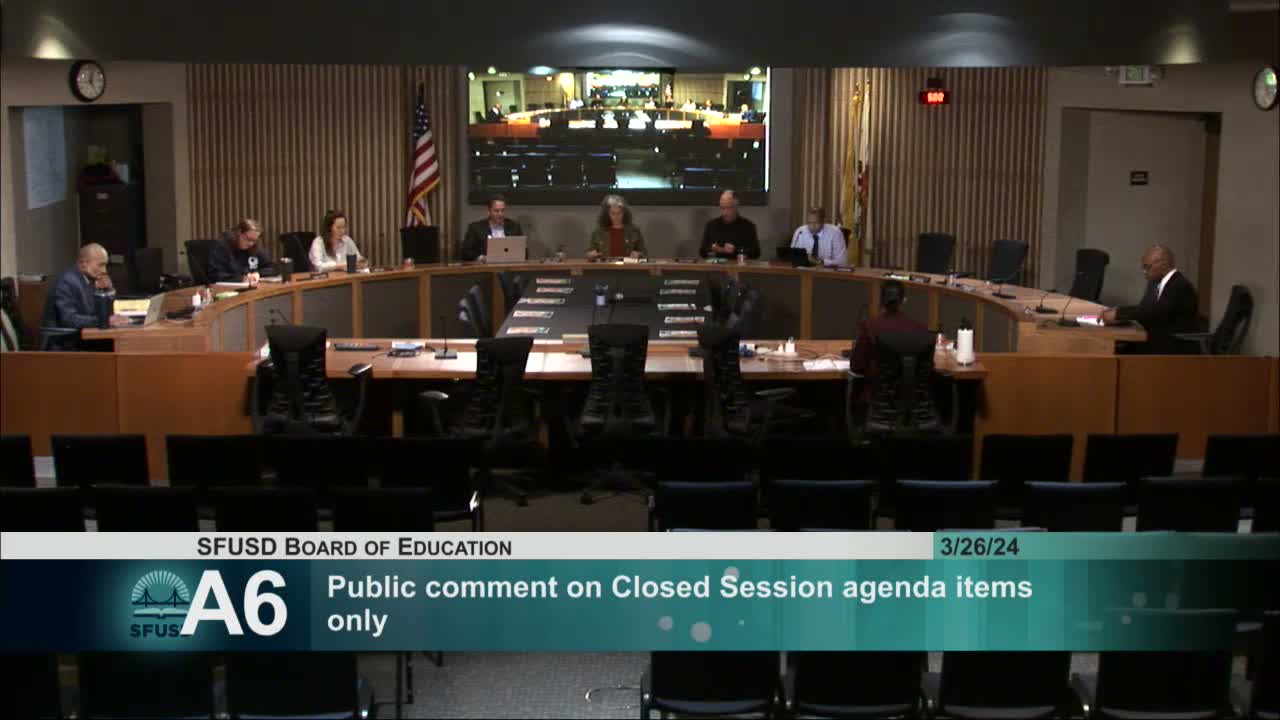
Diane Silver of FairVote told the San Francisco Unified School District board that the organization’s analysis found "meaningful levels of racially polarized voting" in school board races from 2016 to 2022, arguing the data show white voters were able to elect their preferred candidates while AAPI and Latino voters were not. She said increased "bullet voting" amplified that effect.
Tom Sherring, co‑founder of the California Ranked Choice Voting Coalition, warned the board that the California Voting Rights Act does not set a fixed legal threshold and that liability in CVRA cases can turn on judicial interpretation, creating "an element of uncertainty and legal risk" for the district and potentially significant litigation costs.
Scott, who identified himself as representing the party that sent the CVRA notice, told the board the group had sought to work with SFUSD and "didn't actually threaten litigation," but alleged the district "violated the Brown Act" and distributed the correspondence improperly. He said his clients were "blindsided" and described the episode as a governance failure.
Board members did not act on the comments during the closed‑session phase; the public commentary on these items concluded before the board recessed into closed session. The board later reported routine closed‑session settlements in OAH special‑education matters but did not announce any public item resolving the CVRA concerns.
The exchanges during public comment placed legal risk and governance transparency at the center of community attention and were recorded for the public record.
Tom Sherring, co‑founder of the California Ranked Choice Voting Coalition, warned the board that the California Voting Rights Act does not set a fixed legal threshold and that liability in CVRA cases can turn on judicial interpretation, creating "an element of uncertainty and legal risk" for the district and potentially significant litigation costs.
Scott, who identified himself as representing the party that sent the CVRA notice, told the board the group had sought to work with SFUSD and "didn't actually threaten litigation," but alleged the district "violated the Brown Act" and distributed the correspondence improperly. He said his clients were "blindsided" and described the episode as a governance failure.
Board members did not act on the comments during the closed‑session phase; the public commentary on these items concluded before the board recessed into closed session. The board later reported routine closed‑session settlements in OAH special‑education matters but did not announce any public item resolving the CVRA concerns.
The exchanges during public comment placed legal risk and governance transparency at the center of community attention and were recorded for the public record.
View the Full Meeting & All Its Details
This article offers just a summary. Unlock complete video, transcripts, and insights as a Founder Member.
✓
Watch full, unedited meeting videos
✓
Search every word spoken in unlimited transcripts
✓
AI summaries & real-time alerts (all government levels)
✓
Permanent access to expanding government content
30-day money-back guarantee
