SFUSD monitoring report shows small gains in kindergarten; board debates realism of interim literacy goals and adopts new curriculum
March 26, 2024 | San Francisco City, San Francisco County, California
This article was created by AI summarizing key points discussed. AI makes mistakes, so for full details and context, please refer to the video of the full meeting. Please report any errors so we can fix them. Report an error »
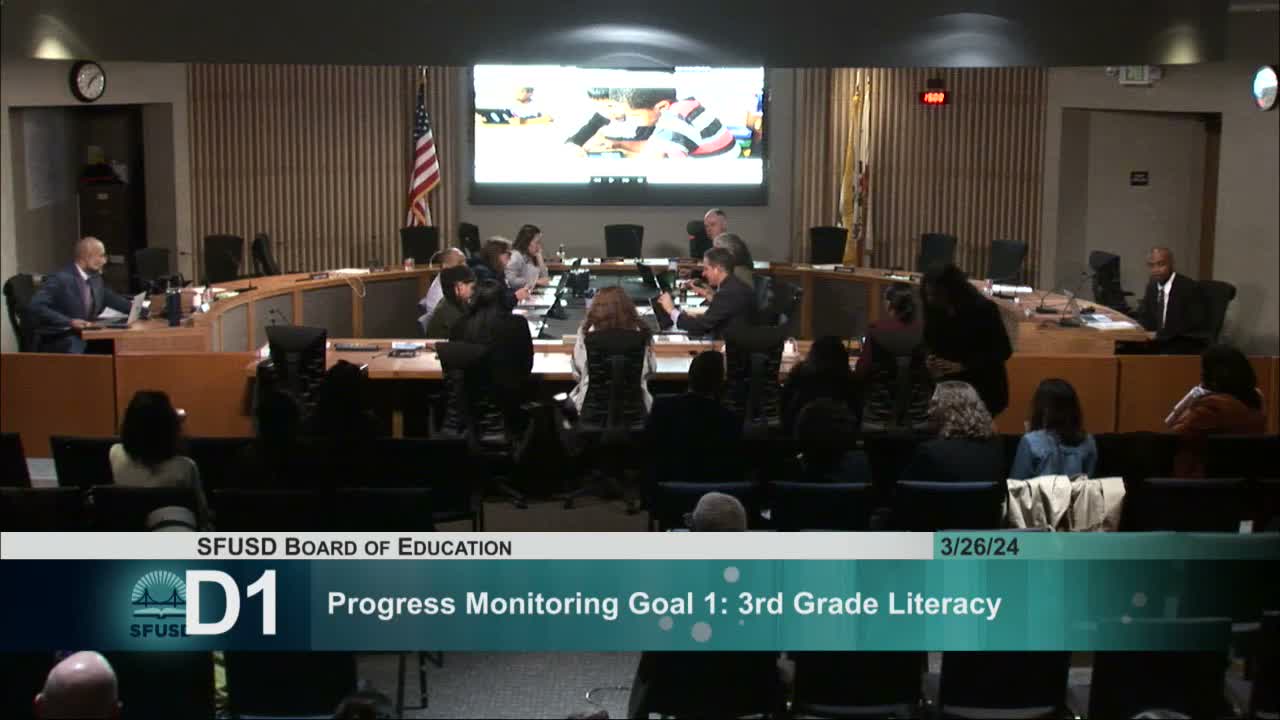
Superintendent Dr. Wayne presented the district’s third progress monitoring report on third‑grade literacy and said the fall‑to‑winter STAR benchmark showed slight kindergarten improvement but left the district "off track" for the district’s five‑year third‑grade literacy target (report cited roughly 33% of students meeting standards vs. a 40% interim trajectory).
Staff described Each and Every by Name, a case‑management approach focused on roughly 225 Black and Pacific Islander kindergarteners per grade. Director Leticia Irving said the initiative includes personalized family outreach, distribution of leveled decodable readers, site‑level coordinated care teams and professional learning for teachers to drive targeted interventions.
Dr. Nicole Priestley summarized the Amira high‑dosage tutoring program the board recently approved for initial rollout. She said Amira is grounded in the science of reading, offers student‑level feedback and teacher reports, and will be piloted with training sessions beginning the next day. Staff emphasized that Amira is one initial intervention and that district teams are working with pilot schools that volunteered to be early adopters.
Board members pressed staff on three monitoring questions staff asked the board to consider: does the current reality match the district's vision, is there measurable growth toward that vision, and is the strategy and plan sufficient to cause growth. Commissioners raised concerns about the pace of progress, staffing and whether the district has a sufficiently specific, resourced contingency plan. Staff pointed to bright spots in pilot schools (an example cited a target school with a 44% rate for the targeted subgroup) and said additional assessment and third‑trimester results would be reported in June.
After the monitoring discussion the board considered an action item to adopt new core instructional materials for TK–K–5 and 6–8. Staff described a multi‑year review and pilot process (EdReports screening, TNTP partnership, ~200 teachers piloting materials) and recommended adoption to enable ordering and early teacher training. The board approved the adoption by roll call vote.
Next steps: staff will continue monitoring with a third‑trimester assessment in June; the board signaled it expects more detailed implementation metrics and budget alignment in subsequent reports.
Staff described Each and Every by Name, a case‑management approach focused on roughly 225 Black and Pacific Islander kindergarteners per grade. Director Leticia Irving said the initiative includes personalized family outreach, distribution of leveled decodable readers, site‑level coordinated care teams and professional learning for teachers to drive targeted interventions.
Dr. Nicole Priestley summarized the Amira high‑dosage tutoring program the board recently approved for initial rollout. She said Amira is grounded in the science of reading, offers student‑level feedback and teacher reports, and will be piloted with training sessions beginning the next day. Staff emphasized that Amira is one initial intervention and that district teams are working with pilot schools that volunteered to be early adopters.
Board members pressed staff on three monitoring questions staff asked the board to consider: does the current reality match the district's vision, is there measurable growth toward that vision, and is the strategy and plan sufficient to cause growth. Commissioners raised concerns about the pace of progress, staffing and whether the district has a sufficiently specific, resourced contingency plan. Staff pointed to bright spots in pilot schools (an example cited a target school with a 44% rate for the targeted subgroup) and said additional assessment and third‑trimester results would be reported in June.
After the monitoring discussion the board considered an action item to adopt new core instructional materials for TK–K–5 and 6–8. Staff described a multi‑year review and pilot process (EdReports screening, TNTP partnership, ~200 teachers piloting materials) and recommended adoption to enable ordering and early teacher training. The board approved the adoption by roll call vote.
Next steps: staff will continue monitoring with a third‑trimester assessment in June; the board signaled it expects more detailed implementation metrics and budget alignment in subsequent reports.
View the Full Meeting & All Its Details
This article offers just a summary. Unlock complete video, transcripts, and insights as a Founder Member.
✓
Watch full, unedited meeting videos
✓
Search every word spoken in unlimited transcripts
✓
AI summaries & real-time alerts (all government levels)
✓
Permanent access to expanding government content
30-day money-back guarantee
