SFUSD board declines to accept eighth‑grade math monitoring report, cites insufficient plan
April 30, 2024 | San Francisco City, San Francisco County, California
This article was created by AI summarizing key points discussed. AI makes mistakes, so for full details and context, please refer to the video of the full meeting. Please report any errors so we can fix them. Report an error »
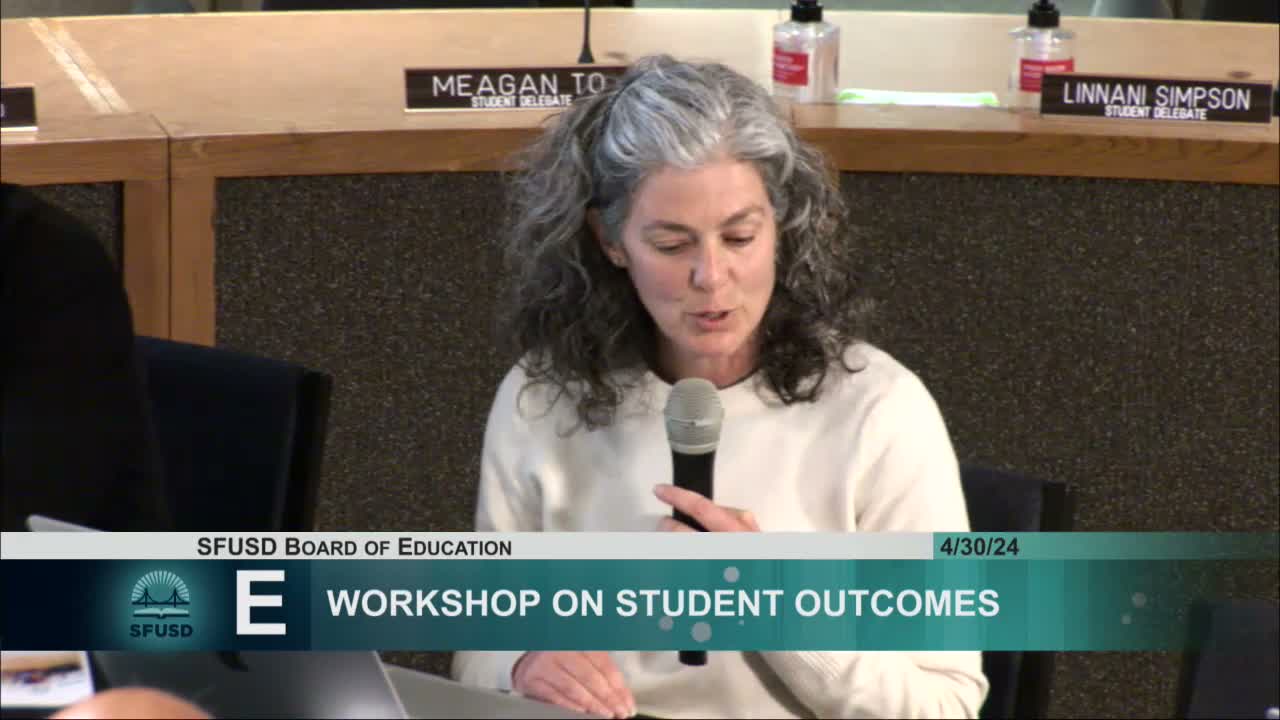
The San Francisco Unified School District Board of Education voted unanimously to not accept the district’s monitoring report on its eighth‑grade math goal after a monitoring workshop in which trustees pressed staff for clearer timelines, numeric targets and equity safeguards.
The vote followed presentations from district staff about interim assessment data, the broader curriculum adoption process and supplemental supports such as DreamBox. In public comment before the discussion, parent John Jurson said the report left him "more worried for my kids," and parents and advocates urged greater emphasis on in‑person supports such as high‑dosage tutoring.
Superintendent (as identified in the meeting) and staff told trustees that new assessments used this year measure more standards and that, as a result, fewer students currently meet the district’s interim benchmarks. Staff pointed to DreamBox users showing stronger scale‑score growth than nonusers and described a curriculum review process that will narrow candidates to pilots for the 2024‑25 school year. Jeanette Hernandez, executive director of professional learning and coaching, described a lesson‑study model and site‑based coaching for middle schools.
Trustees repeatedly pressed staff on instructional minutes and bell schedules, noting large variance across middle schools (examples discussed in the meeting ranged from roughly 40‑minute to 75‑minute periods). District presenters said the district will set a 205‑minute baseline for math next year and that LEAD (district instructional leaders) will review and approve bell and master schedules. Assistant superintendent Dr. Aguilera Fortes committed to delivering, by May, a detailed scope and sequence for professional learning, related staffing and a timeline for rollout.
Equity questions were prominent in the discussion. Several trustees asked how the district will avoid racially disparate tracking if algebra is restored or if additional math periods are offered. Staff described changing an "opt‑in" approach to an "assigned unless opt‑out" model for additional math periods and said the district plans readiness work (including programs referenced as Black Star Rising) to broaden access.
After the Q&A, the board conducted a roll‑call vote on whether to accept the monitoring report. The tally recorded in the meeting was seven 'no' votes and zero 'yes' votes, and the motion failed. The board did not approve the report and directed staff to return with clearer, school‑level plans and data to address the board’s concerns.
The board adjourned at 8:24 p.m. and asked staff to correct missing or inconsistent materials posted to BoardDocs and to provide additional disaggregated data for a future monitoring session.
The vote followed presentations from district staff about interim assessment data, the broader curriculum adoption process and supplemental supports such as DreamBox. In public comment before the discussion, parent John Jurson said the report left him "more worried for my kids," and parents and advocates urged greater emphasis on in‑person supports such as high‑dosage tutoring.
Superintendent (as identified in the meeting) and staff told trustees that new assessments used this year measure more standards and that, as a result, fewer students currently meet the district’s interim benchmarks. Staff pointed to DreamBox users showing stronger scale‑score growth than nonusers and described a curriculum review process that will narrow candidates to pilots for the 2024‑25 school year. Jeanette Hernandez, executive director of professional learning and coaching, described a lesson‑study model and site‑based coaching for middle schools.
Trustees repeatedly pressed staff on instructional minutes and bell schedules, noting large variance across middle schools (examples discussed in the meeting ranged from roughly 40‑minute to 75‑minute periods). District presenters said the district will set a 205‑minute baseline for math next year and that LEAD (district instructional leaders) will review and approve bell and master schedules. Assistant superintendent Dr. Aguilera Fortes committed to delivering, by May, a detailed scope and sequence for professional learning, related staffing and a timeline for rollout.
Equity questions were prominent in the discussion. Several trustees asked how the district will avoid racially disparate tracking if algebra is restored or if additional math periods are offered. Staff described changing an "opt‑in" approach to an "assigned unless opt‑out" model for additional math periods and said the district plans readiness work (including programs referenced as Black Star Rising) to broaden access.
After the Q&A, the board conducted a roll‑call vote on whether to accept the monitoring report. The tally recorded in the meeting was seven 'no' votes and zero 'yes' votes, and the motion failed. The board did not approve the report and directed staff to return with clearer, school‑level plans and data to address the board’s concerns.
The board adjourned at 8:24 p.m. and asked staff to correct missing or inconsistent materials posted to BoardDocs and to provide additional disaggregated data for a future monitoring session.
View the Full Meeting & All Its Details
This article offers just a summary. Unlock complete video, transcripts, and insights as a Founder Member.
✓
Watch full, unedited meeting videos
✓
Search every word spoken in unlimited transcripts
✓
AI summaries & real-time alerts (all government levels)
✓
Permanent access to expanding government content
30-day money-back guarantee
