SFUSD says internships are growing; student and UCSF partners highlight program supports and limits
May 28, 2024 | San Francisco City, San Francisco County, California
This article was created by AI summarizing key points discussed. AI makes mistakes, so for full details and context, please refer to the video of the full meeting. Please report any errors so we can fix them. Report an error »
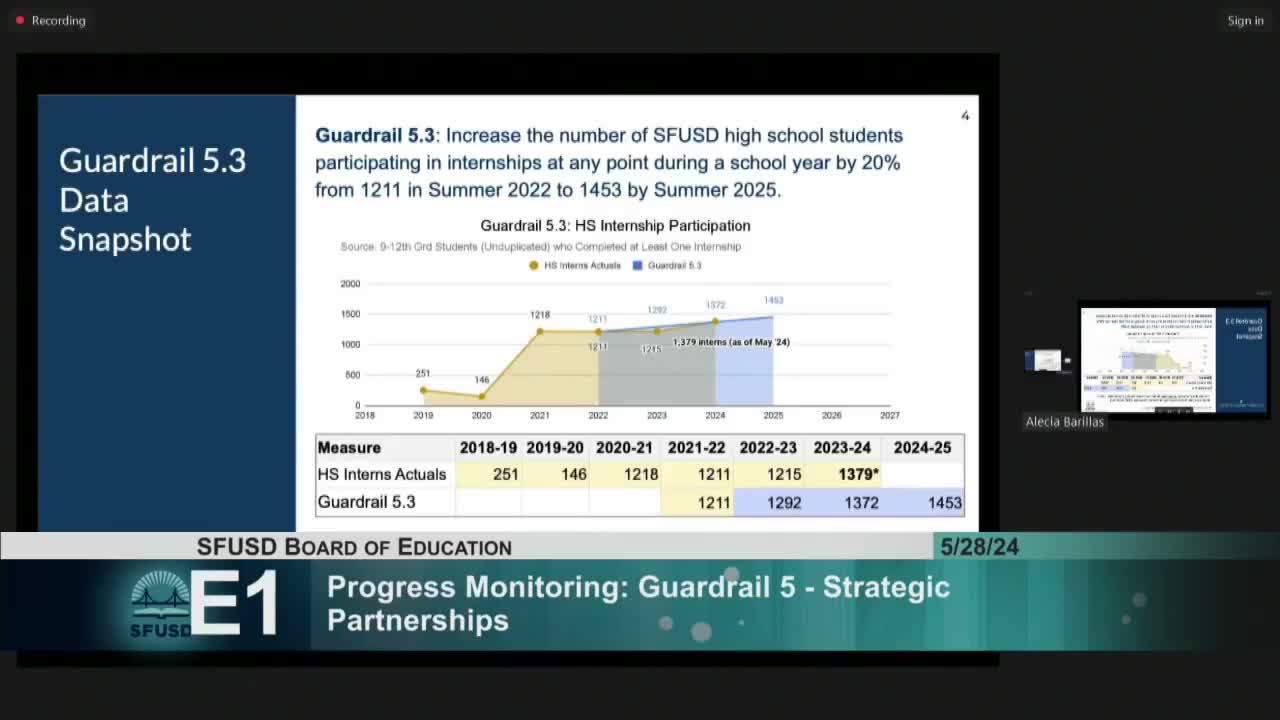
San Francisco Unified School District staff reported that the district is on track to meet an interim Guardrail 5 goal to increase paid high-school internships by 20%—from about 1,211 in summer 2022 to a target of 1,453 by summer 2025.
Presenters said the district expects roughly 1,379 interns this summer, modestly above the stated target, and outlined the program model: host MOUs, student learning plans, host orientations, payroll and workers' compensation arrangements, dual-enrollment opportunities with City College classes for qualifying interns, and supervision provided by district staff. Staff said much of the paid work is supported by philanthropy and city funding streams such as DCYF.
Student testimony was a central part of the session. Genesis Cerritos, a multi-year intern placed at Carver Elementary with the Boys and Girls Club, told commissioners the experience "has helped me grow as a person" and credited named supervisors for mentorship, dual-enrollment coursework, and financial support for her family. A UCSF pathway coordinator, Fabiola Aguinaga, said UCSF will accept 46 district students this summer and discussed how past interns have extended placements and taken on additional responsibilities.
Commissioners used the monitoring session to probe program scalability and coordination across city partners. Questions focused on how the district is aligning internship placements with city agencies (for example, PUC and MTA), how students who need credit recovery can participate, and the district's ability to scale given staff capacity and the need for standardized MOUs across departments. Staff emphasized staffing constraints—including a district hiring freeze and shortages of certificated staff—and noted one practical limit: setting up individual MOUs for many small placements imposes heavy administrative overhead, whereas larger host sites (for example, Boys and Girls Club cohorts) are easier to supervise.
Staff also confirmed a typical pay rate cited during discussion and said the district uses DCYF and philanthropic funds to support stipends. Commissioners asked for more detailed implementation instruments and playbooks; AJ Crabill and staff said those playbooks exist and that a monitoring calendar will be provided for board review.
The board voted to accept the Guardrail 5 monitoring report and shifted into a broader conversation about whether the board should revise the guardrail framework to include additional focus on fiscal and operational health and to consider ad hoc work on governance and monitoring calendars. The monitoring acceptance vote was unanimous.
Next steps recorded during the meeting included requests for staff to share implementation playbooks, the monitoring calendar, and additional data on outcomes the board asked to track (for example, whether participation in internships correlates with improved academic or completion metrics).
Presenters said the district expects roughly 1,379 interns this summer, modestly above the stated target, and outlined the program model: host MOUs, student learning plans, host orientations, payroll and workers' compensation arrangements, dual-enrollment opportunities with City College classes for qualifying interns, and supervision provided by district staff. Staff said much of the paid work is supported by philanthropy and city funding streams such as DCYF.
Student testimony was a central part of the session. Genesis Cerritos, a multi-year intern placed at Carver Elementary with the Boys and Girls Club, told commissioners the experience "has helped me grow as a person" and credited named supervisors for mentorship, dual-enrollment coursework, and financial support for her family. A UCSF pathway coordinator, Fabiola Aguinaga, said UCSF will accept 46 district students this summer and discussed how past interns have extended placements and taken on additional responsibilities.
Commissioners used the monitoring session to probe program scalability and coordination across city partners. Questions focused on how the district is aligning internship placements with city agencies (for example, PUC and MTA), how students who need credit recovery can participate, and the district's ability to scale given staff capacity and the need for standardized MOUs across departments. Staff emphasized staffing constraints—including a district hiring freeze and shortages of certificated staff—and noted one practical limit: setting up individual MOUs for many small placements imposes heavy administrative overhead, whereas larger host sites (for example, Boys and Girls Club cohorts) are easier to supervise.
Staff also confirmed a typical pay rate cited during discussion and said the district uses DCYF and philanthropic funds to support stipends. Commissioners asked for more detailed implementation instruments and playbooks; AJ Crabill and staff said those playbooks exist and that a monitoring calendar will be provided for board review.
The board voted to accept the Guardrail 5 monitoring report and shifted into a broader conversation about whether the board should revise the guardrail framework to include additional focus on fiscal and operational health and to consider ad hoc work on governance and monitoring calendars. The monitoring acceptance vote was unanimous.
Next steps recorded during the meeting included requests for staff to share implementation playbooks, the monitoring calendar, and additional data on outcomes the board asked to track (for example, whether participation in internships correlates with improved academic or completion metrics).
View the Full Meeting & All Its Details
This article offers just a summary. Unlock complete video, transcripts, and insights as a Founder Member.
✓
Watch full, unedited meeting videos
✓
Search every word spoken in unlimited transcripts
✓
AI summaries & real-time alerts (all government levels)
✓
Permanent access to expanding government content
30-day money-back guarantee
