DAS commission approves RFP schedule and a series of caregiver, nutrition and health program grants
September 07, 2022 | San Francisco City, San Francisco County, California
This article was created by AI summarizing key points discussed. AI makes mistakes, so for full details and context, please refer to the video of the full meeting. Please report any errors so we can fix them. Report an error »
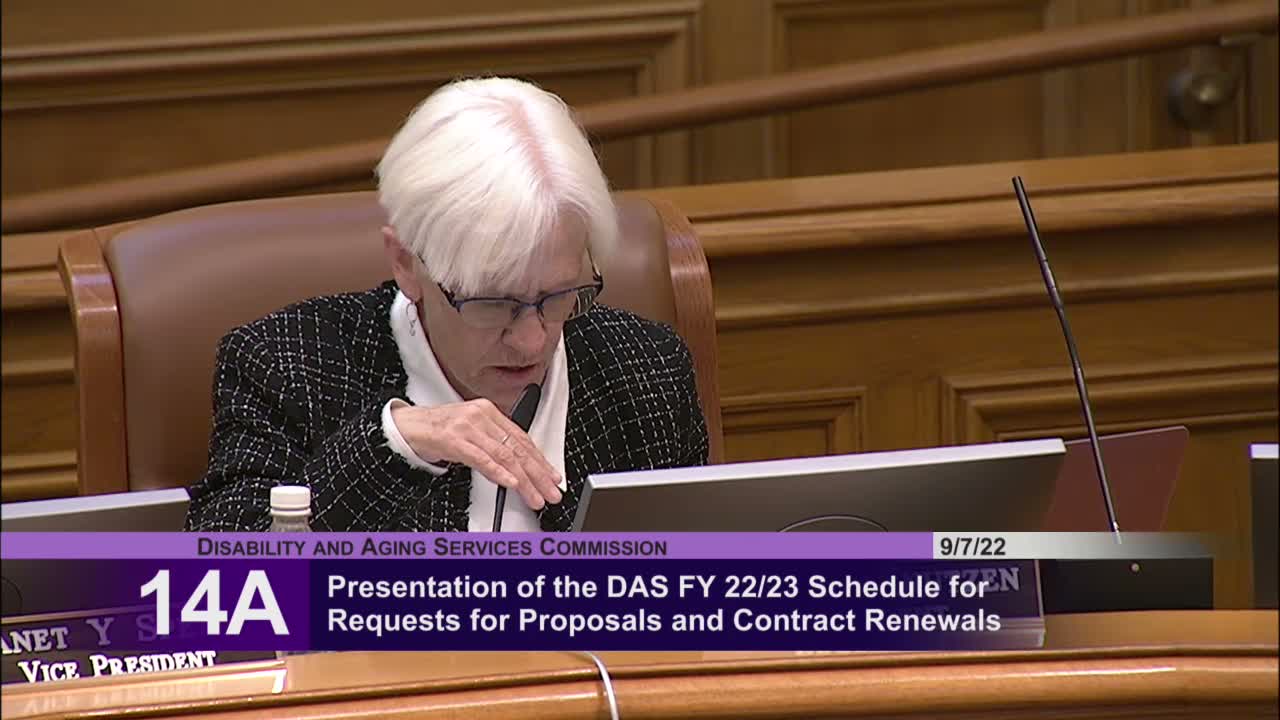
The San Francisco Department of Disability and Aging Services Commission on Sept. 7 approved a busy FY22–23 contracting schedule and a series of grant awards and contract modifications aimed at expanding respite, nutrition education and chronic disease self-management services for older adults and adults with disabilities.
Executive Director Kelly Dearman told the commission the department will be involved in a state pilot for ‘‘care courts’’ (CARE, Community Assistance, Recovery and Empowerment) that San Francisco is slated to implement beginning in October 2023; she also described DAS’s heat-response outreach, including wellness calls and coordination with community partners.
Why it matters: Commissioners said they wanted to see the DAS contracting calendar so they could track how services funded through the Dignity Fund, American Rescue Plan Act (ARPA) and other sources will be procured and delivered. The department presented a schedule of 29 RFPs for the coming year and highlighted programs designed to reduce isolation, increase digital access and expand culturally and linguistically appropriate services.
Key actions and funding
- Institute on Aging respite grant: The commission approved a new Dignity Fund grant to the Institute on Aging (IOA) to operate a temporary caregiver respite support program from Sept. 1, 2022, through June 30, 2026. Program analyst Erica Maybaum said, “The purpose of this grant is to assist San Francisco residents who are unpaid caregivers of older adults or adults with disabilities by providing respite and to expand caregiver support services.” The award is $3,137,948 plus a 10% contingency, for a total not to exceed $3,451,743. IOA plans to serve at least 125 unduplicated caregivers in year one (9,600 respite hours) and 175 annually thereafter (16,750 hours).
- Interim Family Caregiver Alliance (FCA) funding: To avoid gaps while IOA ramps up, the commission approved a $160,000 budget modification to FCA (plus a 10% contingency; the commission-recorded revised total references DAS accounting) to provide up to 2,000 hours of additional in‑home respite, extra caregiver counseling hours and outreach to additional caregivers.
- SNAP-Ed modification (Self Help for the Elderly): Tiffany Kearney, DAS lead nutritionist, presented a modification to add $73,502 (plus 10% contingency) to Self Help for the Elderly’s SNAP-Ed award for May 1–Sept. 30, 2022, increasing the total to not exceed $217,623. Kearney said SNAP-Ed supports nutrition education, cooking demonstrations and activities at community sites and noted special outreach to veterans and BIPOC-serving locations including coordination with Swords to Plowshare.
- MIPA / HiCAP funds (Self Help for the Elderly): The commission approved an $84,792 addition (plus 10% contingency; total not to exceed $93,271) to add Medicare Improvements for Patients and Providers Act (MIPA) outreach funding into the HiCAP counseling contract to boost outreach around low-income subsidies and Medicare Savings Plan enrollment.
- On Lok Day Services modification: The commission approved a modification to On Lok Day Services to add $105,516 (plus 10% contingency) to expand evidence-based disease self-management offerings, including a chronic pain self-management course, multilingual delivery and staff training. The department’s posted total in the transcript was inconsistently formatted as “not to exceed 1,000,000, $64,989”; DAS materials clarify the intended revised not-to-exceed amount as $1,064,989.
Commission process and votes
All motions to approve the minutes, the teleconferencing resolution, authorization for third-party virtual presenters, the RFP schedule-related items and the grant and contract modifications carried on unanimous roll-call votes. Motions were made and seconded on the record (for example, the minutes were moved by Commissioner Sasha Buettner and seconded by Commissioner Wanda Jeong).
Questions and follow-up
Commissioners pressed presenters on outreach plans for the IOA respite grant and SNAP-Ed modifications. Maybaum and Kearney described reliance on contractors’ existing outreach channels and offered to follow up with more detailed outreach plans. Commissioners also asked how one-time ARPA funds would affect long-term service levels; staff said ARPA funding is one-time and baseline Title IIID and similar program funds would determine ongoing capacity.
What’s next: DAS staff said they will share contractors’ detailed outreach plans and implementation timelines with commissioners as the new grants and modifications are executed. The commission adjourned after brief announcements.
Executive Director Kelly Dearman told the commission the department will be involved in a state pilot for ‘‘care courts’’ (CARE, Community Assistance, Recovery and Empowerment) that San Francisco is slated to implement beginning in October 2023; she also described DAS’s heat-response outreach, including wellness calls and coordination with community partners.
Why it matters: Commissioners said they wanted to see the DAS contracting calendar so they could track how services funded through the Dignity Fund, American Rescue Plan Act (ARPA) and other sources will be procured and delivered. The department presented a schedule of 29 RFPs for the coming year and highlighted programs designed to reduce isolation, increase digital access and expand culturally and linguistically appropriate services.
Key actions and funding
- Institute on Aging respite grant: The commission approved a new Dignity Fund grant to the Institute on Aging (IOA) to operate a temporary caregiver respite support program from Sept. 1, 2022, through June 30, 2026. Program analyst Erica Maybaum said, “The purpose of this grant is to assist San Francisco residents who are unpaid caregivers of older adults or adults with disabilities by providing respite and to expand caregiver support services.” The award is $3,137,948 plus a 10% contingency, for a total not to exceed $3,451,743. IOA plans to serve at least 125 unduplicated caregivers in year one (9,600 respite hours) and 175 annually thereafter (16,750 hours).
- Interim Family Caregiver Alliance (FCA) funding: To avoid gaps while IOA ramps up, the commission approved a $160,000 budget modification to FCA (plus a 10% contingency; the commission-recorded revised total references DAS accounting) to provide up to 2,000 hours of additional in‑home respite, extra caregiver counseling hours and outreach to additional caregivers.
- SNAP-Ed modification (Self Help for the Elderly): Tiffany Kearney, DAS lead nutritionist, presented a modification to add $73,502 (plus 10% contingency) to Self Help for the Elderly’s SNAP-Ed award for May 1–Sept. 30, 2022, increasing the total to not exceed $217,623. Kearney said SNAP-Ed supports nutrition education, cooking demonstrations and activities at community sites and noted special outreach to veterans and BIPOC-serving locations including coordination with Swords to Plowshare.
- MIPA / HiCAP funds (Self Help for the Elderly): The commission approved an $84,792 addition (plus 10% contingency; total not to exceed $93,271) to add Medicare Improvements for Patients and Providers Act (MIPA) outreach funding into the HiCAP counseling contract to boost outreach around low-income subsidies and Medicare Savings Plan enrollment.
- On Lok Day Services modification: The commission approved a modification to On Lok Day Services to add $105,516 (plus 10% contingency) to expand evidence-based disease self-management offerings, including a chronic pain self-management course, multilingual delivery and staff training. The department’s posted total in the transcript was inconsistently formatted as “not to exceed 1,000,000, $64,989”; DAS materials clarify the intended revised not-to-exceed amount as $1,064,989.
Commission process and votes
All motions to approve the minutes, the teleconferencing resolution, authorization for third-party virtual presenters, the RFP schedule-related items and the grant and contract modifications carried on unanimous roll-call votes. Motions were made and seconded on the record (for example, the minutes were moved by Commissioner Sasha Buettner and seconded by Commissioner Wanda Jeong).
Questions and follow-up
Commissioners pressed presenters on outreach plans for the IOA respite grant and SNAP-Ed modifications. Maybaum and Kearney described reliance on contractors’ existing outreach channels and offered to follow up with more detailed outreach plans. Commissioners also asked how one-time ARPA funds would affect long-term service levels; staff said ARPA funding is one-time and baseline Title IIID and similar program funds would determine ongoing capacity.
What’s next: DAS staff said they will share contractors’ detailed outreach plans and implementation timelines with commissioners as the new grants and modifications are executed. The commission adjourned after brief announcements.
View the Full Meeting & All Its Details
This article offers just a summary. Unlock complete video, transcripts, and insights as a Founder Member.
✓
Watch full, unedited meeting videos
✓
Search every word spoken in unlimited transcripts
✓
AI summaries & real-time alerts (all government levels)
✓
Permanent access to expanding government content
30-day money-back guarantee
