San Francisco aging services agency warns of large multi-year budget shortfalls; will return Feb. 7 with recommended cuts
January 10, 2024 | San Francisco City, San Francisco County, California
This article was created by AI summarizing key points discussed. AI makes mistakes, so for full details and context, please refer to the video of the full meeting. Please report any errors so we can fix them. Report an error »
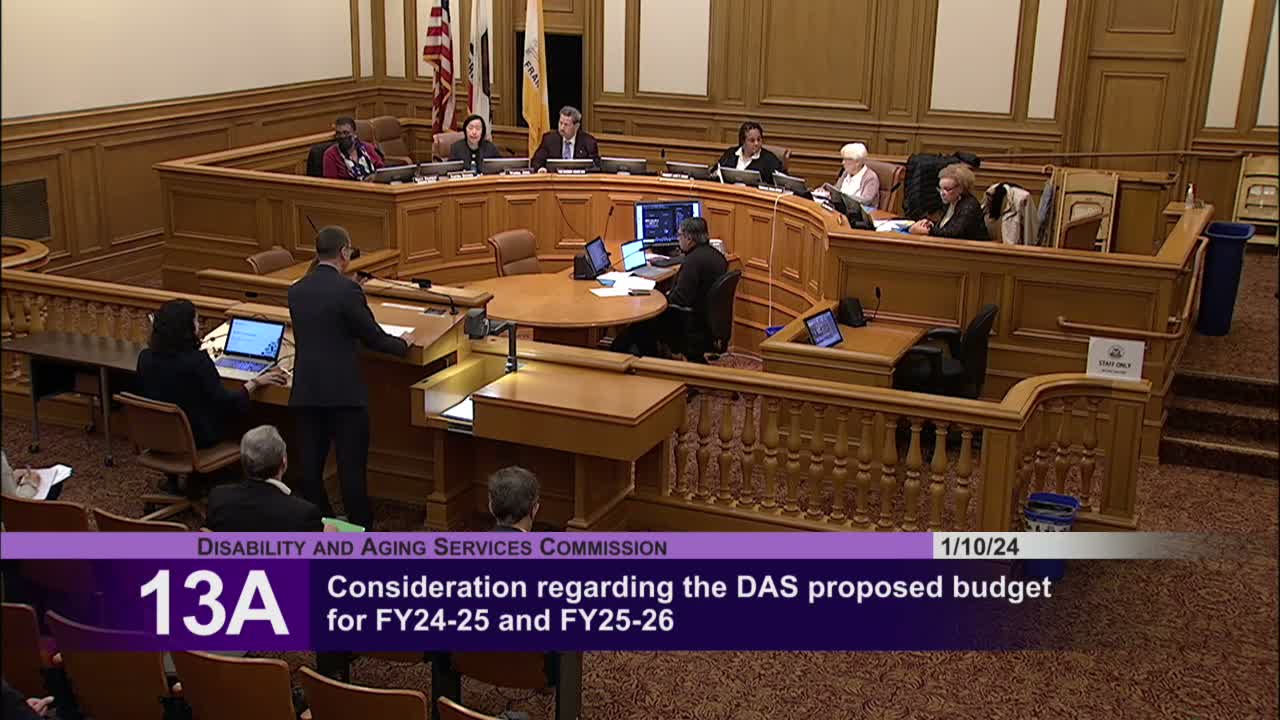
The San Francisco Department of Disability and Aging Services told commissioners on Jan. 10 that the city and agency face a substantial budget gap and that staff will return Feb. 7 with a recommended budget proposing discretionary reductions.
HSA Deputy Director for Administration and Finance Dan Kaplan opened the department's budget briefing by describing a multi-year forecast that he said projects "a budget deficit of $1,300,000,000 a year" in the joint five-year outlook for the city. He later cited deficit figures for the next two budget years, noting a projected shortfall of about $245,000,000 in the budget year and $555,000,000 in the following year. "This is a cut year," Kaplan said, adding that the mayor has directed agencies to propose cuts equal to 10% of their discretionary general-fund revenue and to include a 5% contingency reduction.
Why it matters: DAS runs large programs that serve older adults and people with disabilities, and many DAS dollars are nondiscretionary. Kaplan told the commission that roughly 70% of the DAS program budget is tied to in-home supportive services (IHSS) and associated administration and benefits, leaving a smaller share of the budget that is eligible for discretionary reductions.
Kaplan outlined key drivers behind the shortfall: slower recovery of downtown commercial activity and tourism, reassessments of commercial properties, high inflation and rising health-care premiums, and the possibility of higher-than-assumed labor settlements. He said the city's five-year forecast "keeps growing" the deficit in out years and referenced long-term estimates approaching nearly $1 billion-plus in later years if assumptions do not change.
Director Kelly Dearman emphasized program needs and new demands on DAS resources, including implementation of a state change in conservatorship law. "As of January 1, the definition of grave disability for conservatorship has been expanded to now include people with severe substance use disorder," Dearman said, and she noted cross-departmental work with DPH, police, fire, the sheriff's office and the mayor's office to prepare for increased referrals and service demands.
Staff described revenue and expenditure composition: roughly 24% federal, 36% state and 40% local funding for DAS overall; realignment (1991 and 2011) and dedicated funds such as the Dignity Fund were discussed as partially protected revenue streams. Kaplan also explained that certain large program costs (for example, the IHSS maintenance-of-effort formula and some Dignity Fund amounts) are not discretionary and therefore are not candidates for the 10% reductions.
What commissioners asked for and what's next: Commissioners pressed staff to identify where discretionary cuts would appear; Kaplan and Dearman said those specifics will be included in the Feb. 7 recommended budget. Kaplan said staff will look for a mix of approaches: seeking potential revenue opportunities, right-sizing contracts where service levels do not match contract ceilings, and minimizing direct service reductions where possible. He said the budget office and program teams will aim to preserve client services and CBO partners as much as feasible.
The commission did not take action on the informational item. Staff will present the recommended DAS budget at the Feb. 7 meeting and submit the agency's requested budget to the mayor by Feb. 21 as required by the city charter.
HSA Deputy Director for Administration and Finance Dan Kaplan opened the department's budget briefing by describing a multi-year forecast that he said projects "a budget deficit of $1,300,000,000 a year" in the joint five-year outlook for the city. He later cited deficit figures for the next two budget years, noting a projected shortfall of about $245,000,000 in the budget year and $555,000,000 in the following year. "This is a cut year," Kaplan said, adding that the mayor has directed agencies to propose cuts equal to 10% of their discretionary general-fund revenue and to include a 5% contingency reduction.
Why it matters: DAS runs large programs that serve older adults and people with disabilities, and many DAS dollars are nondiscretionary. Kaplan told the commission that roughly 70% of the DAS program budget is tied to in-home supportive services (IHSS) and associated administration and benefits, leaving a smaller share of the budget that is eligible for discretionary reductions.
Kaplan outlined key drivers behind the shortfall: slower recovery of downtown commercial activity and tourism, reassessments of commercial properties, high inflation and rising health-care premiums, and the possibility of higher-than-assumed labor settlements. He said the city's five-year forecast "keeps growing" the deficit in out years and referenced long-term estimates approaching nearly $1 billion-plus in later years if assumptions do not change.
Director Kelly Dearman emphasized program needs and new demands on DAS resources, including implementation of a state change in conservatorship law. "As of January 1, the definition of grave disability for conservatorship has been expanded to now include people with severe substance use disorder," Dearman said, and she noted cross-departmental work with DPH, police, fire, the sheriff's office and the mayor's office to prepare for increased referrals and service demands.
Staff described revenue and expenditure composition: roughly 24% federal, 36% state and 40% local funding for DAS overall; realignment (1991 and 2011) and dedicated funds such as the Dignity Fund were discussed as partially protected revenue streams. Kaplan also explained that certain large program costs (for example, the IHSS maintenance-of-effort formula and some Dignity Fund amounts) are not discretionary and therefore are not candidates for the 10% reductions.
What commissioners asked for and what's next: Commissioners pressed staff to identify where discretionary cuts would appear; Kaplan and Dearman said those specifics will be included in the Feb. 7 recommended budget. Kaplan said staff will look for a mix of approaches: seeking potential revenue opportunities, right-sizing contracts where service levels do not match contract ceilings, and minimizing direct service reductions where possible. He said the budget office and program teams will aim to preserve client services and CBO partners as much as feasible.
The commission did not take action on the informational item. Staff will present the recommended DAS budget at the Feb. 7 meeting and submit the agency's requested budget to the mayor by Feb. 21 as required by the city charter.
View the Full Meeting & All Its Details
This article offers just a summary. Unlock complete video, transcripts, and insights as a Founder Member.
✓
Watch full, unedited meeting videos
✓
Search every word spoken in unlimited transcripts
✓
AI summaries & real-time alerts (all government levels)
✓
Permanent access to expanding government content
30-day money-back guarantee
