San Francisco DAS reports shifts in Community Living Fund after CalAIM referrals; no waitlist reported
May 08, 2024 | San Francisco City, San Francisco County, California
This article was created by AI summarizing key points discussed. AI makes mistakes, so for full details and context, please refer to the video of the full meeting. Please report any errors so we can fix them. Report an error »
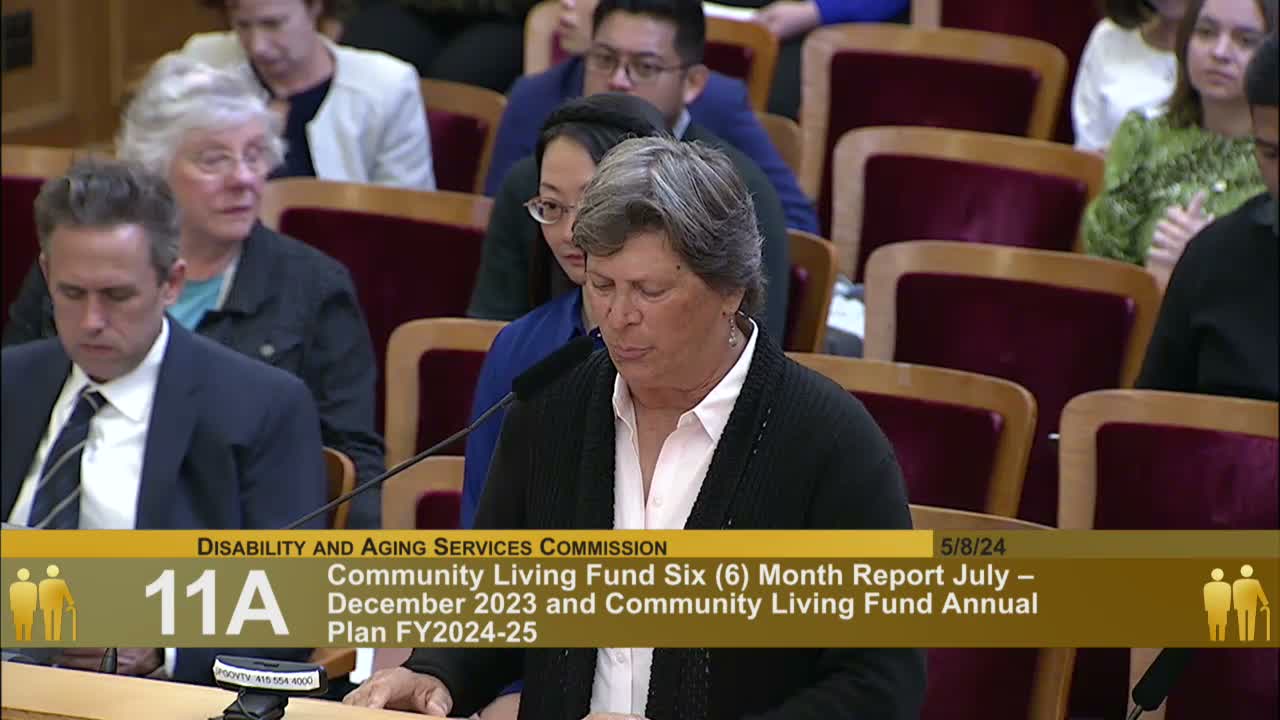
The San Francisco Department of Disability and Aging Services on Wednesday presented the Community Living Fund (CLF) six‑month report covering July–December 2023 and an annual plan for fiscal year 2024–25, noting operational changes tied to CalAIM’s enhanced care management referrals.
Melissa McGee, program manager in the Office of Community Partnerships, told the Disability and Aging Services Commission that CLF completed a database transition during the reporting period and that data remains spread across systems, requiring some manual work while a new data management system is finalized. She said the program received 362 new referrals in the period; roughly 25% of those referred were eligible and 89% of eligible individuals were approved for services.
McGee said CLF served 279 participants during the period, with 63% receiving traditional intensive case management (ICM) and 37% receiving enhanced care management (ECM) through the San Francisco Health Plan. She also said 99 of those participants received rental subsidies administered by Brilliant Corners.
Zhiqing Li, CLF program analyst, described five priorities for FY24–25 including continued ECM through CalAIM, expansion of the integrated housing model with Brilliant Corners, participation in the multidisciplinary CORE team led by Laguna Honda Hospital, continued support for the Public Guardian Housing Fund, and targeted outreach to increase equitable access for Asian and Pacific Islander and LGBTQ+ communities.
Presenters noted demographic shifts in referrals during the reporting period: white referrals fell to 23% while Black/African American referrals rose to 36% and now represent the largest share. Requests at intake most commonly included case management (57%), in‑home support (45%), mental health/substance‑abuse services (45%), housing support (43%) and food support (49%).
On costs, staff reported a net decrease in CLF program costs of $439,160 compared with the prior six‑month period and an average total monthly cost per client of $2,413, a $634 decrease from the previous six‑month measure. McGee said staff are still analyzing whether changes in referral composition and billing processes under ECM explain the cost change and that more definitive answers are expected once the database and billing processes are complete.
Commissioners asked how federal, state and local budget pressures could affect services; staff cautioned that federal funding has been largely flat and that the May Revise could affect local budget decisions. McGee reported that as of April 2024 there were no clients wait‑listed for ICM or ECM services.
The presentation was informational and did not require a vote. Commissioners thanked staff for transparency and asked for follow‑up reporting when the new data platform and billing reconciliation are complete.
Melissa McGee, program manager in the Office of Community Partnerships, told the Disability and Aging Services Commission that CLF completed a database transition during the reporting period and that data remains spread across systems, requiring some manual work while a new data management system is finalized. She said the program received 362 new referrals in the period; roughly 25% of those referred were eligible and 89% of eligible individuals were approved for services.
McGee said CLF served 279 participants during the period, with 63% receiving traditional intensive case management (ICM) and 37% receiving enhanced care management (ECM) through the San Francisco Health Plan. She also said 99 of those participants received rental subsidies administered by Brilliant Corners.
Zhiqing Li, CLF program analyst, described five priorities for FY24–25 including continued ECM through CalAIM, expansion of the integrated housing model with Brilliant Corners, participation in the multidisciplinary CORE team led by Laguna Honda Hospital, continued support for the Public Guardian Housing Fund, and targeted outreach to increase equitable access for Asian and Pacific Islander and LGBTQ+ communities.
Presenters noted demographic shifts in referrals during the reporting period: white referrals fell to 23% while Black/African American referrals rose to 36% and now represent the largest share. Requests at intake most commonly included case management (57%), in‑home support (45%), mental health/substance‑abuse services (45%), housing support (43%) and food support (49%).
On costs, staff reported a net decrease in CLF program costs of $439,160 compared with the prior six‑month period and an average total monthly cost per client of $2,413, a $634 decrease from the previous six‑month measure. McGee said staff are still analyzing whether changes in referral composition and billing processes under ECM explain the cost change and that more definitive answers are expected once the database and billing processes are complete.
Commissioners asked how federal, state and local budget pressures could affect services; staff cautioned that federal funding has been largely flat and that the May Revise could affect local budget decisions. McGee reported that as of April 2024 there were no clients wait‑listed for ICM or ECM services.
The presentation was informational and did not require a vote. Commissioners thanked staff for transparency and asked for follow‑up reporting when the new data platform and billing reconciliation are complete.
Don't Miss a Word: See the Full Meeting!
Go beyond summaries. Unlock every video, transcript, and key insight with a Founder Membership.
✓
Get instant access to full meeting videos
✓
Search and clip any phrase from complete transcripts
✓
Receive AI-powered summaries & custom alerts
✓
Enjoy lifetime, unrestricted access to government data
30-day money-back guarantee
