Controller's Office reports rise in whistleblower reports; many anonymous or out of jurisdiction
August 23, 2021 | San Francisco City, San Francisco County, California
This article was created by AI summarizing key points discussed. AI makes mistakes, so for full details and context, please refer to the video of the full meeting. Please report any errors so we can fix them. Report an error »
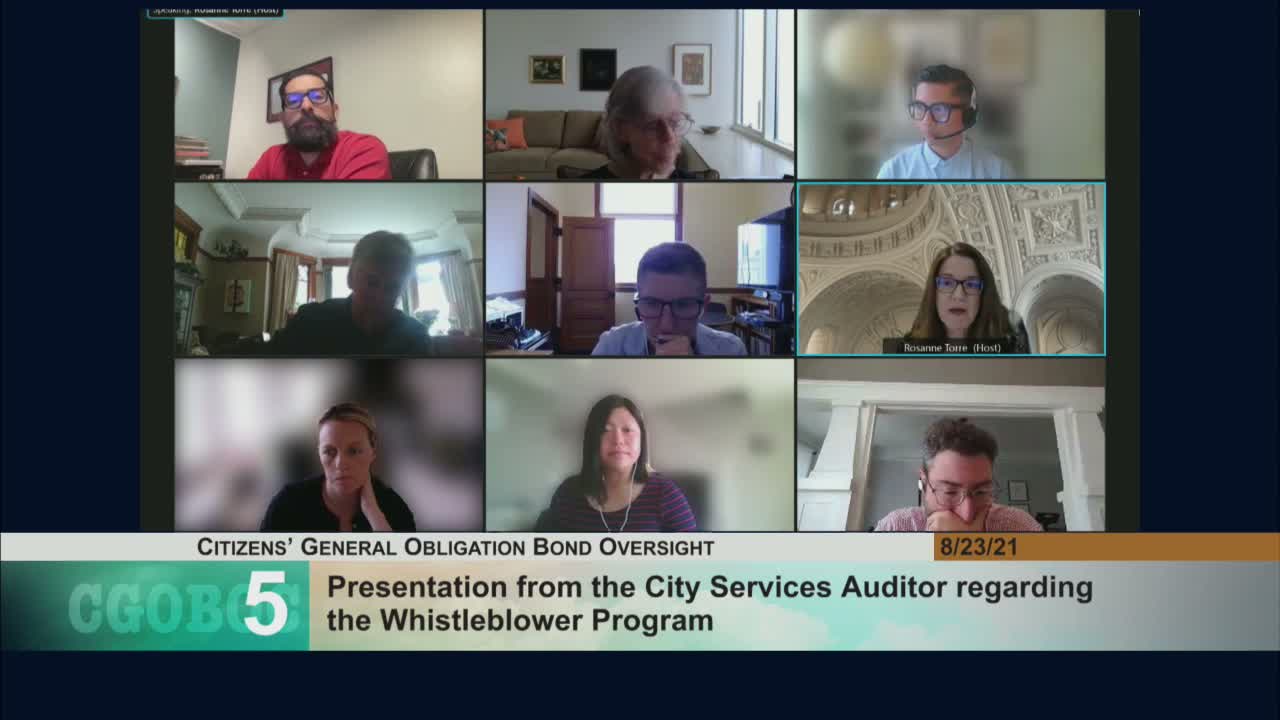
The Office of the Controller presented a quarterly and annual update on San Francisco's whistleblower program, reporting a rebound in complaints during fiscal year 2020–21 and outlining staffing, intake and next steps for program improvement.
Mark Dela Rosa introduced acting program manager Tiffany Wong and senior auditor‑investigator Steven Munoz, who summarized statutory authority and caseload metrics. Wong said the program's authority is derived from "California Government Code section 53087.6, the San Francisco Charter Appendix F, and the San Francisco Campaign and Governmental Conduct Code Article 4." She described recent operational upgrades, including a new case‑management system.
Wong reported that the office received 668 complaints in the fiscal year, closed 720 reports during that period, and had 53 reports open at close of year. "Sixty‑seven percent of reporters chose to remain anonymous," she said, and the office closed 82 percent of reports within 90 days. The program noted that 49 percent of closed reports were investigated; of investigative closures, 34 percent resulted in corrective or preventive action.
Controller's staff told the committee they have seen a recent spike in reports that contain only links or otherwise provide insufficient information for investigation, and that a substantial portion of incoming matters are outside the program's charter jurisdiction and must be referred to other agencies (for example, the City Attorney, district attorney or agency grievance mechanisms). Tiffany Wong said staff reach out for more information when possible but cannot investigate anonymous, link‑only complaints without additional facts.
Committee members pressed staff on why a large share of investigated reports do not lead to corrective action. "Why do two‑thirds of investigative reports not result in corrective or preventive action?" Commissioner Post asked. Wong and Mark Dela Rosa responded that some investigations are unsubstantiated, some matters are referred out, and that the Controller's Office issues recommendations while departments implement corrective steps and must provide follow‑up documentation.
The office outlined FY2021–22 initiatives: continued quarterly public reporting, liaison training for department investigators, two national webinars on fraud hotline practices, mandated whistleblower training for city employees, and an independent review of the program (an RFP and procurement timeline were described). The committee encouraged the Controller's Office to provide additional breakdowns on substantiation and referral categories and for staff to circulate more detailed statistics on the reasons investigative cases did not lead to corrective action.
There was no public comment on the whistleblower item.
Mark Dela Rosa introduced acting program manager Tiffany Wong and senior auditor‑investigator Steven Munoz, who summarized statutory authority and caseload metrics. Wong said the program's authority is derived from "California Government Code section 53087.6, the San Francisco Charter Appendix F, and the San Francisco Campaign and Governmental Conduct Code Article 4." She described recent operational upgrades, including a new case‑management system.
Wong reported that the office received 668 complaints in the fiscal year, closed 720 reports during that period, and had 53 reports open at close of year. "Sixty‑seven percent of reporters chose to remain anonymous," she said, and the office closed 82 percent of reports within 90 days. The program noted that 49 percent of closed reports were investigated; of investigative closures, 34 percent resulted in corrective or preventive action.
Controller's staff told the committee they have seen a recent spike in reports that contain only links or otherwise provide insufficient information for investigation, and that a substantial portion of incoming matters are outside the program's charter jurisdiction and must be referred to other agencies (for example, the City Attorney, district attorney or agency grievance mechanisms). Tiffany Wong said staff reach out for more information when possible but cannot investigate anonymous, link‑only complaints without additional facts.
Committee members pressed staff on why a large share of investigated reports do not lead to corrective action. "Why do two‑thirds of investigative reports not result in corrective or preventive action?" Commissioner Post asked. Wong and Mark Dela Rosa responded that some investigations are unsubstantiated, some matters are referred out, and that the Controller's Office issues recommendations while departments implement corrective steps and must provide follow‑up documentation.
The office outlined FY2021–22 initiatives: continued quarterly public reporting, liaison training for department investigators, two national webinars on fraud hotline practices, mandated whistleblower training for city employees, and an independent review of the program (an RFP and procurement timeline were described). The committee encouraged the Controller's Office to provide additional breakdowns on substantiation and referral categories and for staff to circulate more detailed statistics on the reasons investigative cases did not lead to corrective action.
There was no public comment on the whistleblower item.
View the Full Meeting & All Its Details
This article offers just a summary. Unlock complete video, transcripts, and insights as a Founder Member.
✓
Watch full, unedited meeting videos
✓
Search every word spoken in unlimited transcripts
✓
AI summaries & real-time alerts (all government levels)
✓
Permanent access to expanding government content
30-day money-back guarantee
