MOHCD updates oversight committee on 2015, 2016 and 2019 affordable‑housing GO bond programs
February 28, 2022 | San Francisco City, San Francisco County, California
This article was created by AI summarizing key points discussed. AI makes mistakes, so for full details and context, please refer to the video of the full meeting. Please report any errors so we can fix them. Report an error »
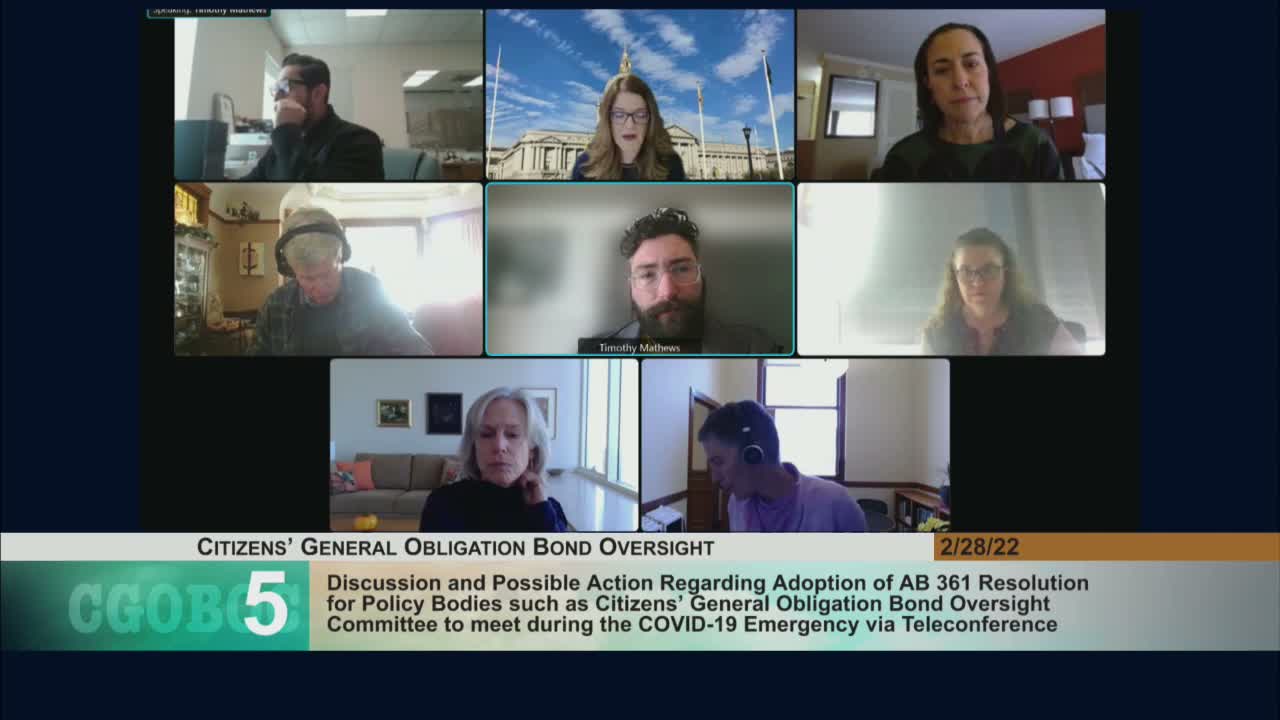
The Mayor’s Office of Housing and Community Development (MOHCD) briefed the Citizens General Obligation Bond Oversight Committee on the status of the city’s 2015 and 2019 affordable‑housing general‑obligation (GO) bond programs and provided a detailed update on the 2016 preservation, acquisition and seismic safety (PAS) program.
Andrea Grammer (MOHCD) said the office uses GO bonds to provide loans to developers rather than to build city projects directly. She reported that the 2015 bond’s first two issuances were more than 97% spent as of December and are projected to be fully spent by the end of 2022; the third 2015 issuance (completed in October 2019) was about 30% spent and depends heavily on an educator housing project at 40 Third and Irving for further drawdowns. Grammer said the 2015 bonds are projected to add roughly 1,500 affordable units overall and include down‑payment assistance loans as part of the program.
Grammer also reviewed the 2019 bond, noting the first issuance was for $254,000,000 and that MOHCD had spent roughly a quarter of that issuance to date. She said MOHCD projects the first issuance will be spent down by mid‑2024 and that the 2019 bond is similar in structure to 2015 but larger in scale, with projected units funded by the first issuance above 2,300.
Jonah Lee, Director of Portfolio Management and Preservation, described the PAS program (2016) that expanded the seismic‑safety loan authority to prioritize acquisition and preservation of affordable housing at roughly 80% AMI (with a cap at 120% AMI for individual households). Lee said small‑sites work focuses on buildings of 5–25 units and that the program uses two financing models (direct financing and permanent takeout) to provide timely capital.
On loan performance and COVID response, Lee said the city saw strong historic performance but had seven projects enter forbearance during the pandemic. He reported a roughly 60% collection rate on the forborne projects and said total forborne debt was less than $500,000; three of those loans had already been successfully worked out and the remaining four were on track for resolution in the spring. Lee said MOHCD has revised underwriting guidelines to be more conservative and has made roughly $3,500,000 in capacity‑building grant funds to nonprofit partners active in acquisition/preservation work.
Committee members asked for clarifications about program eligibility (teacher and first‑responder set‑asides, income bands, homebuyer training requirement for down‑payment assistance) and about how MOHCD handles contractor delay claims; MOHCD staff said developers typically manage construction contracts and that down‑payment assistance uses an applicant lottery and certification process.
Andrea Grammer (MOHCD) said the office uses GO bonds to provide loans to developers rather than to build city projects directly. She reported that the 2015 bond’s first two issuances were more than 97% spent as of December and are projected to be fully spent by the end of 2022; the third 2015 issuance (completed in October 2019) was about 30% spent and depends heavily on an educator housing project at 40 Third and Irving for further drawdowns. Grammer said the 2015 bonds are projected to add roughly 1,500 affordable units overall and include down‑payment assistance loans as part of the program.
Grammer also reviewed the 2019 bond, noting the first issuance was for $254,000,000 and that MOHCD had spent roughly a quarter of that issuance to date. She said MOHCD projects the first issuance will be spent down by mid‑2024 and that the 2019 bond is similar in structure to 2015 but larger in scale, with projected units funded by the first issuance above 2,300.
Jonah Lee, Director of Portfolio Management and Preservation, described the PAS program (2016) that expanded the seismic‑safety loan authority to prioritize acquisition and preservation of affordable housing at roughly 80% AMI (with a cap at 120% AMI for individual households). Lee said small‑sites work focuses on buildings of 5–25 units and that the program uses two financing models (direct financing and permanent takeout) to provide timely capital.
On loan performance and COVID response, Lee said the city saw strong historic performance but had seven projects enter forbearance during the pandemic. He reported a roughly 60% collection rate on the forborne projects and said total forborne debt was less than $500,000; three of those loans had already been successfully worked out and the remaining four were on track for resolution in the spring. Lee said MOHCD has revised underwriting guidelines to be more conservative and has made roughly $3,500,000 in capacity‑building grant funds to nonprofit partners active in acquisition/preservation work.
Committee members asked for clarifications about program eligibility (teacher and first‑responder set‑asides, income bands, homebuyer training requirement for down‑payment assistance) and about how MOHCD handles contractor delay claims; MOHCD staff said developers typically manage construction contracts and that down‑payment assistance uses an applicant lottery and certification process.
View the Full Meeting & All Its Details
This article offers just a summary. Unlock complete video, transcripts, and insights as a Founder Member.
✓
Watch full, unedited meeting videos
✓
Search every word spoken in unlimited transcripts
✓
AI summaries & real-time alerts (all government levels)
✓
Permanent access to expanding government content
30-day money-back guarantee
