Capital plan update: city keeps GEO bond cap, limited new capacity until 2028
August 31, 2023 | San Francisco City, San Francisco County, California
This article was created by AI summarizing key points discussed. AI makes mistakes, so for full details and context, please refer to the video of the full meeting. Please report any errors so we can fix them. Report an error »
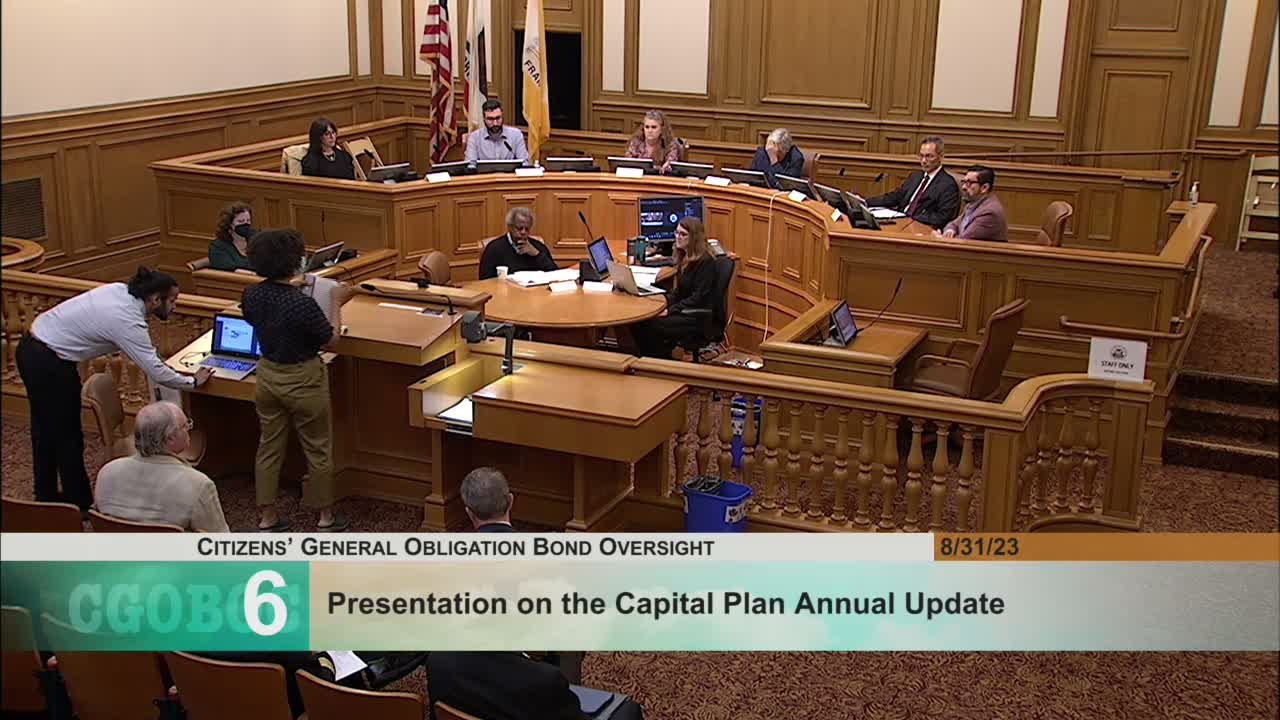
City capital planners presented a biannual update to the 10‑year capital plan and a proposed schedule for future general obligation (GEO) bond authorizations, emphasizing constraints on near‑term borrowing and prioritization of housing and public health needs.
Kate Faust, capital planning manager, said the capital plan is a fiscally constrained roadmap that balances investment across priorities including racial and social equity, climate resilience and earthquake safety. "The capital plan provides a fiscally constrained road map that lays out anticipated infrastructure investments over the next decade," Faust said.
Nishad Joshi, capital budget manager, spelled out the program and the constraint officials call the GEO bond cap. "The current policy is for the city not to issue any more GEO bonds that would increase the tax rates above the 2006 level. So we refer to this as the GEO bond cap," Joshi said. He told the committee assessed‑value projections and recent large bond issuances mean the city’s bonding capacity is limited until around 2028.
Given that constraint, staff proposed moving $40 million from an initial $340 million authorization into the November 2024 authorization and making March 2024 a primarily affordable‑housing bond of roughly $300 million. Joshi said the schedule also anticipates a transportation authorization in November 2026 targeted at the San Francisco Municipal Transportation Agency’s most urgent facilities needs, but that the $300 million figure does not cover the MTA’s full request.
Staff also discussed alternative financing tools used since COVID‑era revenues tightened, including Certificates of Participation (COPs) and pay‑as‑you‑go (PAYGO) cash programming. Joshi cautioned that PAYGO levels remain below pre‑pandemic targets and that the administration has not yet achieved planned PAYGO capitalization for FY24.
Committee members asked for a written reference to where the GEO cap is documented; staff said it is an administrative capital‑plan policy created when the plan was first adopted in 2006 and that they would provide follow‑up documentation.
Next steps: staff will refine bond amounts as ballot and assessed‑value conditions evolve and return to the committee with updates and any requested documentation about the GEO cap.
Kate Faust, capital planning manager, said the capital plan is a fiscally constrained roadmap that balances investment across priorities including racial and social equity, climate resilience and earthquake safety. "The capital plan provides a fiscally constrained road map that lays out anticipated infrastructure investments over the next decade," Faust said.
Nishad Joshi, capital budget manager, spelled out the program and the constraint officials call the GEO bond cap. "The current policy is for the city not to issue any more GEO bonds that would increase the tax rates above the 2006 level. So we refer to this as the GEO bond cap," Joshi said. He told the committee assessed‑value projections and recent large bond issuances mean the city’s bonding capacity is limited until around 2028.
Given that constraint, staff proposed moving $40 million from an initial $340 million authorization into the November 2024 authorization and making March 2024 a primarily affordable‑housing bond of roughly $300 million. Joshi said the schedule also anticipates a transportation authorization in November 2026 targeted at the San Francisco Municipal Transportation Agency’s most urgent facilities needs, but that the $300 million figure does not cover the MTA’s full request.
Staff also discussed alternative financing tools used since COVID‑era revenues tightened, including Certificates of Participation (COPs) and pay‑as‑you‑go (PAYGO) cash programming. Joshi cautioned that PAYGO levels remain below pre‑pandemic targets and that the administration has not yet achieved planned PAYGO capitalization for FY24.
Committee members asked for a written reference to where the GEO cap is documented; staff said it is an administrative capital‑plan policy created when the plan was first adopted in 2006 and that they would provide follow‑up documentation.
Next steps: staff will refine bond amounts as ballot and assessed‑value conditions evolve and return to the committee with updates and any requested documentation about the GEO cap.
View the Full Meeting & All Its Details
This article offers just a summary. Unlock complete video, transcripts, and insights as a Founder Member.
✓
Watch full, unedited meeting videos
✓
Search every word spoken in unlimited transcripts
✓
AI summaries & real-time alerts (all government levels)
✓
Permanent access to expanding government content
30-day money-back guarantee
