City committee hears annual update on 2016 Public Health and Safety bond, projects near closeout
December 04, 2023 | San Francisco City, San Francisco County, California
This article was created by AI summarizing key points discussed. AI makes mistakes, so for full details and context, please refer to the video of the full meeting. Please report any errors so we can fix them. Report an error »
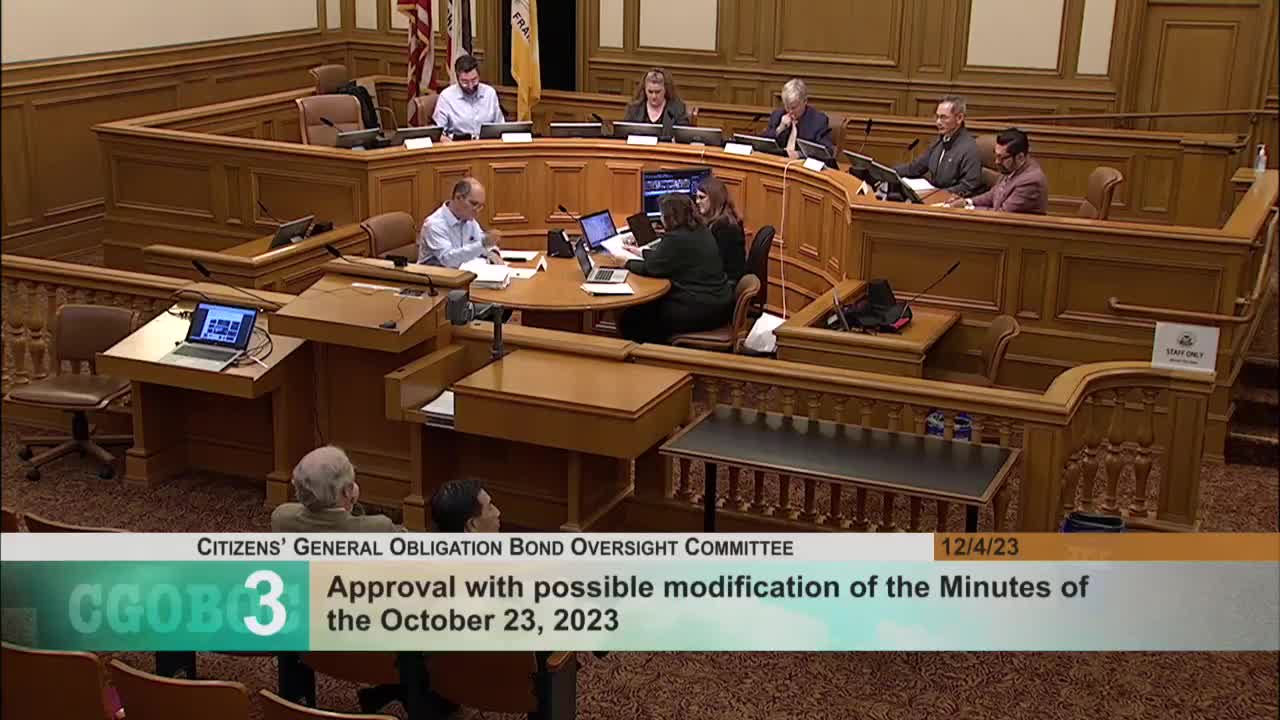
Joe Chin, Public Works program manager for the 2016 Public Health and Safety bond program, told the Citizen General Obligation Bond Committee that the program’s total approved authorization is $350,000,000 and that work across its components is largely complete or in active construction.
Chin outlined funding allocations and project status: $270 million allocated to Department of Public Health components (including ZSFG Building 5, Southeast Health Center and community health centers); $58 million for two San Francisco Fire Department components (an ambulance deployment facility and neighborhood fire stations); and $20 million for the homeless service site component. He said the program is “78% based on expenditures only and over 95% based on expenditures plus encumbrances, with the remaining balance of $15,800,000.”
Chin described recent accomplishments and near‑term milestones. He said flagship projects in three components — community health centers, Southeast Health Center and the ambulance deployment facility — are in closeout. On ZSFG Building 5, several projects are completed, six are in active construction, and two—psychiatric emergency services and a family health center—are planned to begin construction next year. Chin also said the team is working with the Office of Public Finance on a supplemental appropriation of approximately $14,000,000 in bond interest earnings to expand authorized funding.
Committee members pressed staff on project‑specific issues. Chin acknowledged post‑occupancy building problems such as leaking windows and controls integration work where the new building management system must be reconciled with existing systems. He warned that lead times for large electrical equipment such as emergency generators and switchgear remain long — “up to 1 to 2 years” — and continue to affect schedules.
Members also asked about dispute resolution on the Maxine Hall project. Chin said elevator warranty items and a contractor claim prolonged final closeout; the settlement was negotiated and required committee and Board of Supervisors approvals before the project could be formally closed.
Chin explained job order contracting (JOC) as a prequalified task‑order contracting tool Public Works uses for scopes typically under about $1 million, and noted that certain rehab work is being delivered via traditional design‑bid‑build contracts.
The presentation closed with staff available to answer follow‑up questions; there were no public comments on the presentation recorded. Next procedural steps noted by staff include pursuing the supplemental appropriation and moving the remaining ZSFG and family health center projects into active construction.
Chin outlined funding allocations and project status: $270 million allocated to Department of Public Health components (including ZSFG Building 5, Southeast Health Center and community health centers); $58 million for two San Francisco Fire Department components (an ambulance deployment facility and neighborhood fire stations); and $20 million for the homeless service site component. He said the program is “78% based on expenditures only and over 95% based on expenditures plus encumbrances, with the remaining balance of $15,800,000.”
Chin described recent accomplishments and near‑term milestones. He said flagship projects in three components — community health centers, Southeast Health Center and the ambulance deployment facility — are in closeout. On ZSFG Building 5, several projects are completed, six are in active construction, and two—psychiatric emergency services and a family health center—are planned to begin construction next year. Chin also said the team is working with the Office of Public Finance on a supplemental appropriation of approximately $14,000,000 in bond interest earnings to expand authorized funding.
Committee members pressed staff on project‑specific issues. Chin acknowledged post‑occupancy building problems such as leaking windows and controls integration work where the new building management system must be reconciled with existing systems. He warned that lead times for large electrical equipment such as emergency generators and switchgear remain long — “up to 1 to 2 years” — and continue to affect schedules.
Members also asked about dispute resolution on the Maxine Hall project. Chin said elevator warranty items and a contractor claim prolonged final closeout; the settlement was negotiated and required committee and Board of Supervisors approvals before the project could be formally closed.
Chin explained job order contracting (JOC) as a prequalified task‑order contracting tool Public Works uses for scopes typically under about $1 million, and noted that certain rehab work is being delivered via traditional design‑bid‑build contracts.
The presentation closed with staff available to answer follow‑up questions; there were no public comments on the presentation recorded. Next procedural steps noted by staff include pursuing the supplemental appropriation and moving the remaining ZSFG and family health center projects into active construction.
View the Full Meeting & All Its Details
This article offers just a summary. Unlock complete video, transcripts, and insights as a Founder Member.
✓
Watch full, unedited meeting videos
✓
Search every word spoken in unlimited transcripts
✓
AI summaries & real-time alerts (all government levels)
✓
Permanent access to expanding government content
30-day money-back guarantee
