OCII approves preliminary official statement for Transbay affordable‑housing and infrastructure bonds
June 20, 2023 | San Francisco City, San Francisco County, California
This article was created by AI summarizing key points discussed. AI makes mistakes, so for full details and context, please refer to the video of the full meeting. Please report any errors so we can fix them. Report an error »
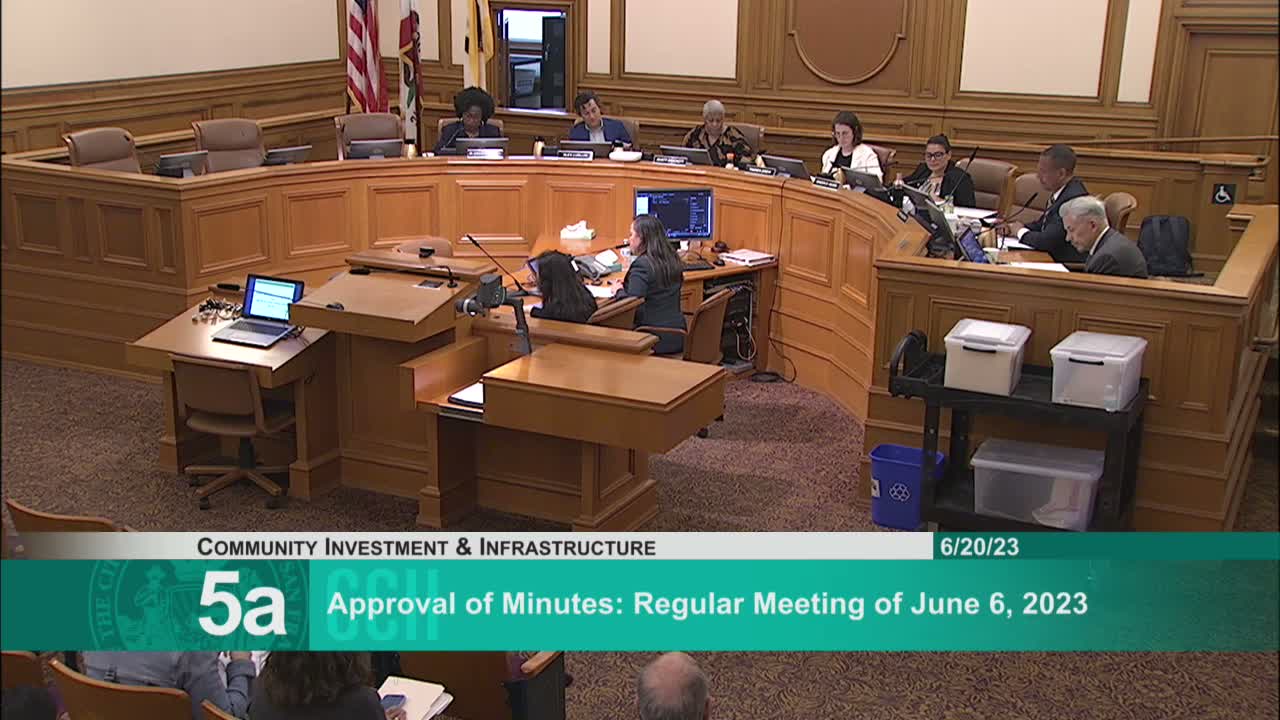
The Commission on Community Investment and Infrastructure on June 20 approved a preliminary official statement that clears the way for new‑money tax allocation bonds to finance Transbay affordable housing and related infrastructure.
OCII staff said the approval covers two series: a taxable Series A for affordable housing (not to exceed $30,000,000) and a tax‑exempt Series B for Transbay infrastructure (not to exceed $45,000,000). John Daigle, OCII’s senior financial analyst and debt manager, said Series A would move 537 housing units toward construction — 184 units at Transbay 2 East, 151 at Transbay 2 West and 202 in predevelopment at Transbay 4 — and Series B would fund Transbay Block 3 Park and other infrastructure work.
Daigle described the sources and uses for each series, the role of a debt service reserve as a market credit enhancement and the plan to publish a preliminary official statement (POS) that investors will use when considering the offering. He said the POS must include all material information, “positive or negative,” and that the final official statement will be filled in once bonds are priced.
Commissioners pressed staff on new disclosures in the POS related to climate change, hazardous substances and declines in assessed values. Sarah Hollenbeck, managing director at PFM California Advisors, said the disclosures follow advice from the commission’s disclosure counsel and the city’s recent precedent: “it is appropriate to call attention and call out in the preliminary official statement so that investors have that information clearly presented to them,” she said.
David Meeley of Urban Analytics, OCII’s fiscal consultant, summarized the appraisal‑appeal data the team is tracking. He said the project‑area appeals data (as pulled in late May) showed 121 resolved appeals and 104 pending appeals, and that the fiscal projections use a standard 2% growth assumption consistent with Proposition 13’s minimum. Meeley cautioned the commission that the next assessment roll (released in July) will provide more definitive information on year‑to‑year changes.
Staff and advisors stressed the bonds’ coverage and market testing as risk mitigants. Daigle told the commission the current pledged‑revenue coverage in the lowest year is about 480%, meaning pledged revenues would be roughly 4.8 times the required debt service in that scenario.
Next steps outlined by staff include final supervisory and Department of Finance approvals and then pricing and sale; Daigle said the board of supervisors item will typically be available in July and the team expects to go to market after that, with final bond closing weeks after pricing.
The commission approved the item by a recorded vote of five ayes; no public comments were received during the item’s public comment period.
OCII staff said the approval covers two series: a taxable Series A for affordable housing (not to exceed $30,000,000) and a tax‑exempt Series B for Transbay infrastructure (not to exceed $45,000,000). John Daigle, OCII’s senior financial analyst and debt manager, said Series A would move 537 housing units toward construction — 184 units at Transbay 2 East, 151 at Transbay 2 West and 202 in predevelopment at Transbay 4 — and Series B would fund Transbay Block 3 Park and other infrastructure work.
Daigle described the sources and uses for each series, the role of a debt service reserve as a market credit enhancement and the plan to publish a preliminary official statement (POS) that investors will use when considering the offering. He said the POS must include all material information, “positive or negative,” and that the final official statement will be filled in once bonds are priced.
Commissioners pressed staff on new disclosures in the POS related to climate change, hazardous substances and declines in assessed values. Sarah Hollenbeck, managing director at PFM California Advisors, said the disclosures follow advice from the commission’s disclosure counsel and the city’s recent precedent: “it is appropriate to call attention and call out in the preliminary official statement so that investors have that information clearly presented to them,” she said.
David Meeley of Urban Analytics, OCII’s fiscal consultant, summarized the appraisal‑appeal data the team is tracking. He said the project‑area appeals data (as pulled in late May) showed 121 resolved appeals and 104 pending appeals, and that the fiscal projections use a standard 2% growth assumption consistent with Proposition 13’s minimum. Meeley cautioned the commission that the next assessment roll (released in July) will provide more definitive information on year‑to‑year changes.
Staff and advisors stressed the bonds’ coverage and market testing as risk mitigants. Daigle told the commission the current pledged‑revenue coverage in the lowest year is about 480%, meaning pledged revenues would be roughly 4.8 times the required debt service in that scenario.
Next steps outlined by staff include final supervisory and Department of Finance approvals and then pricing and sale; Daigle said the board of supervisors item will typically be available in July and the team expects to go to market after that, with final bond closing weeks after pricing.
The commission approved the item by a recorded vote of five ayes; no public comments were received during the item’s public comment period.
View the Full Meeting & All Its Details
This article offers just a summary. Unlock complete video, transcripts, and insights as a Founder Member.
✓
Watch full, unedited meeting videos
✓
Search every word spoken in unlimited transcripts
✓
AI summaries & real-time alerts (all government levels)
✓
Permanent access to expanding government content
30-day money-back guarantee
