OCII staff report shows mixed SBE and local-hire results; CityBuild expands training and stipend pilot
October 03, 2023 | San Francisco City, San Francisco County, California
This article was created by AI summarizing key points discussed. AI makes mistakes, so for full details and context, please refer to the video of the full meeting. Please report any errors so we can fix them. Report an error »
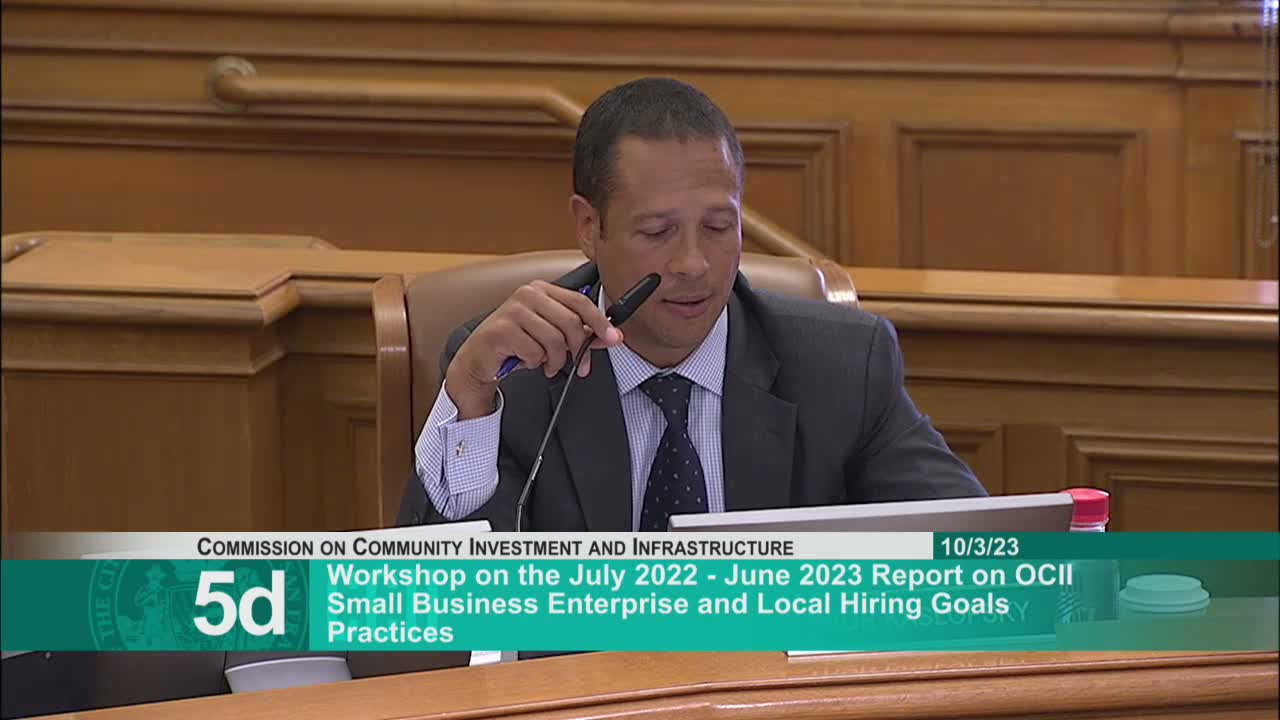
OCII staff presented the annual small business enterprise (SBE) and local hiring report covering fiscal year 2022–23 and described workforce programs designed to place local residents on OCII projects.
Maria (contract compliance specialist) told commissioners OCII maintains a 50% SBE participation goal for contracts under its jurisdiction, with "first consideration" for project-area SBEs in zip codes 94124, 94134 and 94107. For the reporting period, contracting activity totaled about $161.5 million concentrated in four affordable-housing projects; overall SBE participation was 50.3%. Professional services far exceeded the goal at 90.7% while construction achieved 48.2%, slightly below the 50% target.
Maria also reported that women- and minority-owned firms won 81.9% of professional-services contracts and roughly 36.3% of construction and supply contracts during the period, amounting to about $62.4 million (38.6% of total contract value) going to women- and minority-owned small firms.
On the workforce side, CityBuild director Ken (CityBuild) reviewed the program’s local-hire goals and training pipeline. CityBuild requires a 50% local-hire goal with first consideration for project-area residents and uses the LCP Tracker to monitor compliance and certified payroll. Ken highlighted training cohorts and placement outcomes, including multiple cycles of the CityBuild academy and architecture-and-engineering trainee placements that produced 79 student positions across 41 firms since the program's inception. He described a stipend model for trainees that guarantees up to $3,000 per participant across a three-month period ($500 the first month, $1,500 the second, $1,000 the third) to reduce financial barriers to training. Retention services and partnerships with unions and contractors provide mentorship and support for apprentices transitioning to journey-level status.
Public commenters who had participated in OCIIs programs—Oscar James, Abdulley Jallow, Dawn Bradstreet, and YA Studio principal Yaku Askew—testified about positive internship and training experiences and urged expansion of outreach to high schools and underserved neighborhoods.
Commissioners asked staff for more granular data on hours by trade and for ideas to reduce administrative friction for SBEs; staff noted that the LCP Tracker can report hours by trade and that certain craft-transition data are limited. Staff also discussed efforts to increase first-consideration outreach in the Southeast sector and to coordinate with the Office of Economic and Workforce Development and other local partners.
Next steps: staff said they will continue outreach to SBEs, refine data reporting, and consider working-group recommendations to unbundle contracts and reduce barriers for small firms. CityBuild will share outcomes from targeted training cycles and the stipend pilot.
Maria (contract compliance specialist) told commissioners OCII maintains a 50% SBE participation goal for contracts under its jurisdiction, with "first consideration" for project-area SBEs in zip codes 94124, 94134 and 94107. For the reporting period, contracting activity totaled about $161.5 million concentrated in four affordable-housing projects; overall SBE participation was 50.3%. Professional services far exceeded the goal at 90.7% while construction achieved 48.2%, slightly below the 50% target.
Maria also reported that women- and minority-owned firms won 81.9% of professional-services contracts and roughly 36.3% of construction and supply contracts during the period, amounting to about $62.4 million (38.6% of total contract value) going to women- and minority-owned small firms.
On the workforce side, CityBuild director Ken (CityBuild) reviewed the program’s local-hire goals and training pipeline. CityBuild requires a 50% local-hire goal with first consideration for project-area residents and uses the LCP Tracker to monitor compliance and certified payroll. Ken highlighted training cohorts and placement outcomes, including multiple cycles of the CityBuild academy and architecture-and-engineering trainee placements that produced 79 student positions across 41 firms since the program's inception. He described a stipend model for trainees that guarantees up to $3,000 per participant across a three-month period ($500 the first month, $1,500 the second, $1,000 the third) to reduce financial barriers to training. Retention services and partnerships with unions and contractors provide mentorship and support for apprentices transitioning to journey-level status.
Public commenters who had participated in OCIIs programs—Oscar James, Abdulley Jallow, Dawn Bradstreet, and YA Studio principal Yaku Askew—testified about positive internship and training experiences and urged expansion of outreach to high schools and underserved neighborhoods.
Commissioners asked staff for more granular data on hours by trade and for ideas to reduce administrative friction for SBEs; staff noted that the LCP Tracker can report hours by trade and that certain craft-transition data are limited. Staff also discussed efforts to increase first-consideration outreach in the Southeast sector and to coordinate with the Office of Economic and Workforce Development and other local partners.
Next steps: staff said they will continue outreach to SBEs, refine data reporting, and consider working-group recommendations to unbundle contracts and reduce barriers for small firms. CityBuild will share outcomes from targeted training cycles and the stipend pilot.
View the Full Meeting & All Its Details
This article offers just a summary. Unlock complete video, transcripts, and insights as a Founder Member.
✓
Watch full, unedited meeting videos
✓
Search every word spoken in unlimited transcripts
✓
AI summaries & real-time alerts (all government levels)
✓
Permanent access to expanding government content
30-day money-back guarantee
