OCII discusses SB 593 replacement-housing authority and heavy public calls to prioritize COP holders
October 03, 2023 | San Francisco City, San Francisco County, California
This article was created by AI summarizing key points discussed. AI makes mistakes, so for full details and context, please refer to the video of the full meeting. Please report any errors so we can fix them. Report an error »
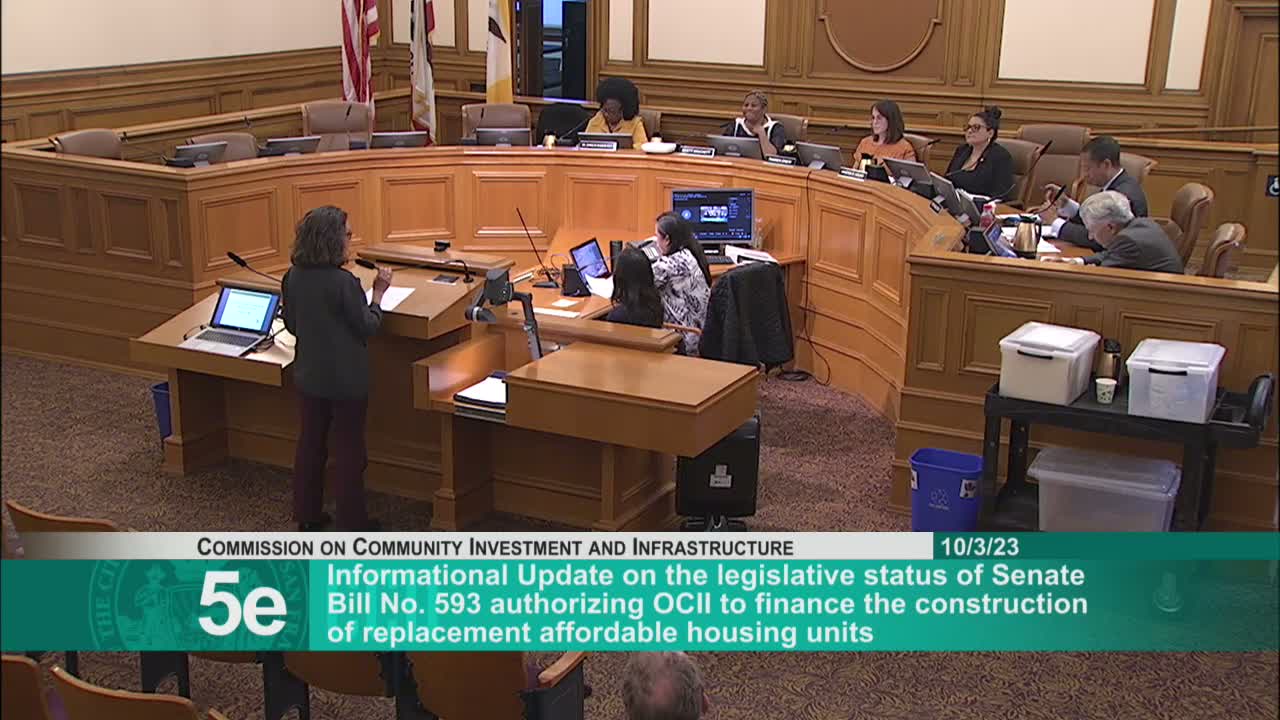
OCII staff provided an informational update on Senate Bill 593 (the Replacement Housing Act) and commissioners heard extensive public testimony urging that the new funding be used to prioritize people displaced by redevelopment.
Elizabeth Colomello, OCII housing program manager, told the commission that SB 593 would allow OCII to use a portion of tax increment financing after existing enforceable obligations and tax pledges to schools and other entities are satisfied to finance replacement housing for 5,842 units destroyed and never replaced by the former redevelopment agency. She said staff currently estimate a first availability of funds in late 2025 to 2026 and expect several issuances over approximately 30 years; staff noted the program will rely on leveraging traditional sources such as tax-exempt bonds and low-income housing tax credits.
Colomello explained replacement housing must meet affordable-housing standards, be restricted to the income categories of displaced households, and carry long-term affordability restrictions. She said the law allows replacement funds to be used for preservation of existing housing as well as new construction, and that OCII plans outreach workshops and to bring a priority policy for commission consideration in early November.
Public commenters and commissioners focused on certificate-of-preference (COP) holders' access to replacement housing. Oscar James, who identified himself as a COP holder and longtime Hunters Point resident, urged that the 5,842 units be directed to COP holders and descendants and said many original displaced residents and their descendants cannot afford current housing costs. "We want these 5,000 units of housing to go to certificate holders as a preference," he said.
Commissioners and staff acknowledged multiple barriers: some eligible people are not being located, MOHCD application processing backlogs have delayed certificate issuance, and eligibility documentation can be difficult for elderly or formerly displaced residents to produce. General Counsel Jim Morales clarified that state law does not require a person to hold a physical certificate to be eligible for the preference; eligibility is based on being displaced or a descendant. Commissioners urged more proactive outreach, a crosswalk of policy constraints and near-term strategies such as purchasing or preserving small buildings to house COP holders sooner rather than waiting for large bond issuances.
Several commissioners and the COP committee recommended structural policy changes and a set of priorities, including maintaining income categories at the time of displacement for eligibility calculations, providing down-payment and rental-assistance funds, creating a small-sites acquisition program, considering community-land-trust or community-based developer options, and using sworn affidavits where records are missing. Staff noted some near-term options exist within OCII project areas and that some funding would realistically not be available until 2025 given the bond issuance timeline and phasing of tax increment revenues.
The item was informational; staff committed to holding workshops with community advisory committees and returning with a draft priority policy. Commissioners emphasized urgency and asked staff to explore both immediate preservation opportunities and longer-term program design.
Elizabeth Colomello, OCII housing program manager, told the commission that SB 593 would allow OCII to use a portion of tax increment financing after existing enforceable obligations and tax pledges to schools and other entities are satisfied to finance replacement housing for 5,842 units destroyed and never replaced by the former redevelopment agency. She said staff currently estimate a first availability of funds in late 2025 to 2026 and expect several issuances over approximately 30 years; staff noted the program will rely on leveraging traditional sources such as tax-exempt bonds and low-income housing tax credits.
Colomello explained replacement housing must meet affordable-housing standards, be restricted to the income categories of displaced households, and carry long-term affordability restrictions. She said the law allows replacement funds to be used for preservation of existing housing as well as new construction, and that OCII plans outreach workshops and to bring a priority policy for commission consideration in early November.
Public commenters and commissioners focused on certificate-of-preference (COP) holders' access to replacement housing. Oscar James, who identified himself as a COP holder and longtime Hunters Point resident, urged that the 5,842 units be directed to COP holders and descendants and said many original displaced residents and their descendants cannot afford current housing costs. "We want these 5,000 units of housing to go to certificate holders as a preference," he said.
Commissioners and staff acknowledged multiple barriers: some eligible people are not being located, MOHCD application processing backlogs have delayed certificate issuance, and eligibility documentation can be difficult for elderly or formerly displaced residents to produce. General Counsel Jim Morales clarified that state law does not require a person to hold a physical certificate to be eligible for the preference; eligibility is based on being displaced or a descendant. Commissioners urged more proactive outreach, a crosswalk of policy constraints and near-term strategies such as purchasing or preserving small buildings to house COP holders sooner rather than waiting for large bond issuances.
Several commissioners and the COP committee recommended structural policy changes and a set of priorities, including maintaining income categories at the time of displacement for eligibility calculations, providing down-payment and rental-assistance funds, creating a small-sites acquisition program, considering community-land-trust or community-based developer options, and using sworn affidavits where records are missing. Staff noted some near-term options exist within OCII project areas and that some funding would realistically not be available until 2025 given the bond issuance timeline and phasing of tax increment revenues.
The item was informational; staff committed to holding workshops with community advisory committees and returning with a draft priority policy. Commissioners emphasized urgency and asked staff to explore both immediate preservation opportunities and longer-term program design.
Don't Miss a Word: See the Full Meeting!
Go beyond summaries. Unlock every video, transcript, and key insight with a Founder Membership.
✓
Get instant access to full meeting videos
✓
Search and clip any phrase from complete transcripts
✓
Receive AI-powered summaries & custom alerts
✓
Enjoy lifetime, unrestricted access to government data
30-day money-back guarantee
