OCII approves 12‑month extension (plus amended 6‑month discretion) for Mexican Museum grant after controller audit
May 21, 2024 | San Francisco City, San Francisco County, California
This article was created by AI summarizing key points discussed. AI makes mistakes, so for full details and context, please refer to the video of the full meeting. Please report any errors so we can fix them. Report an error »
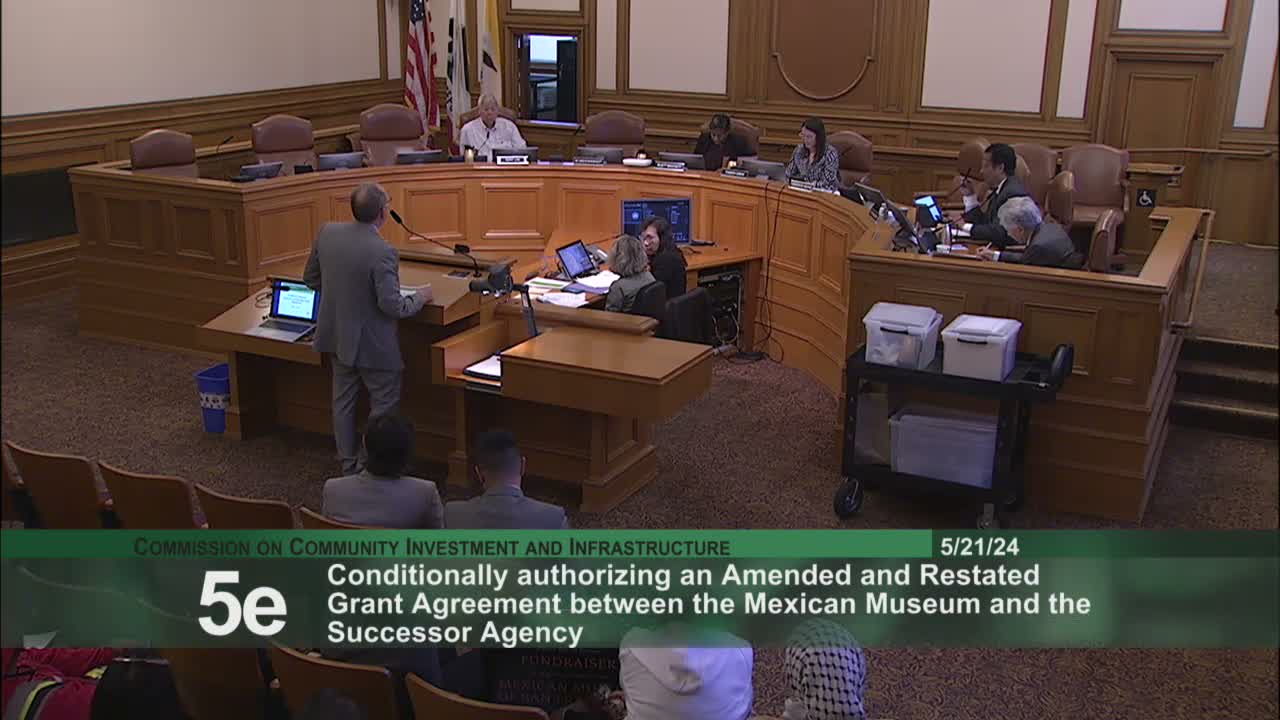
The OCII Commission on May 21 conditionally approved an amended and restated grant agreement to extend time for the Mexican Museum to draw down remaining OCII funds, following a city controller audit that found unspent funds and questioned some past expenditures.
Deputy Director Mark Slutskin told the Commission the agency originally committed $10,566,000 for tenant improvements at 706 Mission Street. OCII records show about $6.3 million in grant distribution agreements were approved and roughly $4.1 million spent; the museum still needs to complete tenant improvements and raise additional capital. "The museum has not complied with the key requirements of the lease and facilities agreement," Slutskin said, and staff identified roughly $43,616 in ineligible expenses and about $930,000 in activities requiring further documentation. The audit produced 10 recommendations for OCII and four for the city's real estate division.
Representatives of the Mexican Museum outlined a phased buildout and a fundraising plan. Andrew Kluger, chair of the museum’s board, said the museum has engaged Mission Neighborhood Centers as a fiscal agent and fundraiser and has a plan to raise the private matching funds before tapping OCII grant dollars: "We have collaborated with the staff to address tight compliance metrics," he said, and asked the Commission to support OCII’s staff recommendation for an 18‑month extension (12 months plus a 6‑month option).
Community testimony was broadly supportive. Dozens of artists, small-business owners and local leaders described the museum as a cultural anchor and emphasized local hiring, micro‑LBE contracting, and educational programming. Oscar James, a Hunters Point native and COP holder, urged the Commission to "do whatever it takes" to make the museum viable.
Commissioners expressed concern about past oversight and the realism of the museum’s fundraising timeline. OCII staff said oversight practices have changed: subsequent reimbursements are now required and staff verify invoices before distributions. Slutskin described the updated approach as a correction to earlier practices around dissolution and changing rules.
Chair Bavette Brackett proposed — and the Commission adopted — an amendment to the staff proposal that substitutes the Commission for the executive director in approving the optional six‑month extension. The Commission approved the amended resolution by roll call (Commissioner Drew: Aye; Commissioner Lim: Yes; Chair Brackett: Aye; Commissioners Aquino and Vice Chair Scott absent), a 3–0 vote with two absent. Staff noted the next procedural steps: transmittal to the Oversight Board and the Department of Finance for final action.
The grant terms approved by the Commission require the museum to raise specified private funds before OCII distributes grant dollars for Phase 1 work. OCII staff said no OCII funds should be disbursed until the museum demonstrates it has raised at least the agreed minimum (the museum’s plan calls for raising $4.5 million for Phase 1). The Commission directed staff to monitor compliance with the audit‑related conditions and return with the sixth distribution agreement if milestones are met.
The Commission’s action was procedural and conditional; the oversight board and Department of Finance retain final review authority under the enforceable obligation process. The Commission’s amended resolution is intended to ensure closer oversight and clearer, enforceable fundraising benchmarks before grant funds are released.
Deputy Director Mark Slutskin told the Commission the agency originally committed $10,566,000 for tenant improvements at 706 Mission Street. OCII records show about $6.3 million in grant distribution agreements were approved and roughly $4.1 million spent; the museum still needs to complete tenant improvements and raise additional capital. "The museum has not complied with the key requirements of the lease and facilities agreement," Slutskin said, and staff identified roughly $43,616 in ineligible expenses and about $930,000 in activities requiring further documentation. The audit produced 10 recommendations for OCII and four for the city's real estate division.
Representatives of the Mexican Museum outlined a phased buildout and a fundraising plan. Andrew Kluger, chair of the museum’s board, said the museum has engaged Mission Neighborhood Centers as a fiscal agent and fundraiser and has a plan to raise the private matching funds before tapping OCII grant dollars: "We have collaborated with the staff to address tight compliance metrics," he said, and asked the Commission to support OCII’s staff recommendation for an 18‑month extension (12 months plus a 6‑month option).
Community testimony was broadly supportive. Dozens of artists, small-business owners and local leaders described the museum as a cultural anchor and emphasized local hiring, micro‑LBE contracting, and educational programming. Oscar James, a Hunters Point native and COP holder, urged the Commission to "do whatever it takes" to make the museum viable.
Commissioners expressed concern about past oversight and the realism of the museum’s fundraising timeline. OCII staff said oversight practices have changed: subsequent reimbursements are now required and staff verify invoices before distributions. Slutskin described the updated approach as a correction to earlier practices around dissolution and changing rules.
Chair Bavette Brackett proposed — and the Commission adopted — an amendment to the staff proposal that substitutes the Commission for the executive director in approving the optional six‑month extension. The Commission approved the amended resolution by roll call (Commissioner Drew: Aye; Commissioner Lim: Yes; Chair Brackett: Aye; Commissioners Aquino and Vice Chair Scott absent), a 3–0 vote with two absent. Staff noted the next procedural steps: transmittal to the Oversight Board and the Department of Finance for final action.
The grant terms approved by the Commission require the museum to raise specified private funds before OCII distributes grant dollars for Phase 1 work. OCII staff said no OCII funds should be disbursed until the museum demonstrates it has raised at least the agreed minimum (the museum’s plan calls for raising $4.5 million for Phase 1). The Commission directed staff to monitor compliance with the audit‑related conditions and return with the sixth distribution agreement if milestones are met.
The Commission’s action was procedural and conditional; the oversight board and Department of Finance retain final review authority under the enforceable obligation process. The Commission’s amended resolution is intended to ensure closer oversight and clearer, enforceable fundraising benchmarks before grant funds are released.
Don't Miss a Word: See the Full Meeting!
Go beyond summaries. Unlock every video, transcript, and key insight with a Founder Membership.
✓
Get instant access to full meeting videos
✓
Search and clip any phrase from complete transcripts
✓
Receive AI-powered summaries & custom alerts
✓
Enjoy lifetime, unrestricted access to government data
30-day money-back guarantee
